roundups
Best Hydroponic Systems for Vegetables 2026
The best hydroponic systems for vegetables: NFT for leafy greens, Dutch buckets for fruiting crops, DWC for beginners. Systems ranked by crop type.
 Priya Anand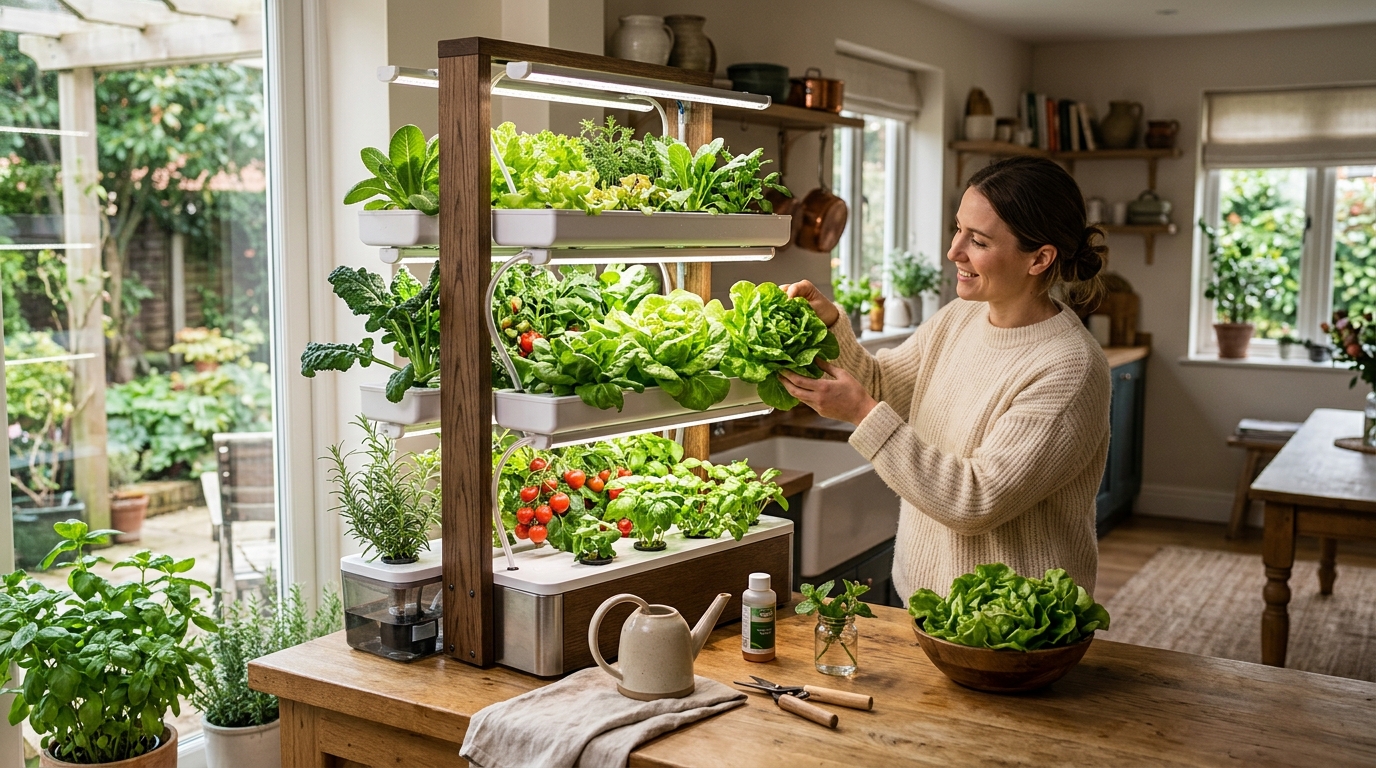
The best hydroponic system for vegetables depends entirely on what you grow. For leafy greens and herbs, an NFT channel or the Lettuce Grow Farmstand delivers the highest yield per watt. For tomatoes, peppers, and cucumbers, Dutch buckets are the commercial standard. For a no-fuss beginner setup, the AeroGarden Farm XL handles the widest range of edible crops out of any plug-and-play system on the market.
Why vegetable type determines the system
Vegetables span a wider range of root mass, nutrient demand, and vertical envelope than any other plant category. Grouping them by growth habit clarifies the right system choice.
Leafy greens and herbs (lettuce, kale, chard, spinach, basil, cilantro) have shallow roots, low nutrient demands at EC 1.0-2.0, and short crop cycles of 30-50 days. NFT channels, Kratky containers, and aeroponic towers are the correct platform. These crops grow well at 150-400 PPFD of full-spectrum light and require almost no intervention once the system is running.
Fruiting vegetables (tomatoes, peppers, cucumbers, eggplant, beans) have heavy root masses, high nutrient demands at EC 2.0-3.5, and crop cycles of 60-120 days. Dutch buckets, top-drip systems, and large DWC buckets are the correct platforms. These crops require 400-900 PPFD of full-spectrum light, benefit from Cal-Mag supplementation throughout the cycle, and need hand-pollination indoors.
Root vegetables (carrots, beets, radishes, potatoes) are generally impractical in hydroponics because their edible parts grow underground in a solid medium. Radishes work in a deep aggregate media tray; all others are better grown in soil or a large coco-coir container. Mixing crop types in one system is possible but involves tradeoffs. A Kratky jar suited to lettuce cannot sustain a pepper through fruiting. The Lettuce Grow Farmstand and AeroGarden Farm XL handle mixed plantings best because each pod site is independently planted.
Quick comparison
| Product | Best for | Rating | Notes | |
|---|---|---|---|---|
| Lettuce Grow Farmstand 24-Pod | mixed vegetables and herbs in a vertical aeroponic tower | ★★★★★ | $500-700 with LED add-on. Aeroponic misting. 24 plant sites in a 2 sqft footprint. | Check price |
| General Hydroponics NFT System | maximum yield of leafy greens and culinary herbs | ★★★★☆ | $120-220. Nutrient Film Technique channels. Up to 12 plant sites per 6-foot channel. | Check price |
| Dutch Bucket (Bato) Drip Kit | fruiting vegetables — tomatoes, peppers, cucumbers | ★★★★★ | $60-150 for 2-4 buckets. Recirculating drip. Scales to any size grow space. | Check price |
| AeroGarden Farm XL | countertop plug-and-play for greens, herbs, and compact peppers | ★★★★★ | $300-450. 24 pods. 60W LED included. Zero assembly required. | Check price |
| DWC 5-Gallon Bucket Kit | one fast-growing vegetable plant at minimum cost | ★★★★☆ | $40-90 per plant. Deep water culture. Works for peppers, cucumbers, and squash. | Check price |
The picks
Best all-in-one for mixed vegetables: Lettuce Grow Farmstand
Best for households that want a mix of greens, herbs, cherry tomatoes, and small peppers in one self-contained vertical tower
Lettuce Grow Farmstand 24-Pod Aeroponic Tower
The Lettuce Grow Farmstand is a vertical aeroponic tower with 24 plant sites arranged in six rings around a central column. A pump at the base sends nutrient solution up through the center, where it mists exposed roots through small emitters, then drains back into the 10-gallon reservoir below. Aeroponic misting accelerates root growth faster than any NFT channel or media-based system. The optional LED Halos add 30 watts per ring, scaling from 30W for the base ring to 180W total for all six rings. For a household that wants variety — a few heads of lettuce, two basil plants, some cherry peppers, and cherry tomatoes in the upper pods — no other system puts 24 sites in a two-square-foot footprint. Greens occupy the lower rings; fruiting crops go in the upper rings closest to the LED. Plan on hand-pollinating peppers and tomatoes with a soft brush every other day. The Farmstand costs more than a DIY NFT setup but eliminates every plumbing decision and fits any room corner.
★★★★★ 4.6 · 360 reviews
Check current price on Amazon→Pros
- 24 plant sites in a 2 sqft floor footprint — best density of any vertical system
- Aeroponic misting accelerates root growth versus NFT channels or media-based beds
- Modular LED Halos scale from one ring to six as crop height increases
- Self-contained reservoir requires filling once every 7-14 days
- Grows greens, herbs, cherry peppers, compact tomatoes, and strawberries in one tower
Cons
- Higher upfront cost than a comparable DIY NFT or Dutch bucket setup
- Misting nozzles clog if nutrient EC and pH drift out of range for extended periods
- Fruiting crops in upper pods require manual pollination indoors
- Proprietary seedling cups add ongoing cost versus standard 2-inch net pots
Best for leafy greens and herbs: General Hydroponics NFT System
Best for maximizing the yield of lettuce, kale, spinach, chard, and culinary herbs per watt of grow light
General Hydroponics Nutrient Film Technique (NFT) Channel System
Nutrient Film Technique runs a thin, continuous stream of nutrient solution along the bottom of sloped channels. Plant roots grow through net cups set into holes in the channel lid; the lower portion of each root hangs in the moving film while the upper portion is exposed to air, giving roots both nutrients and oxygen simultaneously. NFT is the method commercial lettuce operations use to grow 30,000 heads per acre per year at low water and nutrient cost. General Hydroponics builds the benchmark consumer NFT system: food-grade HDPE channels in 4-foot and 6-foot lengths, a recirculating pump, a nutrient reservoir, and a drain manifold. A 6-foot single-channel setup holds up to 12 lettuce sites and produces 6-8 heads every 35-40 days. Adding more channels means connecting a second drain line to the same reservoir and pump. For a household growing only leafy greens and herbs, no system delivers more edible weight per dollar than a properly dialed-in NFT setup.
★★★★☆ 4.4 · 820 reviews
Check current price on Amazon→Pros
- Highest yield per watt for leafy greens and herbs of any hydroponic method
- Low water use — thin film recirculates and evaporation is the only meaningful loss
- Simple to expand: add more channels to the same reservoir and pump without redesigning the system
- Crop cycles of 30-40 days for lettuce — fastest harvest in any hydroponic method
- Works with standard 2-inch net pots and any complete hydroponic nutrient line
Cons
- Not suitable for fruiting crops (tomatoes, peppers) — roots become too large for channels
- Pump failure kills roots within 1-2 hours because channels hold no standing nutrient solution
- Requires a sloped surface so gravity drains solution back to the reservoir
- Kale and chard grow large fast — plan for wider spacing or harvest aggressively
Best for fruiting vegetables: Dutch Bucket (Bato) System
Best for tomatoes, peppers, cucumbers, eggplant, and beans — any fruiting vegetable with a heavy root mass
Dutch Bucket (Bato) Hydroponic Drip System
Dutch buckets are the commercial standard for fruiting vegetables because they solve the core challenge: a fruiting plant needs a large, well-supported root zone. Each bucket — typically 3 to 5 gallons — holds one plant in coarse growing media such as perlite, hydroton, or coco chunks. A timed drip emitter delivers nutrient solution to the base of each plant; excess solution drains through an elbow at the bucket bottom into a return line feeding back to the central reservoir. A 4-bucket starter kit costs 60 to 150 dollars and fits comfortably in a 4x4 grow tent with a Dutch bucket drain manifold. The system is forgiving by design: the coarse media holds enough moisture that a pump failure does not kill roots in the minutes that bare-root DWC or NFT systems give you. Commercial greenhouse tomato operations run hundreds of Dutch buckets from a single central reservoir — add more buckets to any existing setup without redesigning the plumbing.
★★★★★ 4.5 · 590 reviews
Check current price on Amazon→Pros
- The correct system for any fruiting vegetable — tomatoes, peppers, cucumbers, and beans
- Coarse growing media buffers against brief pump failures and pH swings
- Scales linearly from 2 buckets to 20 or more on one reservoir without system redesign
- No proprietary parts — standard PVC fittings and any submersible pump work
- Media-based root zone supports large indeterminate plants that need a trellis
Cons
- Requires a separate reservoir, pump, drip lines, and drain pipe — more assembly than countertop systems
- Not efficient for small leafy greens — the setup is overkill for lettuce or basil alone
- Growing media must be sterilized or replaced between crop cycles to prevent pathogen buildup
- Needs a full-spectrum grow light purchased separately for indoor fruiting crop production
Best countertop system: AeroGarden Farm XL
Best for beginners who want a plug-and-play countertop system for greens, herbs, and compact edible crops with zero assembly
AeroGarden Farm XL 24-Pod Indoor Hydroponic Garden
The AeroGarden Farm XL is the largest countertop hydroponic garden AeroGarden makes. It holds 24 seed pods in two staggered rows under a 60-watt full-spectrum LED panel that adjusts height automatically as plants grow taller. Built-in light timers and app-based nutrient-reminder alerts make the Farm XL the closest thing to a self-managing indoor vegetable garden. A practical planting mix: eight basil pods, eight lettuce pods, two dill pods, two cilantro pods, two compact pepper pods, and two cherry tomato pods. Greens are ready to harvest in 30-40 days; peppers and tomatoes follow in 80-100 days. The Farm XL is more expensive per plant site than any DIY system, but it beats every other turnkey option on ease of use. Refill the 3-gallon reservoir every 7-10 days, add nutrients when the app prompts, and harvest. No plumbing, no pump calibration, no custom wiring.
★★★★★ 4.5 · 3,100 reviews
Check current price on Amazon→Pros
- No assembly beyond plugging in — the correct first hydroponic system for new growers
- 24 pod sites in a countertop footprint with an integrated 60W full-spectrum LED
- App reminders for nutrient additions and water top-off eliminate daily guesswork
- Grow arm adjusts height automatically as plants grow through the canopy
- Grows lettuce, herbs, compact peppers, and small cherry tomato varieties reliably
Cons
- Proprietary AeroGarden seed pods add ongoing cost versus custom net pots with any seed
- Only compact determinate tomato and pepper varieties fit the vertical growth envelope
- Three-gallon reservoir requires daily top-off during peak fruiting of tomatoes or peppers
- Higher cost per plant site than a comparable DIY NFT channel or DWC setup
Best single-plant DWC: 5-Gallon Deep Water Culture Bucket Kit
Best for a single fast-growing vegetable plant — cucumber, pepper, zucchini, or cherry tomato — at the lowest possible entry cost
5-Gallon Deep Water Culture (DWC) Hydroponic Bucket Kit
Deep water culture is the simplest hydroponic method for a single vegetable plant: a 5-gallon food-grade bucket, a net-cup lid, an air pump with two air stones, and a grow light overhead. The plant sits in the net cup with roots suspended in aerated nutrient solution below. A cucumber plant in DWC grows 2-3 inches per day during peak vegetative growth and produces fruit in 50-60 days; a pepper plant reaches first ripe fruit in 80-90 days. A complete DWC kit costs 40 to 90 dollars and grows one plant that produces 20 to 40 dollars of groceries per month at harvest. The main risk is pump failure: roots suspended in bare nutrient solution without oxygen die within 4-8 hours. Use a pump rated for 60-plus GPH and run two air stones per bucket. For zucchini and squash, scale up to a 10-gallon container — root mass outgrows a 5-gallon bucket within 5-6 weeks of vegetative growth.
★★★★☆ 4.3 · 1,850 reviews
Check current price on Amazon→Pros
- Lowest-cost entry into vegetable hydroponics — a complete kit costs under 90 dollars
- Fastest root growth of any method due to direct contact between roots and aerated solution
- Works for cucumbers, zucchini, peppers, cherry tomatoes, and fast-growing greens
- Single reservoir means straightforward nutrient management and pH adjustment
- Upgrade to multi-bucket systems later using the same pump and air lines
Cons
- Pump or power failure kills roots within 4-8 hours — no media buffer unlike Dutch buckets
- Reservoir temperature must stay below 72 degrees Fahrenheit to prevent pythium root rot
- Practical only for one to two plants at a home scale
- Zucchini and squash outgrow a 5-gallon bucket — upgrade to 10 gallons before transplanting
Vegetable-specific setup tips
Manage EC by crop stage and type. Leafy greens and herbs stay healthy at EC 1.0-2.0. Start fruiting vegetables at EC 1.5-2.0 during vegetative growth, then increase to EC 2.5-3.5 when flowering begins. Running full fruiting EC on young seedlings causes nutrient burn; running vegetative EC through the fruiting stage produces poor fruit set and low yields regardless of system type.
Supplement calcium and magnesium for all fruiting vegetables. Standard two-part and three-part hydroponic nutrient solutions contain enough calcium and magnesium for leafy greens but undersupply fruiting crops. Add a Cal-Mag supplement at 3-5 ml per gallon starting from the first true leaves on any tomato, pepper, cucumber, or eggplant. Skipping this step is the most common cause of blossom-end rot in tomatoes and tip burn in brassicas grown hydroponically.
Pollinate fruiting crops manually. Indoors there are no wind or pollinators to vibrate flowers and transfer pollen. For tomatoes, peppers, eggplant, cucumbers, and squash: tap flowering clusters daily, run a small oscillating fan near the canopy, or touch an electric toothbrush to each flower truss for two seconds every other day. Poor pollination causes flowers to drop without setting fruit or produces misshapen fruit on the ones that do set.
Provide a trellis or support for tall fruiting crops. Indeterminate tomatoes grow 6-8 feet on a vertical trellis; cucumbers and climbing beans need support cables or a trellis net above the system. Dutch bucket setups pair naturally with a horizontal cable trellis run at 6-foot height above the buckets. NFT channels and countertop systems do not support tall indeterminate crops without external framing.
What to skip
Kratky method for fruiting vegetables. Kratky is passive hydroponics — no pump, no timer, just a plant sitting over a reservoir that depletes as roots absorb solution. It grows lettuce and basil beautifully through a 30-50 day cycle. For tomatoes and peppers, the reservoir runs dry weeks before harvest. Do not attempt Kratky with any fruiting vegetable.
NFT channels for fruiting vegetables. The same shallow channels that make NFT champion for lettuce fail completely for tomatoes and peppers. Root mass from a fruiting plant blocks the nutrient film within four to six weeks, stresses the plant, and can collapse the channel. NFT is the wrong tool for any fruiting crop. Use Dutch buckets.
Undersized air pumps in DWC systems. The 20-GPH aquarium pump bundled with cheap DWC kits is insufficient for a vegetable plant at peak fruiting. Root oxygen demand peaks during fruit development. Use a pump rated for at least 60 GPH per 5-gallon bucket and run two air stones per bucket placed at opposite corners of the reservoir bottom.
Root vegetables in standard hydroponic systems. Carrots, beets, turnips, and parsnips develop edible parts underground and need a solid growing medium throughout their cycle. They do not benefit from the nutrient film or aerated solution that makes hydroponics fast for greens and fruiting crops. Grow them in soil, coco coir, or a deep aggregate media bed instead.
FAQ
Frequently asked questions
What is the best hydroponic system for growing vegetables at home?
Can you grow all vegetables hydroponically?
How much does a hydroponic vegetable system cost?
What nutrients do hydroponic vegetables need?
How fast do vegetables grow in hydroponics?
Do hydroponic vegetables taste the same as soil-grown?
Bottom line
For a mixed vegetable garden: the Lettuce Grow Farmstand handles 24 crops in a two-square-foot aeroponic tower and is the most versatile system available. For leafy greens and herbs at maximum yield: General Hydroponics NFT channels produce the most edible weight per watt of light. For tomatoes, peppers, cucumbers, and other fruiting vegetables: Dutch buckets are the proven commercial standard at home scale. For beginners who want zero assembly: the AeroGarden Farm XL runs itself. For one fast-growing plant at minimum cost: a 5-gallon DWC bucket kit.
Before starting any vegetable system, stock quality hydroponic nutrients and a calibrated pH meter. For crop-specific guides, see hydroponic systems for tomatoes and hydroponic systems for lettuce. New to hydroponics altogether? Start with the beginners guide to hydroponic systems and the best grow lights for your setup.