roundups
Best Hydroponic Systems for Lettuce 2026
The best hydroponic systems for growing lettuce: Kratky jars, AeroGarden, NFT channels, and vertical towers. Speed, yield, and cost compared.
 Priya Anand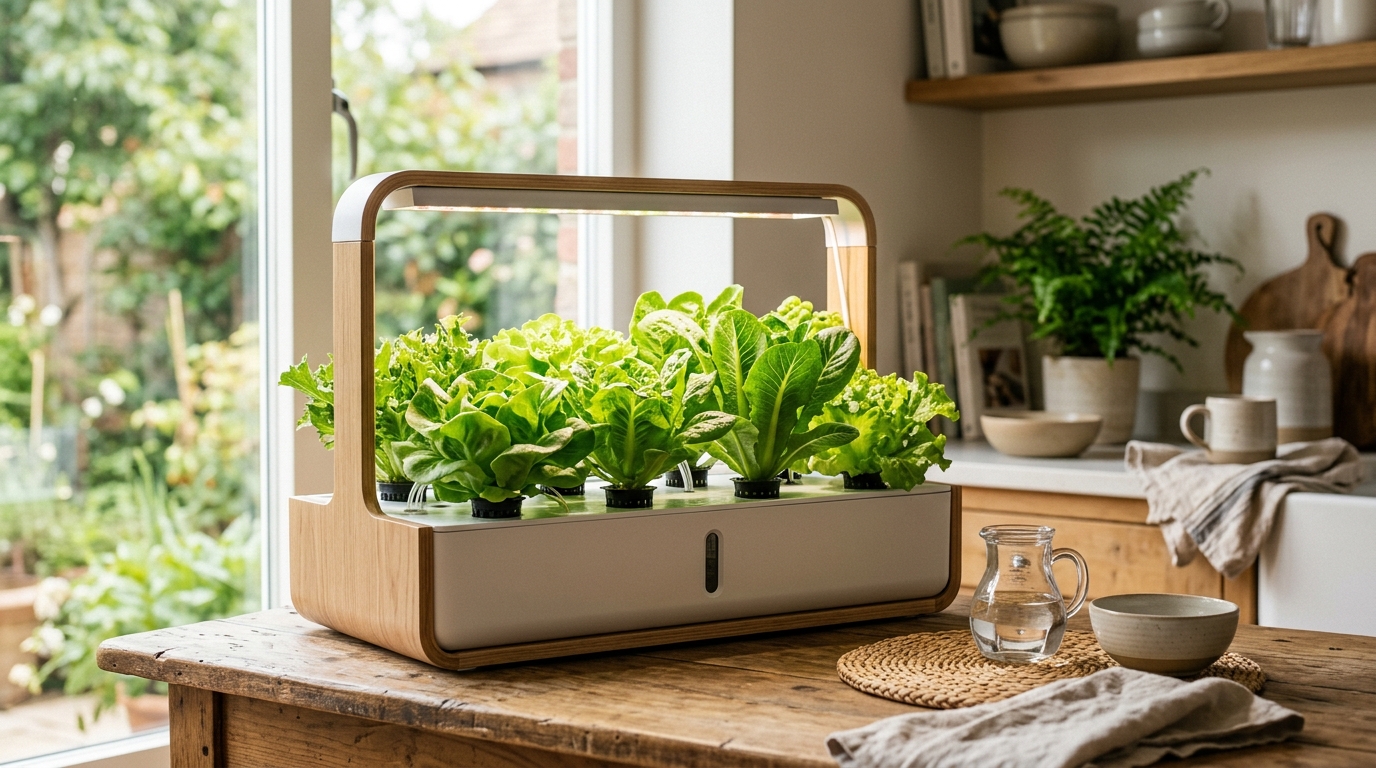
Lettuce is the ideal hydroponic crop: it tolerates low light, grows in 30-45 days, and thrives in Kratky jars, NFT channels, and countertop systems alike. The best system for lettuce depends on your goals: Kratky mason jars ($20-40) for zero-electricity simplicity, AeroGarden Harvest for beginner automation, and Active Aqua NFT channels for serious high-volume production.
Why lettuce is the perfect hydroponic crop
Lettuce excels in hydroponics for five concrete reasons:
-
Low light demand. Lettuce needs just 200-400 PPFD (photosynthetic photon flux density). A basic T5 strip, a window with 4+ hours of indirect sun, or any entry-level LED grow light is sufficient. Fruiting plants like tomatoes need 600-900 PPFD and high-power LEDs.
-
Fast harvest cycle. Loose-leaf lettuce is harvestable in 30-40 days from transplant; whole-head varieties in 45-60 days. You can run 6-8 cycles per year in a perpetual system.
-
Compact root system. Lettuce roots are shallow and fine, which means they work in small reservoirs and thin NFT channels. One NFT channel can grow 8-12 heads per 5-foot run.
-
Forgiving nutrient window. Lettuce wants EC (electrical conductivity) between 0.8 and 1.4 — lower than herbs, vegetables, or fruiting plants. Beginner mistakes with nutrient concentration cause less damage than with more sensitive crops.
-
No fruiting stage. You cut the leaves and eat them. No hand-pollinating, no fruiting triggers, no second lighting stage needed.
Quick comparison
| Product | Best for | Rating | Notes | |
|---|---|---|---|---|
| Kratky Mason Jar Setup | zero-electricity lettuce growing | ★★★★★ | $20-40. No pump. 1-4 heads per setup. 4-6 week harvest. | Check price |
| AeroGarden Harvest (6-pod) | easiest beginner countertop system | ★★★★★ | $80-130. 6 pods. Built-in LED. No setup expertise required. | Check price |
| IDOO 12-Pod Hydroponic Garden | budget countertop with double the pod count | ★★★★☆ | $100-160. 12 pods. Taller grow arm fits butterhead lettuce. | Check price |
| Active Aqua NFT Kit (4-channel) | highest lettuce yield per square foot | ★★★★★ | $200-350. 4-12 channels. 30-100+ plants. Commercial-grade. | Check price |
| Lettuce Grow Farmstand (12-plant) | premium vertical tower; set-and-forget watering | ★★★★★ | $400-600. 12-30 plants. Self-watering cycle. Expandable. | Check price |
The picks
Best no-electricity: Kratky mason jar setup
Best for growing 1-4 heads of lettuce passively with zero electricity
Kratky Hydroponic Mason Jar Kit (no pump, no electricity)
The Kratky method is ideal for lettuce specifically. A wide-mouth mason jar holds nutrient water; a net cup sits in the lid with a lettuce seedling; roots grow down into the solution while the air gap above the water line oxygenates them. No pump, no timer, no electricity. Refill as the water level drops. A single 1-quart jar grows one head of butterhead lettuce to harvest size in 4-6 weeks for under \$5 in nutrients. Four jars on a windowsill or under a cheap LED strip is a perpetual lettuce supply.
★★★★★ 4.6 · 1,200 reviews
Check current price on Amazon→Pros
- Zero electricity — works on a bright windowsill or under any basic LED strip
- Setup in under 30 minutes; no plumbing, no timers, no pumps
- Cost per head of lettuce is $2-5 in nutrients after the initial $20-40 setup
- Completely silent — no pump noise
- Scales horizontally: add more jars as needed, each independent of the others
Cons
- Limited to lettuce and small herbs — not suitable for fruiting plants
- Manual nutrient top-off required every 5-10 days
- Reservoir volume limits plant size compared to DWC buckets
- Algae growth if transparent jars are not covered from light
Best beginner countertop: AeroGarden Harvest
Best for beginners who want a simple countertop system with zero setup complexity
AeroGarden Harvest (6-pod countertop hydroponic garden)
The AeroGarden Harvest is the most beginner-accessible hydroponic system for lettuce. Six plant pods, a built-in 20W LED grow light on an automated timer, and a Remind function that alerts you to add water and nutrients. No nutrient mixing, no pH testing — just fill the reservoir, drop in the pods, and harvest in 30-45 days. The trade-off is cost: proprietary seed pods run \$15-25 per pack (6 pods). You can use compatible third-party net cups and your own seeds to reduce ongoing cost significantly.
★★★★★ 4.5 · 8,200 reviews
Check current price on Amazon→Pros
- No setup expertise needed — works from day one out of the box
- Integrated LED light with automated timer removes the lighting decision
- Wide availability and strong customer support from AeroGarden
- Compact footprint fits on any countertop
- Third-party pods and seeds work with minor modification
Cons
- Proprietary seed pods are expensive ($15-25 for 6 pods)
- Only 6 pods — minimal output for a dedicated lettuce grower
- Cannot upgrade or expand the light or reservoir without buying a larger model
- Higher per-head cost than Kratky or NFT at any meaningful volume
Best budget countertop: IDOO 12-Pod Hydroponic Garden
Best for budget countertop system with double the pod count of AeroGarden Harvest
IDOO 12-Pod Hydroponic Garden System
The IDOO 12-pod countertop system doubles the AeroGarden Harvest pod count at roughly the same price (\$100-160). The taller grow arm accommodates butterhead and romaine varieties that outgrow the Harvest. Compatible with standard net cups and any hydroponic seed, so ongoing costs stay low. The built-in LED is 24W — sufficient for leafy greens, though not the full-spectrum quality of premium lights. For users who want more than 6 heads of lettuce at a time without stepping up to an NFT system, the IDOO is the practical middle ground.
★★★★☆ 4.4 · 3,100 reviews
Check current price on Amazon→Pros
- 12 pods at a price competitive with 6-pod premium systems
- Taller grow arm fits romaine and butterhead at full size
- Compatible with standard net cups and non-proprietary seeds
- Quiet pump; reservoir holds enough water for 10-14 days between refills
Cons
- LED quality below premium systems — adequate for lettuce, not fruiting plants
- Build quality is functional but less refined than AeroGarden
- No automated reminders or app connectivity
Best for high-volume production: Active Aqua NFT Kit
Best for serious lettuce production; 30-100 plants per kit on a grow rack
Active Aqua NFT Hydroponic Kit (4-12 channel)
Nutrient Film Technique (NFT) is the commercial standard for lettuce specifically because it is optimized for high plant density and fast growth. A continuous thin film of nutrient solution flows under roots in horizontal channels; lettuce spacing at 6-8 inches per site puts 8-12 heads per 5-foot channel. The Active Aqua 4-channel starter kit fits 30-50 plants in a 4x2 ft footprint. Scale to a 12-channel kit for 100+ plants. NFT requires more initial setup than Kratky or AeroGarden — a reservoir, pump, timer, and nutrient management — but produces the most lettuce per square foot of any system.
★★★★★ 4.5 · 620 reviews
Check current price on Amazon→Pros
- Highest lettuce yield per square foot of any system type
- Fastest growth rate — continuous nutrient flow accelerates uptake
- Scalable from 4 channels to 12 channels as demand grows
- Commercial-grade construction; same system design used in professional lettuce farms
Cons
- Requires nutrient mixing, pH testing, and pump maintenance
- Pump failure means roots dry within 2-3 hours without intervention
- Larger footprint and infrastructure than countertop systems
- Requires a full-spectrum grow light purchased separately
Best premium vertical: Lettuce Grow Farmstand
Best for households eating salads daily; the most-recommended premium vertical tower
Lettuce Grow Farmstand (12-plant expandable vertical tower)
The Lettuce Grow Farmstand is the category leader for premium vertical hydroponic towers. The 12-plant base model grows butterhead, romaine, red leaf, and loose-leaf lettuce simultaneously in a 2 sqft floor footprint. Water pumps to the top on a 24-hour timer cycle and trickles through plant roots. Expand from 12 to 30 plants by adding growing rings. At \$400-600 for the base model, the Farmstand pays back through grocery savings: a household eating a daily salad replaces \$40-60/month in organic greens, reaching break-even in 8-12 months. HDPE construction lasts a decade-plus.
★★★★★ 4.7 · 1,400 reviews
Check current price on Amazon→Pros
- 12-30 plants in just 2 sqft of floor space — highest density for home use
- Self-watering on a 24-hour cycle; minimal daily management required
- Expandable from 12 to 30 plants without replacing the base unit
- HDPE food-safe construction rated for 10+ years of use
- Strong community and recipe support from Lettuce Grow
Cons
- $400-600 base price is a significant upfront investment
- Add-on LED lighting kit required for indoor use (additional cost)
- Vertical height (4-6 feet) requires adequate ceiling clearance indoors
- Proprietary growing pods preferred, though compatible third-party options exist
Lettuce-specific setup tips
Choose the right variety. Loose-leaf varieties — Buttercrunch, Red Sails, Black Seeded Simpson, Oakleaf — outperform iceberg and crisphead in all hydroponic systems. They grow faster, handle the humidity of enclosed systems better, and can be harvested leaf-by-leaf for ongoing yield rather than all-at-once.
Keep EC lower than most guides suggest. Standard hydroponic guides recommend EC 1.5-2.0. Lettuce prefers 0.8-1.4. High EC causes tip burn — brown, crispy leaf edges that are harmless to eat but indicate the nutrient solution is too strong. If you see tip burn, dilute your reservoir to EC 1.0 and it resolves within 5-7 days.
Water temperature matters. Lettuce roots prefer water at 65-72°F. Above 75°F, dissolved oxygen drops and root rot risk rises sharply. In summer, move systems to the coolest room in the house or add a small aquarium chiller to the reservoir.
Supplemental light for indoor growing. A north-facing window rarely delivers enough light for lettuce year-round. A basic full-spectrum LED strip (6500K color temperature) at 6-12 inches above the plants on a 14-16 hour timer is sufficient — far less demanding than fruiting plants.
What to skip
Generic hydroponic kits under $60 without a branded nutrient solution or integrated light. These are typically net cups, a cheap air pump, and a plastic tub — functional enough, but you will immediately need to add a proper light and quality nutrients, at which point a purpose-built system would have been cheaper.
AeroGarden Harvest with proprietary seed pods long-term. The pod system is convenient but expensive ($15-25 for 6 pods). If you are growing lettuce more than occasionally, switch to compatible third-party net cups and bulk seeds after your first grow. The hardware is excellent; the ongoing pod economics are not.
Kratky for plants other than lettuce and small herbs. The Kratky method works because lettuce has a forgiving, shallow root system with low water consumption. Applying it to tomatoes or peppers results in nutrient exhaustion and pH drift before the plant finishes fruiting.
FAQ
Frequently asked questions
How long does it take to grow lettuce hydroponically?
Does hydroponic lettuce taste different from soil-grown?
What nutrients does lettuce need in hydroponics?
Can I grow lettuce hydroponically without electricity?
How many heads of lettuce can I grow?
What is tip burn in hydroponic lettuce and how do I fix it?
Bottom line
For zero-fuss lettuce growing: start with the Kratky method — a mason jar, nutrients, and a windowsill, under $40, first harvest in five weeks. For the best beginner countertop system: AeroGarden Harvest. For serious volume: Active Aqua NFT channels. For the premium set-and-forget vertical system: Lettuce Grow Farmstand.
Pair any system with a proper hydroponic nutrient solution and a pH meter. For Kratky specifics, read the full Kratky system setup guide. For growing lettuce without a dedicated system, see how to grow lettuce indoors.