roundups
Best Hydroponic Systems for Tomatoes 2026
The best hydroponic systems for tomatoes: Dutch buckets, DWC, drip, and vertical towers. Yield, cost, and setup compared for cherry and slicing tomatoes.
 Priya Anand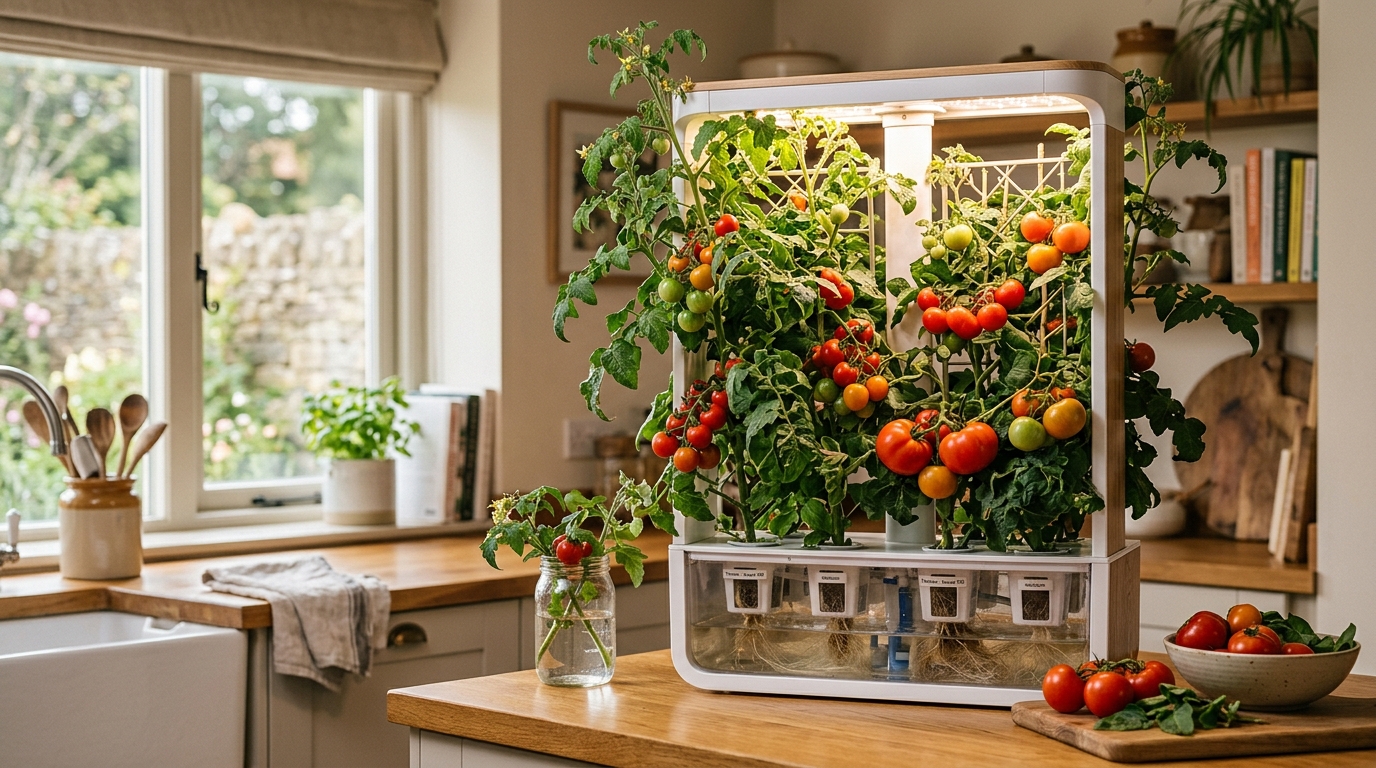
Tomatoes need a system that can support their heavy root mass, high nutrient demand, and long fruiting season, which rules out Kratky jars and countertop pods. The best hydroponic system for tomatoes is a Dutch bucket (Bato bucket) setup for slicers and beefsteaks, a deep water culture (DWC) tote for a single indoor cherry plant, and a top-drip system for a small multi-plant grow. Cherry varieties in a countertop AeroGarden Bounty are the exception for anyone who just wants a taste.
Why tomatoes are demanding hydroponic crops
Tomatoes are not lettuce. Four attributes make them harder to grow hydroponically, and picking the wrong system usually fails on one of them:
-
Massive root mass. A mature indeterminate tomato plant fills a 3-5 gallon root zone. Reservoirs smaller than that starve the plant of oxygen and dissolved nutrients within weeks.
-
High nutrient demand. Tomatoes want EC 2.0-3.5 — nearly triple lettuce. They also need extra calcium and magnesium to prevent blossom-end rot, and a shift to bloom-formula (higher phosphorus and potassium) when flowers set.
-
Long crop cycle with two distinct stages. Vegetative growth for 30-45 days, then flowering and fruiting for another 60-90 days. Systems that only work for fast-cycle leafy crops (Kratky, countertop pods with proprietary lights) cannot sustain a full fruiting cycle.
-
Heavy fruit load. A single indeterminate cherry vine can carry three to five pounds of fruit. You need a trellis, twine, or a tomato clip system integrated with the grow setup.
Dutch buckets solve all four in the cheapest way. DWC works for a single plant if you commit to strong aeration. Drip systems scale well. Countertop AeroGarden-style pods only work for the smallest determinate cherry varieties, and even then only for a shortened harvest.
Quick comparison
| Product | Best for | Rating | Notes | |
|---|---|---|---|---|
| Dutch Bucket (Bato) Kit | the commercial standard for slicers and indeterminates | ★★★★★ | $60-150 for 2-4 buckets. Scales to any grow room size. Recirculating. | Check price |
| DWC 5-Gallon Bucket Kit | one indoor cherry tomato with strong aeration | ★★★★☆ | $40-90 per plant. Simplest single-plant option. Requires large air pump. | Check price |
| GH WaterFarm 4-Pack Drip | top-drip system for 2-4 tomato plants | ★★★★★ | $180-260 for 4 units. Recirculating drip. Trusted design. | Check price |
| AeroGarden Bounty Elite | countertop cherry tomatoes only | ★★★★☆ | $250-350. 9 pods. 45W LED. Works for compact cherry varieties. | Check price |
| Gardyn Home Kit 3.0 | smart vertical tower for cherry tomatoes plus greens | ★★★★☆ | $700-900. 30 plants. App-controlled. Premium vertical for mixed crops. | Check price |
The picks
Best overall for tomatoes: Dutch Bucket (Bato) system
Best for the commercial standard for slicing tomatoes, beefsteaks, and indeterminate vines
Dutch Bucket (Bato) Hydroponic Kit
Dutch buckets are what commercial greenhouse tomato farms use, and they are the right pick for any home grower serious about full-size tomatoes. Each 3-5 gallon bucket holds one plant in a coarse growing media (perlite, hydroton, or coco chunks). A drip line feeds nutrient solution to the base of the plant on a timer; excess solution drains through an elbow at the bucket bottom back into a central reservoir. A four-bucket starter kit costs 60 to 150 dollars and produces 30-60 pounds of tomatoes over one growing cycle. The system is forgiving: if the pump fails, the media holds enough solution to keep the plant alive for hours, unlike NFT or bare-root DWC where a pump failure kills roots quickly.
★★★★★ 4.6 · 480 reviews
Check current price on Amazon→Pros
- Scales linearly from 1 bucket to 20+ without design changes
- Coarse media buffers against pump failure and pH swings
- Works with all tomato varieties from cherries to beefsteaks
- Reservoir change every 2-3 weeks rather than daily top-off
- Recirculating design minimizes nutrient and water waste
Cons
- Requires an external reservoir, pump, and drain lines to assemble
- Larger footprint than a countertop garden or single DWC bucket
- Media replacement between crops adds a small ongoing cost
- Needs a full-spectrum grow light purchased separately
Best for a single plant: DWC 5-gallon bucket
Best for growing one indoor cherry tomato plant with maximum simplicity
Deep Water Culture (DWC) 5-Gallon Bucket Hydroponic Kit
Deep water culture is the simplest way to grow one indoor tomato plant. A 5-gallon bucket, a net-cup lid, a strong air pump with two air stones, and a full-spectrum LED overhead. The plant sits in the net cup with roots dangling into oxygenated nutrient solution below. For a determinate cherry variety like Tiny Tim or Patio, a single DWC bucket produces 3-5 pounds of tomatoes over 70-90 days. For indeterminate cherries, plan on staking or trellising to a nearby wall. Aeration is non-negotiable — use an air pump rated for 40+ gallons per hour, not the small aquarium pumps that ship with cheap kits.
★★★★☆ 4.4 · 2,100 reviews
Check current price on Amazon→Pros
- Cheapest fully hydroponic option for one tomato plant
- Fewer moving parts than drip or Dutch bucket setups
- Fast growth once roots reach the reservoir — no substrate to resist
- Reservoir volume gives a large nutrient and pH buffer
Cons
- Pump failure kills roots within 4-8 hours
- Reservoir temperature must stay under 72F to prevent root rot
- Not practical to scale beyond 2-3 plants at a home level
- Frequent nutrient top-off during peak fruiting stage
Best top-drip system: General Hydroponics WaterFarm 4-Pack
Best for a proven top-drip system for 2-4 tomato plants in a small grow tent
General Hydroponics WaterFarm 4-Pack Drip System
The General Hydroponics WaterFarm is a top-drip recirculating system that has run reliably in home grow tents for two decades. Each module is a 4-gallon plant chamber sitting on top of a 4-gallon reservoir; a pumping column lifts nutrient solution up to a top-drip ring that trickles onto the growing media (typically hydroton). Excess solution drains back through the pumping column into the reservoir. A 4-pack fits in a 3x3 or 4x4 grow tent and grows 4 indeterminate tomato plants comfortably. Compared to Dutch buckets, the WaterFarm is more compact and pre-engineered, but slightly more expensive per plant.
★★★★★ 4.5 · 950 reviews
Check current price on Amazon→Pros
- Well-engineered, self-contained units — no separate reservoir needed
- Compact footprint fits standard grow tent sizes
- General Hydroponics support and nutrient line pair naturally with the hardware
- Individual reservoirs isolate nutrient problems to one plant
Cons
- Higher per-plant cost than Dutch bucket setups
- 4-gallon reservoir is small — daily top-off during peak fruiting
- Air pump and stones are separate purchases for oxygenation
- Individual reservoirs cannot be linked into a single control loop
Best countertop cherry tomatoes: AeroGarden Bounty Elite
Best for growing 1-2 compact cherry tomato plants on a countertop with zero setup
AeroGarden Bounty Elite (9-pod countertop garden)
The AeroGarden Bounty Elite is the only countertop hydroponic garden with a strong record for tomatoes, and only for compact cherry varieties like Red Heirloom Cherry, Golden Harvest, and Tiny Tim. Nine pod sites, a 45W full-spectrum LED on a 24-inch extendable arm, and an app-connected nutrient reminder schedule. Realistically you plant 1-2 tomato pods and fill the remaining 7-8 with basil, lettuce, or leaves. Tomato yield is modest — one plant produces about a pound of cherries over 90-120 days — but the setup is completely turnkey. Expect to hand-pollinate flowers by shaking the plant or brushing them with a soft brush every other day.
★★★★☆ 4.4 · 5,300 reviews
Check current price on Amazon→Pros
- Zero-setup countertop system — works from unboxing
- Bright 45W LED handles the compact cherry varieties well
- Extendable arm gives 24 inches of vertical growth room
- App reminders and automatic light timer remove daily fuss
Cons
- Only compact determinate cherry tomatoes fit the vertical envelope
- Proprietary seed pods add ongoing cost
- Reservoir is small; peak fruiting stage needs top-off every 2-3 days
- Hand-pollination required indoors — no wind or pollinators
Best smart vertical tower: Gardyn Home Kit 3.0
Best for a mixed-crop vertical tower with a couple of dedicated cherry tomato slots
Gardyn Home Kit 3.0 Vertical Hydroponic Garden
The Gardyn Home Kit 3.0 is a 30-plant vertical hybriponic tower (a hybrid of aeroponic and hydroponic irrigation) with built-in LED columns and an app-driven watering schedule. Two of the 30 plant sites can be dedicated to compact cherry tomato yCubes; the other 28 grow greens, herbs, or small peppers. It is a premium purchase at 700 to 900 dollars, but for a household that wants a set-and-forget wall of edible plants in a two-square-foot floor footprint, no other system integrates cherry tomatoes alongside greens as cleanly. Fruit set benefits from turning on the built-in fan or gently shaking the tower daily during flowering.
★★★★☆ 4.3 · 780 reviews
Check current price on Amazon→Pros
- 30 plant sites across a 2 sqft floor footprint
- Integrated full-spectrum LED and automated watering
- App tracks plant age and prompts refills; camera-based plant monitoring on Elite tier
- Aesthetic enough for a living room or kitchen wall
Cons
- Premium price point relative to Dutch bucket production per pound
- Proprietary yCube seed pods dominate the intended workflow
- Only compact cherry tomato varieties fit the vertical spacing
- Optional membership fee unlocks full app features
Tomato-specific setup tips
Pick a variety that matches your system envelope. Compact determinate cherry types (Tiny Tim, Patio, Bush Early Girl, Red Robin) top out at 18-24 inches and suit countertop gardens and single DWC buckets. Indeterminate cherries (Sungold, Sweet 100, Black Cherry) grow 6-8 feet on a trellis and need Dutch buckets or drip systems with vertical space. Slicing and beefsteak indeterminates (Big Beef, Better Boy, Cherokee Purple) are Dutch bucket territory only.
Boost calcium and magnesium. Standard hydroponic nutrient mixes contain enough calcium and magnesium for lettuce, but tomatoes deplete both quickly during fruit set. Add Cal-Mag (a supplemental calcium and magnesium blend) at 3-5 ml per gallon starting from the first true leaves. Skipping this step is the number one cause of blossom-end rot — the leathery brown patch on the bottom of otherwise healthy fruit.
Shift to bloom nutrients at first flower. A 2-part or 3-part hydroponic line typically has a Grow formula (higher nitrogen) and a Bloom formula (higher phosphorus and potassium). Transition to the Bloom formula when the first flower cluster appears. Continuing the Grow formula through fruiting produces lush foliage and poor fruit.
Pollinate by hand or fan. Tomato flowers are self-fertile but need vibration to release pollen. Outdoors, wind does the job. Indoors, tap flowering clusters gently daily, run a small oscillating fan on low near the plants, or use an electric toothbrush against the flower truss for a few seconds every other day.
Aim for 14-16 hours of light per day during veg and 12-14 during flower. Tomatoes are day-neutral, meaning day length does not trigger flowering, but they benefit from longer photoperiods for total energy accumulation. Keep the fixture 12-18 inches above the canopy and target 600-900 PPFD.
What to skip
Kratky-method jars for tomatoes. Kratky works only for lettuce and small herbs because nutrient consumption is low and the crop finishes before the solution runs out. A tomato plant exhausts a 1-gallon reservoir long before fruit set and stalls or dies. Do not attempt.
NFT channels for tomatoes. Nutrient Film Technique is the lettuce champion but a poor tomato host. NFT channels are shallow (typically 2-3 inch) and cannot support the mass of tomato roots or the vertical structure of the plant. Dutch buckets are the correct commercial choice for tomatoes for the same reason NFT is correct for lettuce.
Undersized countertop pods for slicers. Do not attempt to grow Big Beef or Cherokee Purple in an AeroGarden. Even the Bounty Elite maxes out at compact cherries. Trying to force a slicing variety into a countertop garden gives you a leggy, malnourished plant and no meaningful fruit.
Cheap air pumps for DWC. A 40-gallon-per-hour aquarium pump is barely enough for a single 5-gallon DWC bucket during fruiting. Undersized aeration is the second most common cause of DWC failure (after warm water temperatures). Buy a commercial-grade air pump at 60+ GPH and two air stones per bucket.
FAQ
Frequently asked questions
How long does it take to grow tomatoes hydroponically?
What nutrient EC and pH do hydroponic tomatoes need?
Can I grow tomatoes in an AeroGarden?
How much light do hydroponic tomatoes need?
Why do my hydroponic tomatoes have blossom-end rot?
Do I need to pollinate hydroponic tomatoes indoors?
Bottom line
For serious tomato production: Dutch buckets — the commercial-grade standard, forgiving and scalable, best for slicers and indeterminates. For one indoor cherry plant: a 5-gallon DWC bucket with strong aeration. For a small grow-tent setup with 2-4 plants: the General Hydroponics WaterFarm 4-pack. For a countertop with zero setup: the AeroGarden Bounty Elite, limited to compact cherry varieties. For a mixed vertical garden with greens and cherries together: the Gardyn Home Kit 3.0.
Pair any system with quality hydroponic nutrient solution, a reliable pH meter, and a full-spectrum LED grow light. For a soil-based approach or a comparison, read how to grow cherry tomatoes indoors. To troubleshoot fruiting issues, see the nitrogen deficiency guide for hydroponics.