roundups
Best Hydroponic System for Beginners 2026
The 5 best hydroponic systems for beginners compared — AeroGarden, IDOO, Kratky, DWC bucket, and Gardyn. Which to start with and why.
 Priya Anand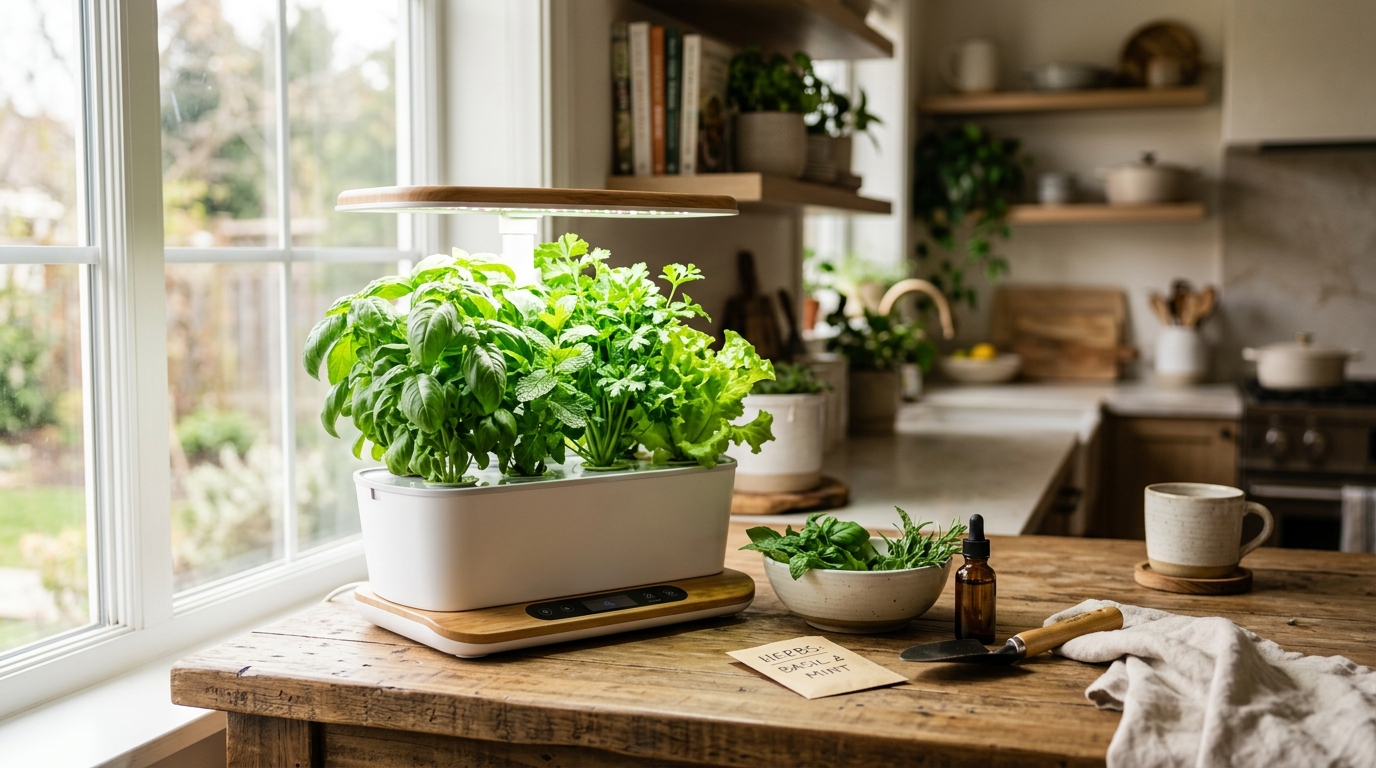
The best hydroponic system for most beginners is the AeroGarden Bounty — 9 pre-seeded herb pods, a built-in 30W LED, an automatic 16-hour timer, and basil ready to harvest in 3–4 weeks with no sunlight, no nutrient measuring experience, and no prior growing knowledge required. For beginners ready to learn real open-system hydroponics, a 5-gallon DWC bucket kit at $40–80 grows one large plant per bucket with full control and no proprietary pod costs.
What makes a hydroponic system beginner-friendly?
Three factors separate beginner-appropriate hydroponic systems from those that frustrate new growers within the first two weeks:
Forgiving nutrient delivery. Most hydroponic failures happen at the nutrient and pH stage. All-in-one pod systems (AeroGarden, IDOO) handle this through pre-dosed liquid concentrate added every two weeks — no measuring, no mixing ratios, no chemistry knowledge. Open systems (DWC, Kratky) require you to mix a nutrient solution and adjust pH to 5.5–6.5. This is a learnable 10-minute task, but it is the main stumbling block for beginners who switch to open systems before they understand it.
Reliable integrated lighting. All-in-one countertop systems include a built-in LED that runs on an automatic timer — the correct spectrum and photoperiod set at the factory. Open systems require selecting and positioning a separate grow light and setting the timer manually. Both approaches work. The all-in-one approach removes two variables from a beginner’s first grow.
Predictable maintenance rhythm. The best beginner systems have a simple, repeatable schedule: top up the water reservoir every 1–2 weeks, add nutrients on the correct cycle, and confirm plants look healthy. Open DWC systems add pH and EC checks to the routine. Neither is difficult, but understanding what to check and how often is the critical knowledge transfer for new growers.
Quick comparison
| Product | Best for | Rating | Notes | |
|---|---|---|---|---|
| AeroGarden Bounty (9-pod) | best overall; easiest first hydroponic system with no experience needed | ★★★★★ | $130-170. 9 pods, 30W LED, 24-in adjustable arm. Basil ready in 3-4 weeks. | Check price |
| IDOO 12-Pod Countertop Hydroponic | best budget pod system; 12 slots at lower cost per pod than AeroGarden | ★★★★☆ | $100-180. 12 pods, built-in LED, adjustable arm. Generic pods reduce refill costs. | Check price |
| Kratky Mason Jar Setup | simplest passive growing; zero electricity and zero pump required | ★★★★☆ | $20-40. No power needed. Lettuce and small herbs only. Requires nutrient mixing. | Check price |
| DWC 5-Gallon Bucket Kit | best first open system; one large plant per bucket with full control | ★★★★★ | $40-80 per bucket. Air pump, airstone, net cup lid. Grows tomatoes, peppers, large herbs. | Check price |
| Gardyn Home Kit (30-pod smart tower) | best tech-assisted upgrade; AI-guided growing for 30 plants simultaneously | ★★★★★ | $700-900. 30 pods, integrated LED, AI plant monitoring via app. Premium tier. | Check price |
The picks
Best overall for beginners: AeroGarden Bounty 9-Pod
Best for most beginners who want a proven, plug-and-play hydroponic system with no nutrient or light decisions to make
AeroGarden Bounty 9-Pod Hydroponic System
The AeroGarden Bounty removes every variable that causes first-time hydroponic growers to fail. The 9-pod herb kit arrives with everything included: the unit, pre-seeded herb pods (basil, parsley, dill, mint, Thai basil, thyme, curly parsley), liquid nutrient concentrate, and a setup guide. Fill the reservoir with water, drop in the pods, plug in the unit. The 30W full-spectrum LED arm starts a 16-hour on/8-hour off cycle automatically. A built-in pump circulates the reservoir continuously. Ongoing tasks: top up the water reservoir every 1–2 weeks and add the included nutrient concentrate every two weeks — under 2 minutes per session. Basil sprouts in 5–7 days and reaches first harvest at 3–4 weeks. The 24-inch adjustable arm accommodates compact vegetables including cherry tomatoes and small peppers alongside standard herbs. The Wi-Fi app sends push notifications for water and nutrient reminders. The full pod catalog includes 30-plus varieties using the same pod format as the starter kit.
★★★★★ 4.6 · 8,400 reviews
Check current price on Amazon→Pros
- 9-pod capacity supports a complete kitchen herb selection simultaneously — basil, parsley, mint, dill, cilantro at once
- 30W full-spectrum LED runs a 16-hour automatic timer with no configuration and no manual switching required
- No sunlight needed: works on any counter in any apartment regardless of window direction or light exposure
- Wi-Fi app sends water and nutrient reminders on the correct two-week schedule so no step gets missed
- 24-inch adjustable arm supports compact tomatoes and peppers beyond the herb height range
- Full AeroGarden pod catalog available: 30-plus variety options all use the same pod format
Cons
- Pod refill kits run $15-35 for 9 pods — expect $60-100 per year in pod and nutrient costs at regular use
- Basil grows fast and shades slower plants; trim it aggressively from week four to keep other pods productive
- Reservoir must be topped off every 1-2 weeks; this is a light but not zero-maintenance system
- At $130-170, it is the priciest all-in-one option; the IDOO 12-pod offers more slots at lower cost
Best budget pod system: IDOO 12-Pod Countertop Hydroponic
Best for budget-conscious beginners who want 12 growing slots at a lower upfront cost and without proprietary pod lock-in
IDOO 12-Pod Countertop Hydroponic Garden System
The IDOO 12-pod is the most popular budget alternative to AeroGarden in the all-in-one hydroponic category. At \$100–180, it offers 12 growing slots versus 9 on the AeroGarden Bounty, and the non-proprietary pod design accepts both IDOO-branded pods and standard 2-inch net cup inserts — cutting long-term pod costs significantly. The built-in LED runs a programmable timer (16 hours is the correct setting for herbs and greens), and the adjustable arm accommodates plants up to 13 inches tall. Nutrient management mirrors AeroGarden: a liquid concentrate added to the reservoir every two weeks. pH adjustment is not required for the included nutrient formula; users who switch to third-party nutrients such as General Hydroponics or Masterblend will need a pH meter and pH Down solution. Build quality and pump reliability are the main areas where the IDOO trails AeroGarden in long-term reviews, but at the \$100–180 price point the IDOO delivers strong value per pod slot for any beginner.
★★★★☆ 4.4 · 2,100 reviews
Check current price on Amazon→Pros
- 12 growing slots at $100-180 versus 9 slots at $130-170 for the AeroGarden Bounty — better capacity per dollar spent
- Non-proprietary pod format accepts standard 2-inch net cup inserts to reduce ongoing replacement costs
- Built-in LED with programmable timer provides the same plug-and-play growing experience as AeroGarden
- Compact countertop footprint fits kitchens, offices, and small apartments with limited surface space
Cons
- Plastic construction and pump durability trail AeroGarden according to long-term user reviews
- Arm height limit of 13 inches restricts pod support to herbs and compact greens — fruiting plants need more clearance
- Third-party nutrients require pH measurement and adjustment — budget an additional $15-30 for a pH meter and pH Down
- Replacement parts and customer support are less accessible than the AeroGarden ecosystem
Simplest passive system: Kratky Mason Jar Method
Best for beginners who want the lowest-cost, zero-electricity hydroponic setup to learn the fundamentals before investing in a powered system
Kratky Hydroponic Mason Jar Kit (net cups and nutrients)
The Kratky method is the most minimal form of hydroponics: a mason jar filled with nutrient water, a net cup with a seedling at the top, and nothing else. No air pump. No water pump. No electricity. The seedling roots split between the nutrient water (for food) and the air gap above the water line (for oxygen) as the plant drinks down the reservoir over 4–6 weeks. For lettuce — the ideal Kratky crop — a single head grows to full harvest size in 4–6 weeks from a setup costing under \$40 for jars, net cups, nutrient powder, and seeds. Ongoing management: top off the reservoir every 2–3 weeks as water level drops below the air gap. Kratky is limited to lettuce, spinach, and small herbs; fruiting plants exhaust the fixed reservoir before maturing. The Kratky method is the ideal first experiment with hydroponic principles before committing to a powered open system.
★★★★☆ 4.4 · 1,200 reviews
Check current price on Amazon→Pros
- Zero electricity: no pump, no power cord, no energy cost — runs entirely on the plant drinking down nutrient water
- Lowest entry cost of any hydroponic method: full setup under $40 for jars, net cups, nutrients, and seeds
- No pump maintenance, no airstone fouling, no mechanical failure points — fewest moving parts of any hydro approach
- Multiple jars operate independently: if one jar fails, every other jar in the batch is unaffected
- Best proof-of-concept for learning hydroponic principles before investing in a powered system
Cons
- Limited to lettuce, spinach, and small herbs — fruiting plants and large vegetables are not compatible with the Kratky method
- Requires nutrient mixing and pH adjustment to 5.5-6.5 for every new jar — the chemistry step that pod systems eliminate
- Fixed reservoir: once the nutrient water is consumed, growth stops — topping off requires care not to eliminate the air gap
- No integrated light: requires a south-facing window with 4-6 hours of direct sun or a separately purchased grow light
Best first open hydroponic system: DWC 5-Gallon Bucket Kit
Best for beginners ready to learn real open-system hydroponics and grow one large plant per bucket — tomatoes, peppers, basil
DWC 5-Gallon Bucket Hydroponic Kit (air pump, airstone, net cup lid)
Deep water culture (DWC) is the most widely recommended first open hydroponic system because it has the fewest components and the clearest feedback loop for new growers. A 5-gallon bucket holds the nutrient reservoir. A net cup lid sits in the bucket opening and holds the plant. An air pump with an airstone oxygenates the reservoir continuously — the single powered component. Plant roots grow directly into the nutrient water. A single DWC tomato plant yields 15–30 lbs in a 5–6 month indoor season. A DWC herb bucket produces basil or mint at a scale no countertop pod kit can approach. The learning requirements beyond pod systems: mix nutrient solution to the correct EC (1.5–2.0 for most vegetables), adjust pH to 5.5–6.5 before each reservoir fill, and check both metrics every 3–4 days. A \$25 combo pH/EC meter covers both checks in under 5 minutes. Scale by adding more buckets — 4 buckets growing in parallel produce a serious indoor food garden for under \$400 total including lights.
★★★★★ 4.5 · 1,800 reviews
Check current price on Amazon→Pros
- Fewest components of any open hydroponic system: one bucket, one air pump, one airstone, one net cup lid
- Grows full-size plants that no countertop pod system supports: tomatoes, large peppers, mature basil and mint bushes
- Scalable with no new skills: add more buckets to grow more plants using the exact same technique
- No proprietary pods or ongoing refill costs — use any seeds and growing media such as rockwool or clay pebbles
- Transparent learning curve: pH and EC monitoring teaches core hydroponic principles that transfer to any advanced system
Cons
- Requires pH and EC checks before every reservoir fill — a 5-10 minute task that pod systems eliminate entirely for beginners
- No integrated light: a separate grow light in the $50-200 range is required and must be positioned at the correct distance
- One plant per bucket — growing five plants simultaneously requires five buckets, five air pumps, and five airstones
- Root rot risk if the air pump fails or the airstone fouls; check the pump weekly during the first crop cycle
- Steeper learning curve than pod systems: expect one full crop cycle before technique and monitoring routine become automatic
Best tech-assisted upgrade: Gardyn Home Kit
Best for beginners who want to grow 30 plants simultaneously with AI-guided monitoring and minimal hands-on management
Gardyn Home Kit 30-Pod Smart Vertical Hydroponic Tower
The Gardyn Home Kit occupies the premium tier of beginner-friendly hydroponics: a vertical tower with 30 plant pod slots, integrated LED lighting, an automated watering arm, and an AI system called Kelby that monitors plants via camera and sends push notifications for watering, nutrient additions, and early plant health signals. At \$700–900, the Gardyn is a substantial first investment, but the monitoring software reduces the expertise required to keep 30 plants healthy simultaneously. Kelby identifies yellowing, stretching, and tip burn before they require diagnosis from the grower. The pod catalog includes 50-plus varieties: herbs, leafy greens, cherry tomatoes, and compact flowers. The system uses proprietary Ode pods at \$5–8 each; a full 30-pod tower costs \$150–240 to replant. The Gardyn is the right choice when the goal is a high-yield home food system with software-managed growing assistance, and the budget supports the premium price.
★★★★★ 4.5 · 900 reviews
Check current price on Amazon→Pros
- 30 pods in a vertical tower footprint of roughly 2 sqft — the highest plant density of any system in this comparison
- AI monitoring via the Kelby app identifies plant stress signals before they require grower diagnosis
- Integrated LED and automated watering arm reduce hands-on management compared to any open tower system
- 50-plus variety pod catalog covering herbs, leafy greens, compact tomatoes, and edible flowers
Cons
- Premium pricing at $700-900 makes it the most expensive option for a beginner by a significant margin
- Proprietary Ode pods at $5-8 each set the 30-pod replant cost at $150-240 — highest ongoing cost in this comparison
- Vertical tower height of roughly 5 feet requires dedicated floor or corner space that countertop systems do not need
- Wi-Fi dependency: the AI monitoring and automated features require a stable internet connection at all times
What to skip as a beginner
Sub-$50 no-name hydroponic kits with unbranded LED strips. These kits typically include a small plastic tray with minimal growing holes, a weak submersible pump, and LED strips using incorrect or unspecified spectrum ratios. Seedlings germinate and then stall as the light intensity falls below the minimum threshold for vegetative growth. The pump fails shortly after. Spend $50 more for an IDOO or AeroGarden unit and start with something that works.
NFT (nutrient film technique) channel systems as a first hydroponic setup. NFT is the commercial standard for leafy-green hydroponic production and an excellent system for experienced growers. For beginners, the failure mode is catastrophic: if the pump fails for more than a few hours, roots dry out and the entire crop is lost within a session. DWC roots sit in a reservoir that remains intact if the pump fails temporarily. Start with DWC; move to NFT after completing at least one full hydroponic crop cycle.
Vertical tower systems with no included grow light. Several tower systems require a separate grow light purchase. A 30-plant tower without adequate light is a watering system that will not produce edible harvests regardless of nutrient quality. Confirm that any system you buy includes a grow light rated for the number of plants it holds, or budget $150–300 for a separate LED panel.
FAQ
Frequently asked questions
What is the best hydroponic system for a complete beginner?
Do beginner hydroponic systems require pH adjustment?
How much does a beginner hydroponic system cost to run per year?
What can beginners grow in a hydroponic system?
How often does a beginner hydroponic system need maintenance?
Can I grow hydroponically without any electricity?
Bottom line
The best hydroponic system for most beginners is the AeroGarden Bounty — 9 pods, 30W built-in LED, automatic timer, and basil ready in 3–4 weeks with no prior experience or nutrient knowledge required. Budget-focused beginners should consider the IDOO 12-pod for more slots at a lower cost per plant.
For beginners who want to learn real open-system hydroponics, start with a single DWC 5-gallon bucket kit — one large plant, full pH and EC control, and skills that apply to any advanced system. The Kratky mason jar method is the right zero-cost proof of concept before committing to any powered system.
For further reading: see best hydroponic systems for advanced types including NFT channels and vertical towers, hydroponics vs soil to decide which growing method fits your goals, how to set up a Kratky system for a step-by-step passive growing walkthrough, and best hydroponic nutrients for choosing the right nutrient formula when you move to open-system growing.