roundups
Best Grow Lights for Monstera 2026
Best grow lights for monstera deliciosa and rare varieties: pendant picks, panels, and screw-in options for low-light apartments.
 Priya Anand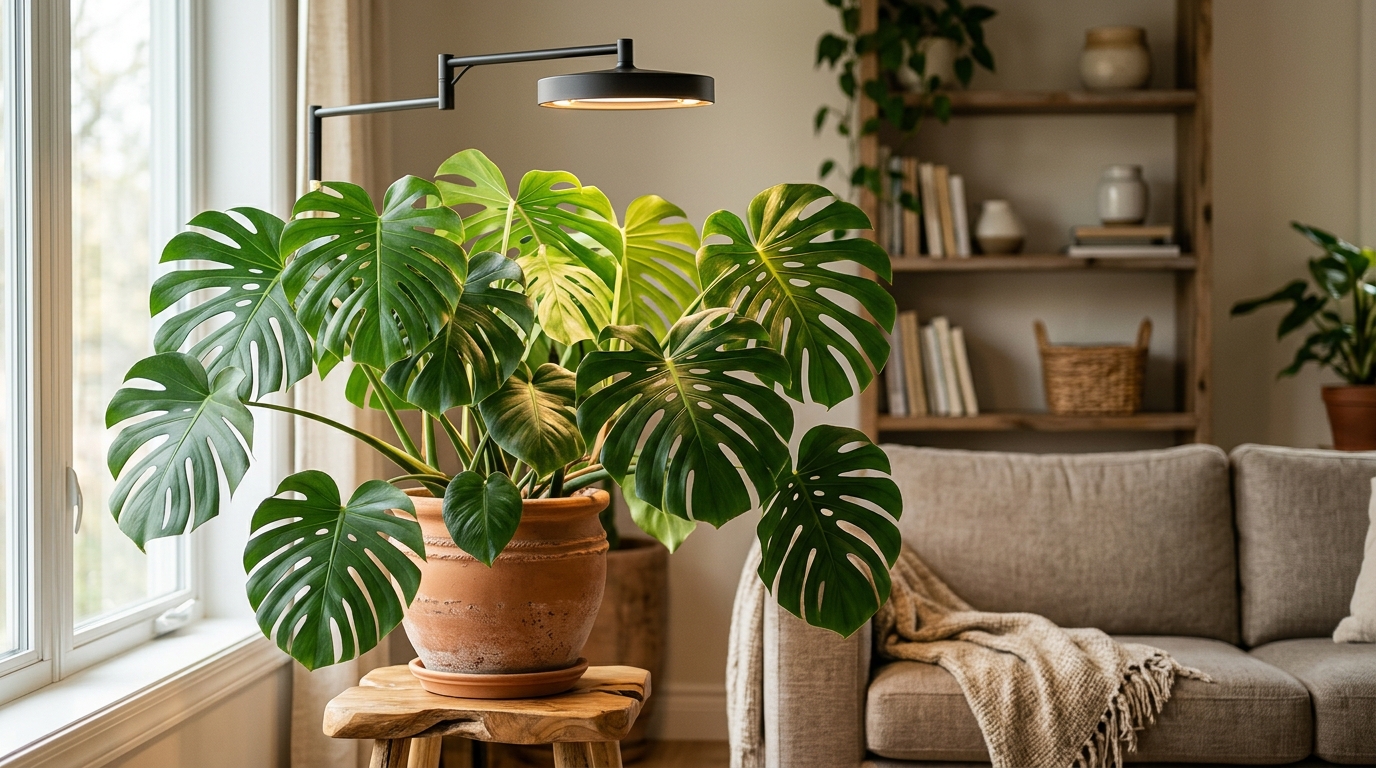
The best grow light for most monstera setups is the Soltech Solutions Aspect — a pendant-style fixture that delivers 150-250 PPFD over a 3-by-3-foot footprint while blending into a living room without looking like a greenhouse installation. For buyers who prioritize value over aesthetics, the Mars Hydro TS 600 panel at $65-80 delivers comparable output with a more industrial look. Either option solves the core monstera problem: insufficient light in apartments and north-facing rooms that causes slow growth and small, unfenestrated leaves.
How much light does a monstera actually need?
Monstera deliciosa is native to the forest floor of Central American rainforests, where it receives bright dappled indirect light filtering through a tropical canopy. In outdoor terms that translates to 1,000-3,000 PPFD of diffused natural light for several hours daily. Indoors, grow lights target the 150-300 PPFD range — the minimum for steady growth and reliable fenestration.
Fenestration is the clearest indicator. Leaves develop their characteristic holes and splits when the plant receives adequate light — the fenestrations allow wind to pass through the canopy without toppling the plant, and they develop in response to light signals. A monstera producing round, solid leaves without holes is typically light-starved. Grow lighting that delivers 200+ PPFD at the canopy restores fenestration within a few new leaf cycles.
Monstera thrives on indirect light, not direct beam. Unlike succulents that benefit from the highest possible PPFD, monstera can suffer from light intensity above 500-600 PPFD at close range — leaves yellow and bleach at the edges. Position grow lights 24-36 inches above the plant canopy rather than the 6-12 inch distances used for succulents and herbs.
Rare varieties need consistent light. Monstera thai constellation and Monstera deliciosa albo variegata have reduced chlorophyll in their white sections and require slightly more light than standard deliciosa to maintain growth rates and the contrast in their variegation. Target 200-350 PPFD for these varieties and run the light for the full 14 hours daily.
Window light alone is rarely enough. A south-facing window in summer may be adequate, but a north or east window year-round — the typical apartment scenario — delivers 30-100 PPFD at the plant. That explains why so many monstera stay small with solid leaves for years: the light level is enough to survive, not enough to thrive.
Quick comparison
| Product | Best for | Rating | Notes | |
|---|---|---|---|---|
| Soltech Solutions Aspect | Living room display monsteras where aesthetics matter | ★★★★★ | About $175-220. Pendant design. Best for blending grow lighting into home decor. | Check price |
| Mars Hydro TS 600 LED Panel | Dedicated plant space or grow cabinet, value-focused | ★★★★★ | About $65-80. 100W actual draw. Best PPFD-per-dollar for monstera coverage. | Check price |
| Sansi 36W Full Spectrum E26 | Floor lamp placement over a single monstera | ★★★★☆ | About $20-25. Fits any E26 socket. Highest-output screw-in option available. | Check price |
| GooingTop LED Grow Light | Small monsteras or adansonii with window backup | ★★★★☆ | About $25-35. Flexible gooseneck. Good for cuttings and supplemental coverage. | Check price |
| Spider Farmer SF-1000 LED Panel | Large mature monstera or rare variegated varieties | ★★★★★ | About $90-110. Samsung LM301B diodes. Best for large specimens and high PPFD needs. | Check price |
The picks
Best for living rooms: Soltech Solutions Aspect
Best for living room or bedroom monsteras where the grow light needs to look intentional rather than industrial
Soltech Solutions Aspect Full Spectrum Grow Light
The Soltech Aspect is the grow light that converted the houseplant community away from the idea that good plant lighting has to look utilitarian. Its pendant design and warm aluminum housing look like a designer fixture, not a grow light — until you check the canopy PPFD. At 24-30 inches above the canopy it delivers 150-250 PPFD across a 3-by-3-foot footprint, right in the target range a full-grown monstera deliciosa needs for steady growth and fenestration. The full-spectrum white output renders leaf color accurately, so you can monitor variegation in thai constellation and albo plants without blurple distortion. At $175-220 it is the premium option, but for a monstera that is a living room focal point, the aesthetic justification is real.
★★★★★ 4.7 · 3,200 reviews
Check current price on Amazon→Pros
- Pendant design passes as a real lamp — the right choice for a visible living room plant
- Delivers 150-250 PPFD at 24-30 inch distance — ideal range for monstera canopy
- Full-spectrum white renders variegation and leaf color without blurple distortion
- Easy height adjustment with included hanging hardware for different monstera heights
- Convection-cooled only — zero fan noise for a quiet living room environment
Cons
- Premium price at $175-220 — harder to justify for a single monstera in a non-display setting
- Not the right tool for a grow cabinet or dedicated plant room with multiple specimens
- Output ceiling near 250 PPFD may fall short for rare variegated varieties needing 300+ PPFD
Best value panel: Mars Hydro TS 600
Best for a dedicated plant corner, grow cabinet, or multiple monsteras where plant performance matters more than room aesthetics
Mars Hydro TS 600 LED Grow Light Panel
At $65-80, the Mars Hydro TS 600 delivers more PPFD per dollar than any pendant-style grow light for monstera. Hang it 24-30 inches above the canopy and it provides 200-350 PPFD across a 2-by-2-foot footprint — adequate for a standard monstera deliciosa through a full growing season. The full-spectrum white output (3000K, 5000K, and 660nm red combined) supports both vegetative leaf growth and the photosynthetic needs of fenestrated leaves without the color distortion of blurple panels. It runs warm after extended use; place it in a space with some airflow. For a plant room, a grow cabinet with multiple monstera cuttings, or any setup where plant performance matters more than room aesthetics, this is the practical pick.
★★★★★ 4.5 · 12,500 reviews
Check current price on Amazon→Pros
- Best PPFD-per-dollar in the $65-80 price range for monstera-scale coverage
- Full-spectrum white output: monitor leaf color and variegation without blurple interference
- Covers a 2-by-2-foot footprint at 24-30 inches — right for one or two medium monsteras
- Well-documented brand with consistent output over thousands of hours of use
Cons
- Industrial panel aesthetics — not suitable for a visible living room display
- Runs warm; requires adequate airflow in enclosed spaces
- Footprint covers 2-by-2 feet — may fall short for a very large mature monstera canopy
Best screw-in: Sansi 36W Full Spectrum
Best for a monstera near a floor lamp with an open bowl or gooseneck fixture already in place
Sansi 36W Full Spectrum E26 Grow Light Bulb
The Sansi 36W is the fastest way to add meaningful grow lighting for a monstera when a floor lamp or table lamp is already nearby. Screw it into an open E26 socket — no enclosed shade, open bowl or gooseneck only — position the lamp 24-30 inches above the canopy, set a timer for 12-14 hours, and the 36W output delivers 150-250 PPFD at plant level. This is the effective range for a monstera with some natural light backup from a north or east window. For an apartment monstera that receives 1-2 hours of indirect window light daily, this addition closes the gap to healthy growth and leaf splitting. It runs warm — open fixture only, no enclosed lamp shades, which trap heat and pose a fire risk at sustained wattage.
★★★★☆ 4.4 · 1,200 reviews
Check current price on Amazon→Pros
- Uses any existing E26 floor lamp or table lamp — zero new fixture cost
- Delivers 150-250 PPFD at 24-30 inches — effective supplemental range for monstera
- Full-spectrum white output; leaf color and variegation remain visible without distortion
- Lowest barrier to entry for apartment monstera growers with a lamp already in place
Cons
- Requires an open fixture — no enclosed lamp shades, which retain heat at sustained wattage
- Most effective as supplemental lighting when some window light is already present
- Heavier than standard bulbs; may not fit lightweight clip-on lamp bases
Best for small monsteras: GooingTop LED Grow Light
Best for Monstera adansonii, small monstera deliciosa cuttings, or any desk or shelf monstera with window backup
GooingTop LED Grow Light for Plants
The GooingTop is a gooseneck grow light with a clip or base stand and enough output to supplement window light for a small monstera. It is the right choice for Monstera adansonii (which stays compact and tolerates slightly lower PPFD than deliciosa), young monstera cuttings being established before their first repot, or any setup where the plant sits near a window and only needs supplemental coverage on short winter days. Run it 12-14 hours daily to extend the photoperiod beyond what the window provides and maintain consistent growth through the low-light months. At $25-35 it is the lowest-cost entry into monstera grow lighting for growers with one small plant and some existing window light.
★★★★☆ 4.3 · 4,800 reviews
Check current price on Amazon→Pros
- Flexible gooseneck positions light over the canopy from desk, shelf, or floor placement
- Built-in or compatible timer options automate the daily photoperiod without an external outlet timer
- Right-sized for Monstera adansonii and small deliciosa cuttings under 18 inches tall
- Low cost under $35 for growers who need supplemental rather than primary lighting
Cons
- Insufficient as a sole light source for a mature Monstera deliciosa in a dark interior room
- Requires window backup to reach adequate PPFD for fenestration development in larger plants
- Gooseneck reach may fall short for floor-level monstera specimens above 24 inches
Best for large monstera: Spider Farmer SF-1000
Best for a large mature Monstera deliciosa, a monstera grow tent, or growers raising rare variegated varieties
Spider Farmer SF-1000 LED Grow Light
The Spider Farmer SF-1000 uses Samsung LM301B diodes — the same technology in grow lights costing twice as much — in a 100W panel that delivers 200-400 PPFD at 24-36 inches across a 3-by-3-foot footprint. For a large mature monstera deliciosa with a 3-foot canopy spread, a monstera thai constellation needing higher PPFD for vigorous variegated growth, or a grower running multiple monstera specimens in a dedicated grow tent setup, the SF-1000 is the right tool. At $90-110 it costs more than the Mars Hydro TS 600 but covers 50% more footprint and delivers higher peak PPFD — the justified step up for serious growers.
★★★★★ 4.6 · 8,900 reviews
Check current price on Amazon→Pros
- Samsung LM301B diodes deliver premium efficiency and consistent output across the panel
- Covers a 3-by-3-foot footprint — appropriate for a large mature monstera canopy
- Higher PPFD ceiling meets the needs of rare variegated varieties needing 300-400 PPFD
- Dimmable design lets you dial PPFD to monstera growth stage and season
Cons
- Industrial panel form factor — not suitable for a living room display setting
- Higher cost at $90-110; harder to justify for a single standard deliciosa in a smaller space
- Requires hanging hardware and adequate vertical clearance above the canopy
What to skip
Standard decorative bulbs under 15W. General-purpose LED bulbs used in table lamps produce 20-50 PPFD at plant level — a fraction of what monstera needs. Even a monstera next to a south window benefits from a dedicated grow bulb rather than sharing a decorative fixture.
Red-blue blurple panels. Blurple grow lights function for photosynthesis but make it nearly impossible to assess monstera health — the purple light masks yellowing, browning edges, and the early signs of nutrient deficiency or overwatering. Full-spectrum white is essential for monitoring a plant as large and complex as monstera.
Grow lights without timers. Consistent 12-14 hour photoperiods matter more for fenestration than peak PPFD. A monstera receiving 14 hours of moderate grow light outgrows one receiving 6-8 hours of higher-intensity light with no consistent schedule. Always pair any grow light with a digital outlet timer. See our grow light schedule guide for monstera-specific timing and photoperiod guidance.
Clip-on lights under 20W as a sole source. These are useful for small monsteras with window backup but will not support fenestration for a medium or large specimen in a dim interior room. Treat any clip-on under 20W as a supplement, not a replacement for a dedicated fixture.
Light placement and setup tips
Position above the growing tip, not the soil. Monstera grows tall, and the meristem — the active growing point — is at the top of the plant. Hang panels 24-36 inches above the topmost leaf node, not the soil line. As the plant grows, raise the fixture to maintain that distance.
Rotate every 2-3 weeks. Large monstera specimens with a single-sided light source develop petioles that angle toward the fixture over time, which affects the symmetry of large mature leaves. A quarter turn every 2-3 weeks keeps growth upright and balanced.
Pair with humidity. Monstera is both a high-light and a high-humidity plant — grow lights address one side of its needs, but humidity below 40% limits growth regardless of PPFD. See our humidity control guide for plants for pairing recommendations.
Monitor for bleaching. Yellow-white patches on the upper leaf surface, especially on new growth, indicate the light intensity or proximity is too high. Move the panel 4-6 inches higher and check again after the next leaf unfurls. See our common indoor plant problems guide for a full symptom-to-cause chart.
FAQ
Frequently asked questions
Why is my monstera not producing fenestrated leaves even with a grow light?
Can a monstera get too much light from a grow light?
Does my Monstera thai constellation need a different grow light than standard deliciosa?
How many hours of grow light does monstera need per day?
Can I use one grow light for both my monstera and other houseplants?
Bottom line
Best for living rooms: Soltech Solutions Aspect. Best value panel: Mars Hydro TS 600. Best screw-in for a floor lamp: Sansi 36W. Best for small monsteras and adansonii with window backup: GooingTop LED. Best for large specimens and rare variegated varieties: Spider Farmer SF-1000.
Monstera needs 150-300 PPFD at 24-36 inch distance, run 12-14 hours daily — less intensity than succulents but far more consistency than a dim north window provides. Match the fixture to the room context: pendant-style for display plants, panels for grow spaces, screw-ins for plants with some existing window light.
More in this cluster: how to position a grow light by plant type, grow light schedule guide for all indoor plants, grow lights for general houseplants compared, and best full-spectrum grow lights reviewed.