guides
How to Control Humidity for Indoor Plants
Learn how to raise or lower humidity for houseplants, ideal levels per plant type, and the best tools for consistent indoor plant humidity.
 Priya Anand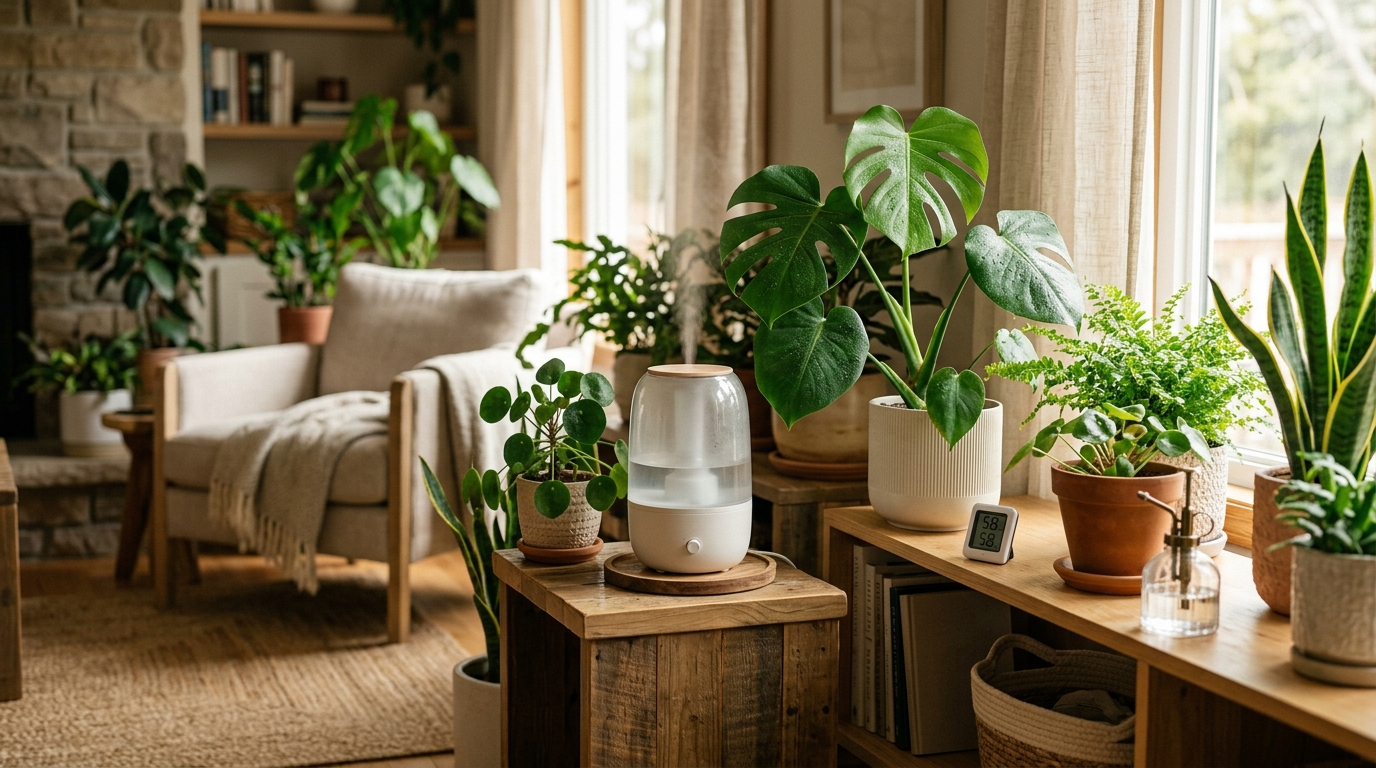
The most effective way to raise humidity for indoor plants is a cool-mist humidifier set to 55–65% RH, placed 2–3 feet from your collection. For a free, equipment-free boost, grouping plants together and adding a pebble tray raises local humidity by 5–15%. A $10 digital hygrometer tells you exactly what level your plants are actually experiencing.
Why indoor air is too dry for most houseplants
Most popular houseplants — calatheas, orchids, ferns, monsteras, pothos, peace lilies — evolved in tropical environments where relative humidity runs between 60 and 80 percent year-round. Indoors in North America, the typical range is 30–45% in winter (forced-air heating strips moisture aggressively) and 40–55% in summer. That gap between what your plant wants and what the air delivers shows up as brown leaf tips, crispy edges, curling leaves, and sluggish growth — symptoms commonly misread as underwatering or fertilizer problems.
Understanding the actual humidity in your home, and which plants need the most help, is the foundation for fixing these problems without over-engineering your setup.
What humidity level do indoor plants need?
Different plants have genuinely different humidity tolerances. Here is a practical breakdown:
| Plant type | Ideal RH range | Notes |
|---|---|---|
| Orchids, calatheas, ferns, anthuriums | 60–80% | Brown tips and failed blooms at lower levels |
| Monsteras, pothos, peace lilies, philodendrons | 50–70% | Tolerate 40% short-term; show stress below that |
| Snake plants, ZZ plants, dracaena | 40–60% | Resilient; tolerate standard indoor air |
| Succulents, cacti | 30–50% | Prefer dry conditions; high humidity invites rot |
| Herbs (basil, mint, parsley) | 50–70% | Bolting and leaf curl increase when air is too dry |
If you keep a mixed collection — tropicals alongside succulents — target 50–60% as a reasonable compromise that suits most species without creating rot risk for your drought-tolerant plants.
How to measure indoor humidity accurately
A digital hygrometer is the only reliable way to know your actual indoor RH. They cost $10–15 on Amazon and read humidity and temperature simultaneously. Analog hygrometers work but drift over time; digital models stay accurate for years without recalibration.
Place the hygrometer at plant level — on the shelf where plants sit, not on a windowsill or near a vent. Temperature and airflow vary considerably across a room, and the reading at plant level is often 5–10% different from the same unit placed on a table three feet away. The ThermoPro TP50 is the most widely used basic option; the Govee Bluetooth Hygrometer logs readings to an app so you can track daily fluctuations over time.
Take a reading at the coldest point in winter — typically January or February — to understand your true baseline. This is when indoor RH is lowest and the gap between plant needs and actual conditions is greatest.
Step-by-step: How to raise humidity for indoor plants
Step 1: Group plants together
The simplest and cheapest humidity intervention is rearranging plants. Plants release water vapor through their leaves via transpiration. Group several plants close together and the shared moisture output from multiple plants raises local relative humidity by 5–10% compared to a single isolated pot.
Cluster humidity-sensitive plants — calatheas, ferns, and orchids — together in the same corner or on the same shelf. Position a hygrometer in the center of the grouping to confirm the actual RH boost the cluster delivers at plant level.
This method has a ceiling: it cannot replace a dedicated humidifier for truly humidity-hungry plants. But it is a meaningful first step that costs nothing and also helps plants share a more stable microclimate.
Step 2: Add a pebble tray
A pebble tray is a shallow dish or tray filled with small stones and water, with the plant pot sitting on top of the stones above the waterline. As water evaporates from the tray, it raises humidity immediately around the plant’s foliage.
The key detail: the pot must sit above the water level, not in it. Roots sitting in standing water develop rot within days. Fill the tray until water reaches just below the surface of the pebbles.
You can buy dedicated pebble humidity trays or use any shallow dish with river pebbles or decorative gravel. Refill the tray every few days as water evaporates. A pebble tray adds roughly 5–10% RH directly around the plant — meaningful for a single specimen but not effective at raising ambient room humidity.
Step 3: Run a cool-mist humidifier
For plants that need 60–80% RH — calatheas, orchids, most ferns, anthuriums — a dedicated humidifier is the only reliable way to hit that target in a standard home. Grouping and pebble trays raise local humidity by 5–15%; a humidifier raises it room-wide and maintains it automatically.
What to look for in a plant humidifier:
- Built-in humidistat: automatically cycles the unit on and off to maintain a target RH level, preventing over-humidification
- Tank size of 3 liters or more: reduces refill frequency to once daily or less
- Ultrasonic or evaporative technology: both are quiet and energy-efficient; evaporative models never produce the white mineral dust that ultrasonic units generate with tap water
- Placement: position 2–3 feet from plants with the nozzle aimed into open air, not directly at leaves
The Levoit Classic 300S is the most popular choice for plant rooms — a 6-liter ultrasonic with a built-in humidistat and WiFi scheduling that runs 30–36 hours between refills. The GENIANI Top Fill 4L is an excellent mid-range option with a wide-mouth top-fill port and an auto humidity mode, without requiring a smart home app.
For a full breakdown of plant humidifier options at every price point, see our best plant humidifiers guide.
Use distilled or filtered water in ultrasonic humidifiers. Tap water works but the unit aerosolizes dissolved minerals as fine white dust that coats leaf surfaces and nearby furniture over time. A $20 pitcher filter or gallon jugs of distilled water eliminates this problem entirely.
Step 4: Move plants to naturally humid rooms
Kitchens and bathrooms have naturally higher baseline humidity from cooking, washing, and showering. Moving humidity-sensitive plants to a bright kitchen windowsill or a bathroom with adequate natural light is a meaningful free upgrade that requires no equipment.
A north-facing bathroom window suits low-light species like ferns, peace lilies, or pothos. A south or east-facing kitchen window supports most medium-light tropicals. The additional humidity from daily kitchen and bathroom activity can raise ambient RH by 10–20% compared to a bedroom with forced-air heating.
What not to do: misting plants
Misting is the most commonly recommended humidity fix — and the least effective. The moisture from a misting session dissipates within 5–10 minutes, and a hygrometer placed nearby shows RH returning to its baseline within 15 minutes of misting.
Worse, misting creates wet leaf surfaces in an environment with normal air circulation. Wet foliage in stagnant air is an ideal incubation environment for botrytis (gray mold), powdery mildew, and bacterial leaf spots. The plants most commonly misted — orchids, calatheas, peace lilies — are exactly the species most prone to fungal damage from wet leaves.
If you enjoy misting as a ritual, it is harmless in small amounts with good airflow. But as a humidity solution it does not work. Use a pebble tray, plant grouping, or humidifier instead.
How to lower humidity if it’s too high
High humidity is a less common problem but matters for growers in naturally humid climates, those running enclosed grow tents, or anyone who has over-humidified a plant room.
Signs of excess humidity:
- White or gray powdery coating on leaves (powdery mildew)
- Soft, rotting spots on leaves or stems (botrytis or bacterial rot)
- Fungus gnat populations surging as soil stays moist longer
- Condensation forming on windows and cold surfaces near plants
How to reduce humidity:
- Increase air circulation. A small oscillating fan set on low keeps air moving and dramatically reduces fungal risk even at elevated RH. Run it 12–16 hours per day directed across the plant canopy rather than pointed directly at individual plants.
- Reduce crowding. Plants grouped tightly in a high-humidity environment amplify the problem. Space them to allow air to circulate between leaves and reduce the combined transpiration output.
- Turn off the humidifier and let the room return to its natural baseline before resuming at a lower target setting.
- Improve room ventilation. Open a window briefly or crack a door to exchange moist indoor air with drier outdoor air.
For grow tents specifically: add an inline exhaust fan rated to the tent volume and maintain slight negative pressure to pull fresh, drier air through continuously. Target 55–65% RH as a sustainable baseline for mixed tropical collections — high enough for humidity-lovers, low enough that good airflow prevents disease.
Humidity and plant problems: what to look for
Low humidity causes a predictable set of symptoms distinct from other problems:
- Brown leaf tips and crispy edges starting at the outermost margin of older leaves — often confused with underwatering or fertilizer burn, but the soil is moist and no recent fertilizing occurred
- Curling leaves on calatheas, orchids, and peace lilies as the plant reduces surface area to conserve moisture under stress
- Wilting despite adequate watering in severe cases, as the plant cannot replace moisture through roots fast enough when dry air pulls it out rapidly
Raise humidity and these symptoms typically stabilize within one to two weeks. New growth that emerges after the adjustment will be healthy; existing brown tips do not reverse but stop spreading.
For a complete guide to diagnosing what your plants are showing, see our common indoor plant problems guide.
FAQ
Frequently asked questions
What humidity level do indoor plants need?
Does misting plants raise humidity?
How do I raise humidity for plants without a humidifier?
Can high humidity hurt indoor plants?
What causes low humidity in a home?
Where should I place a humidifier for plants?
Bottom line
The most effective approach to controlling indoor plant humidity is a three-step system: measure first with a digital hygrometer, add grouping and a pebble tray as free baseline improvements, then add a cool-mist humidifier with a built-in humidistat if plants that need 60–70% RH are still showing brown tips or curling leaves. Misting, despite its popularity, provides no lasting humidity benefit and increases fungal disease risk for the plants most people mist.
For more on keeping your indoor garden healthy: best plant humidifiers for a full equipment breakdown at every price point, how to fertilize indoor plants to pair nutrition with the right growing conditions, common indoor plant problems to diagnose exactly what your plants are showing, and how to water indoor plants to complete the core care fundamentals.