roundups
Best Grow Lights for Houseplants 2026
Best grow lights for houseplants: Soltech Aspect pendant, Barrina LED bars, and screw-in picks for pothos, monstera, snake plants, and fiddle-leaf figs.
 Priya Anand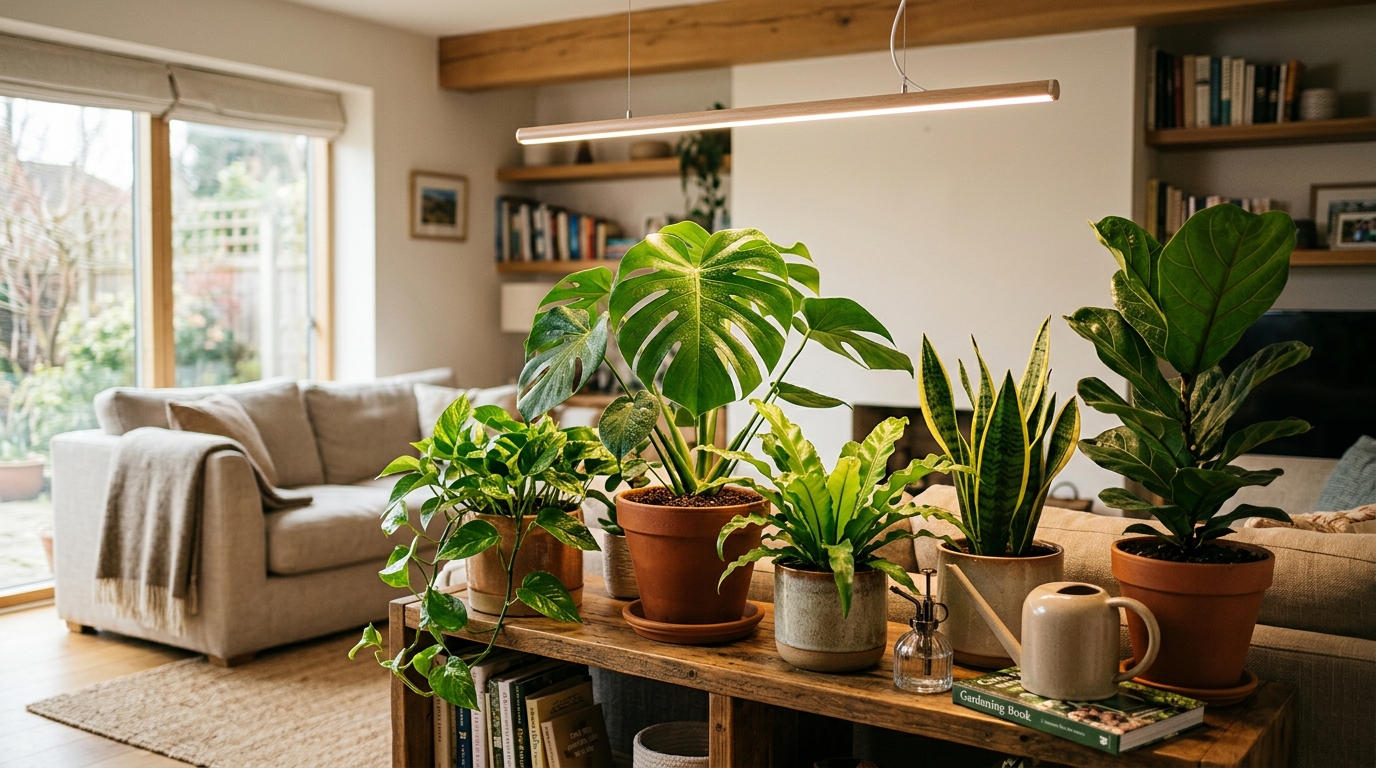
The best grow light for most houseplants is the Soltech Aspect pendant — it outputs enough PAR to support pothos, monstera, snake plants, and most ornamentals while looking like a real lamp, not grow equipment. For shelves and plant walls, Barrina T8 LED bars are the practical choice at a fraction of the cost. Either option beats leaving light-hungry plants in a dim corner through winter.
How much light do houseplants actually need?
Most ornamental houseplants need far less light than food crops. The confusion starts when grow light guides written for tomato growers get read by monstera owners — the PPFD requirements are completely different.
Low-light houseplants (pothos, snake plants, ZZ plants, peace lilies) thrive at 20-75 PPFD. These survive in dim offices and north-facing rooms naturally. A basic grow bulb or clip-on LED is enough.
Medium-light houseplants (monstera, philodendron, fiddle-leaf fig, bird of paradise) prefer 75-200 PPFD. They benefit from supplemental lighting in winter or rooms without south-facing windows. A Soltech Aspect pendant or Barrina T8 bars cover this range well.
High-light houseplants (most cacti, succulents in active growth, orchids, citrus trees indoors) want 200-400 PPFD. These need a stronger LED bar setup or multiple T8 bars on a shelf — a single screw-in bulb from a floor lamp often falls short.
Compare this to food crops: basil wants 400-600 PPFD, tomatoes want 600-900+. A grow panel sized for tomatoes will overwhelm a pothos and waste electricity. Size the light to your actual plant collection.
Quick comparison
| Product | Best for | Rating | Notes | |
|---|---|---|---|---|
| Soltech Aspect (pendant) | Display plants where aesthetics matter most | ★★★★★ | About $130-280. Full-spectrum white. Looks like a real lamp. | Check price |
| Barrina T8 LED Grow Light Bars | Shelves and plant walls with multiple plants | ★★★★★ | About $30-50 per 4-pack. Linkable strips with easy shelf install. | Check price |
| GE BR30 Full Spectrum LED Bulb | Budget entry; fits any existing floor or table lamp | ★★★★★ | About $15 per bulb. E26 socket. Most accessible option. | Check price |
| Sansi 36W Full Spectrum E26 | High-light houseplants: succulents, orchids, citrus | ★★★★☆ | About $20-25. Highest-output screw-in grow bulb available. | Check price |
| Juhefa Clip-on LED Grow Light | Single desk or shelf plant; propagation stations | ★★★★☆ | About $15-20. Gooseneck clip; USB or outlet powered. Built-in timer. | Check price |
The picks
Best overall: Soltech Aspect
Best for display houseplants in living rooms and dining areas where aesthetics matter
Soltech Aspect Full Spectrum Grow Light Pendant
The Soltech Aspect is the only grow light that genuinely looks like a designer lamp. Hang it over a monstera, fiddle-leaf fig, or plant grouping and it reads as ambient lighting — not grow equipment. It outputs full-spectrum white at 100-250 PPFD at typical hanging heights, which covers low-to-medium-light houseplants without the overkill of a food-crop panel. Available in matte black, brass, and white to match room decor. At $130-280 it costs more than a shelf bar or a grow bulb, but it is the only option in the category that does not require you to hide the hardware.
★★★★★ 4.7 · 1,800 reviews
Check current price on Amazon→Pros
- Looks like a pendant lamp — does not signal grow-room hardware in a living space
- Full-spectrum white reads as ambient lighting; guests will not notice it
- Adequate PPFD for all low-to-medium-light ornamental houseplants
- Multiple finishes available: matte black, brass, and white
- Quiet, low heat, long LED lifespan
Cons
- High price: $130-280 compared to $30-50 for Barrina bars or $15 for a GE bulb
- Not adjustable once hung — position carefully above the plant
- Not sufficient for high-PPFD crops, citrus, or fruiting plants
- Pendant style requires a ceiling hook installation
Best for shelves: Barrina T8 LED Grow Light Bars
Best for plant shelves, bookcases, and any multi-plant display with multiple vertical levels
Barrina T8 LED Grow Light Bars for Shelves
Barrina T8 LED bars are the practical choice when you have multiple plants on a shelf or baker rack and need to light them efficiently. They come in 4-packs and 8-packs, link together with included cables, and mount to the underside of any shelf with zip ties or the included clips. Each bar is 2 feet long and provides adequate PPFD for low-to-medium-light houseplants at 6-12 inch shelf spacing. A 4-pack covers a 4-foot shelf with consistent light across the full width. At $30-50 for a 4-pack they are the most economical way to light a plant collection.
★★★★★ 4.5 · 4,200 reviews
Check current price on Amazon→Pros
- Linkable design: connect multiple bars from one outlet for clean cable management
- Easy shelf installation with included mounting clips or zip ties
- 4-pack covers a full 4-foot shelf at a fraction of pendant cost
- Full-spectrum white output suits low-to-medium-light houseplants across the shelf
- Low profile that fits neatly under shelves without adding bulk
Cons
- Visible hardware — clearly not a living room accent light
- Less effective than a pendant for tall floor plants or corner specimens
- Cord management requires planning on open shelving units
- Individual bars output less PPFD than the Soltech at equivalent distance
Best budget: GE BR30 Full Spectrum LED
Best for any existing floor or table lamp; lowest-cost entry point for houseplant grow lighting
GE Full Spectrum BR30 LED Grow Light Bulb
The GE BR30 is the fastest, cheapest way to add grow light support to any plant in your home. Screw it into any E26 floor lamp, table lamp, or clip-on reading light you already own — no new fixtures, no installation. Output is adequate for low-to-medium-light houseplants (pothos, snake plants, ZZ plants, most philodendrons) that need supplemental light through winter. The full-spectrum white looks natural unlike blurple bulbs that turn your room purple. At around $15 it is the most accessible grow light for houseplant owners who want to try supplemental lighting before committing to a larger setup.
★★★★★ 4.5 · 2,800 reviews
Check current price on Amazon→Pros
- Under $15 and available at every hardware store and on Amazon
- Fits any E26 lamp you already own — zero installation cost
- Full-spectrum white output keeps plants easy to inspect visually
- Adequate for low-to-medium-light ornamentals: pothos, snake plant, ZZ plant
Cons
- Lower wattage than 30-36W options — not ideal for medium-to-high-light plants
- Standard floor lamp height (5-6 feet) reduces effective PPFD significantly
- No dimming; full output only
Best high-output bulb: Sansi 36W Full Spectrum
Best for high-light houseplants: succulents, orchids, citrus trees, and birds of paradise
Sansi 36W Full Spectrum E26 Grow Light Bulb
When a 15W GE bulb is not enough, the Sansi 36W is the step up without switching to a full panel. At 36W actual draw it produces roughly 2-3x the PPFD of a standard grow bulb — enough to keep a fiddle-leaf fig, bird of paradise, or succulent collection in strong supplemental light through winter. It runs noticeably warm so keep it 12-18 inches from the plant canopy and use it in an open lamp without a shade. For houseplant owners with a few high-light specimens in a dim room, this bulb closes the gap without the commitment of a dedicated grow panel.
★★★★☆ 4.4 · 1,200 reviews
Check current price on Amazon→Pros
- 36W actual draw — highest PPFD of any screw-in grow bulb in the E26 format
- Effective for high-light houseplants that a 15W bulb cannot adequately support
- Full-spectrum white; usable in open living-space fixtures
- Small incremental cost over GE ($20-25 vs $15) for a significant output increase
Cons
- Runs warm — maintain 12-18 inch minimum distance from plant canopy to prevent stress
- Heavier than standard bulbs; not suitable for lightweight clip-on lamps
- Less efficient per dollar than a small LED panel for larger plant collections
Best clip-on: Juhefa LED Grow Light
Best for a single desk plant, windowsill specimen, or propagation setup
Juhefa Clip-on LED Grow Light for Plants
The Juhefa clip-on grow light handles spots where a floor lamp is too large and a shelf bar would not reach. It clamps onto any surface up to 2 inches thick and has a gooseneck arm for precise positioning toward a single plant. Output is limited — appropriate for low-light plants like pothos, ivy, peperomia, and ferns — but within that envelope it is reliable. The built-in timer is a useful addition for consistent schedules without an external outlet timer.
★★★★☆ 4.2 · 3,100 reviews
Check current price on Amazon→Pros
- Clamps onto any shelf, desk, or pot rim without floor space
- Built-in timer for automated daily light schedules
- USB power option for flexibility; standard outlet version also available
- Gooseneck arm for precise positioning on a single plant
Cons
- Low output — effective only for low-light houseplants and cuttings
- Covers one plant at a time; not a solution for a whole plant collection
- Build quality is lighter than standalone lamps or dedicated bar lights
What to skip
Standard LED bulbs relabeled as grow lights. Normal warm-white (2700K) or cool-white (5000K) LED bulbs sometimes appear as “plant growth” options. Without specific red spectrum peaks around 660nm, they do not drive photosynthesis better than ambient room lighting. Look for products that publish a PPFD value or list red and blue spectrum coverage explicitly.
High-output grow panels for ornamental houseplants. Panels like the Spider Farmer SF-2000 or Mars Hydro TS 1000 are built for food crops at 600-900 PPFD. Running one over a pothos is overkill in output, cost, and visual intrusion. Save the panels for a dedicated growing space — see our full LED grow light roundup if that is your situation.
Red-blue blurple grow lights. They function for plant growth but fill your room with purple-pink light that makes it impossible to inspect plants for yellowing, pests, or overwatering. Modern full-spectrum white lights have replaced blurple entirely.
Sub-$10 clip-on grow lights. Below this price, the spectrum is not validated, diodes degrade within months, and wattage claims are inflated. The Juhefa at $15-20 is the legitimate floor for clip-on grow lights.
FAQ
Frequently asked questions
What is the best grow light for pothos?
Do houseplants need a grow light if they sit near a window?
How far should a grow light be from houseplants?
Can I use a regular floor lamp as a grow light for houseplants?
How many hours a day should I run a grow light for houseplants?
Will a grow light burn my houseplants?
Bottom line
Best overall for display plants: Soltech Aspect pendant. Best for shelves: Barrina T8 LED bars. Best budget: GE BR30 Full Spectrum (~$15). Best high-output bulb: Sansi 36W. Best for a single desk plant: Juhefa clip-on.
Size the light to the actual PPFD needs of your plant, not to a grow-tent guide written for tomato growers. Most ornamental houseplants need far less output than food crops.
Explore related guides: full LED grow light roundup for food growing, screw-in grow light bulb deep-dive, grow light distance positioning guide, and diagnosing common indoor plant problems.