guides
Grow Light Schedule Guide: Hours, DLI, and Timer Setup
Learn the optimal grow light schedule for seedlings, herbs, vegetables, and fruiting plants. Covers photoperiod, DLI, and timer setup tips.
 Priya Anand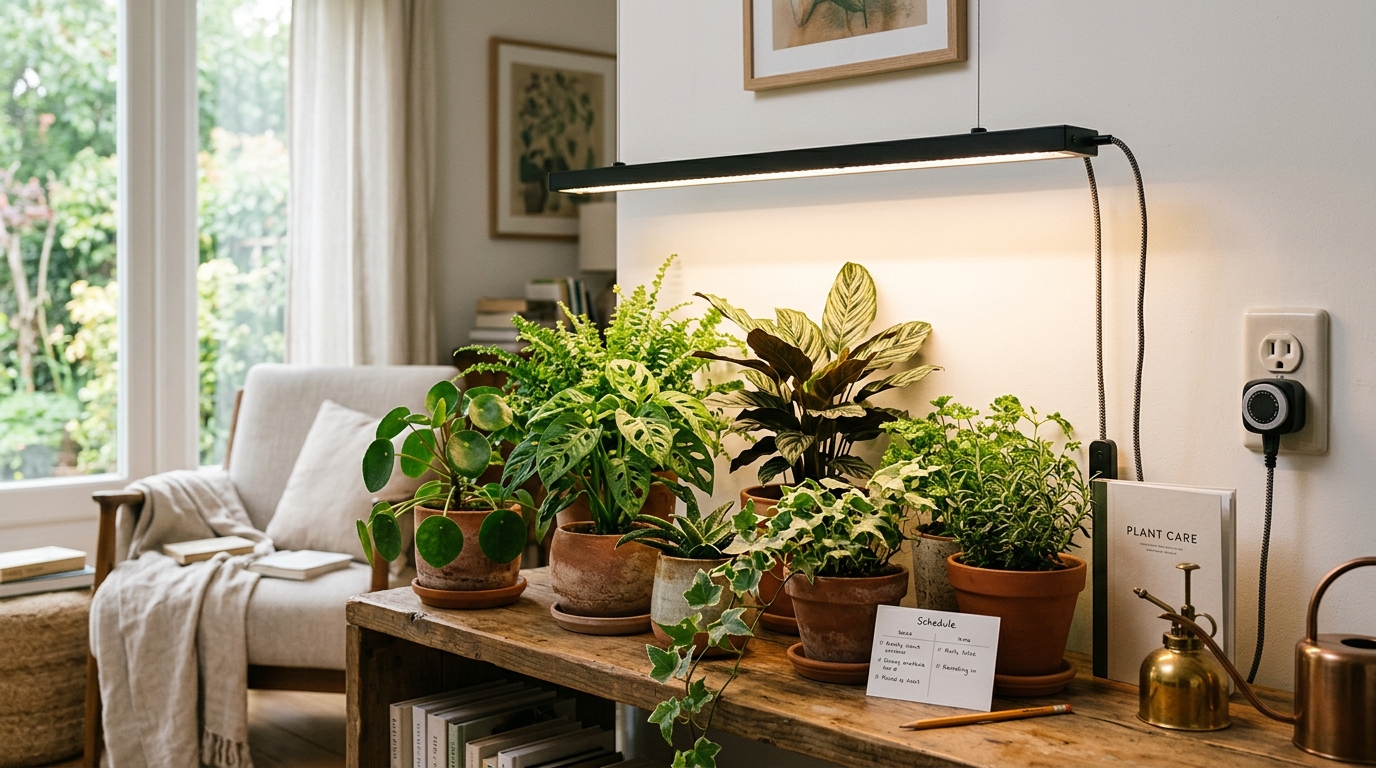
Most indoor plants do best with 14–16 hours of light per day under a grow light. Seedlings need 16–18 hours, leafy greens and herbs thrive at 14–16 hours, and fruiting plants like tomatoes need 12–18 hours depending on growth stage. Set your lights on a timer, give plants at least 6 hours of darkness, and let the schedule run consistently.
How many hours of light do indoor plants need each day?
The answer depends on plant type, growth stage, and light intensity. Here is a practical reference for the most common indoor crops.
| Product | Best for | Rating | Notes | |
|---|---|---|---|---|
| Seedlings (all types) | First 2-4 weeks after germination | ★★★★★ | Seedlings need 16-18 hours of light per day. Without adequate light, seedlings stretch toward the source and become tall, thin, and weak — a problem called etiolation. Keep the light 2-4 inches above seedling trays during this stage. | Check price |
| Leafy greens (lettuce, spinach, kale) | Fastest leaf production with reasonable energy use | ★★★★★ | Leafy greens thrive at 14-16 hours of light per day. They are day-neutral, meaning day length does not trigger flowering, so you have flexibility between 12 and 18 hours. Most growers settle at 16 hours for faster harvests without pushing plants to the limit. | Check price |
| Herbs (basil, parsley, cilantro) | Kitchen countertop growing year-round | ★★★★★ | Herbs need 14-16 hours of light daily. Basil is the most demanding — under 12 hours it grows slowly and may bolt early. A 14-16 hour schedule with moderate-intensity light produces dense, flavorful leaves and steady branching. | Check price |
| Fruiting vegetables (tomatoes, peppers, cucumbers) | Vegetative growth and fruit production | ★★★★★ | Fruiting vegetables need 14-18 hours during vegetative growth and 12-14 hours to trigger and sustain flowering. Tomatoes and peppers are not strictly photoperiod-sensitive, but fruit production improves when light hours drop slightly as plants mature. | Check price |
| Microgreens | High-density tray production indoors | ★★★★★ | Microgreens need 12-14 hours of light per day and prefer moderate intensity compared to mature crops. After the blackout germination period (2-3 days under a cover), expose trays to 12-14 hours of light daily until harvest at 7-14 days. | Check price |
| Succulents and cacti | Supplemental light in low-light rooms | ★★★★☆ | Succulents and cacti need 12-16 hours of light per day but are sensitive to intense heat and over-watering more than under-lighting. Keep the light 12-18 inches away and use a full-spectrum LED. Bleached or scorched patches on leaves indicate the light is too close or too intense. | Check price |
Understanding photoperiod and why it matters
Photoperiod is the number of hours of light a plant receives in a 24-hour cycle. It controls two distinct things: the rate of photosynthesis (more light = more food production up to a point) and, in certain species, whether the plant flowers or stays in vegetative growth.
Day-neutral plants — lettuce, basil, spinach, most herbs, tomatoes, and cucumbers — do not use day length to trigger flowering. You can run them at 14–18 hours without forcing an unwanted reproductive cycle. More hours generally means faster vegetative growth up to about 18 hours, after which the returns diminish and stress responses begin.
Short-day plants flower when the dark period exceeds a threshold — typically 12 hours of darkness per 24-hour cycle. Cannabis is the most common example in indoor growing. Running these plants at 18 hours of light keeps them in vegetative growth indefinitely. Switching to a 12-hours-on, 12-hours-dark schedule triggers flowering. Interrupting the dark period with even a brief light exposure can reset the flowering cycle, which is why light-tight grow tents matter for photoperiod-sensitive crops.
Long-day plants flower when light exceeds a certain threshold — onions, dill, and some lettuce varieties are examples. These are less common in typical indoor growing but worth knowing if you are experimenting with specialty vegetables or annual flowers.
For most indoor food gardens, the practical rule is simple: give plants at least 6 hours of uninterrupted darkness per night, regardless of what you are growing. Continuous light stresses most species and impairs root growth, cellular repair, and overall resilience.
What is DLI and why does it give a better picture than hours alone?
Daily Light Integral (DLI) measures the total amount of photosynthetically active light a plant receives over a 24-hour period, expressed in moles of photons per square meter per day (mol/m2/day).
The reason DLI matters: a weak grow light run for 18 hours can deliver far less total light energy than a high-output LED run for 12 hours. Hours alone does not tell you whether the plant is actually getting enough light to grow well — intensity is equally important.
| Plant Category | Target DLI | At 200 µmol/m2/s | At 400 µmol/m2/s |
|---|---|---|---|
| Seedlings | 10–15 mol/m2/day | 14–21 hours | 7–10 hours |
| Leafy greens and herbs | 12–20 mol/m2/day | 17–28 hours (cap at 18h) | 9–14 hours |
| Fruiting vegetables | 25–40 mol/m2/day | Exceeds practical limits | 18–28 hours (use a brighter light) |
| Microgreens | 8–14 mol/m2/day | 11–20 hours | 6–10 hours |
Practical takeaway: If your grow light is low-output (PPFD under 200 µmol/m2/s at canopy level), running it for 16–18 hours partially compensates for lower intensity. If your light is high-output (PPFD over 400 µmol/m2/s), you can run shorter 12–14 hour schedules and still hit target DLI for leafy greens and herbs. Your light’s manufacturer PPFD map tells you the intensity at different heights — multiply by the hours to estimate DLI.
Grow light schedules by plant stage
Germination and seedling stage (weeks 1–3)
Schedule: 16–18 hours on / 6–8 hours off
Seeds do not need light to germinate — moisture and warmth at 70–75°F trigger sprouting. But the moment seedlings emerge, light becomes critical. Without adequate intensity and duration in the first week, seedlings stretch toward the source and develop thin, weak stems that cannot support the plant later.
A 16- to 18-hour schedule with the light positioned 2–4 inches above the tray gives seedlings enough energy to develop a compact, sturdy structure. If your light is dimmable, run it at 30–50% power during the seedling stage and increase gradually as plants mature — a full-power 600W LED 6 inches from new sprouts will bleach or burn tender growth.
Vegetative stage (weeks 3 through harvest or transplant)
Schedule: 14–16 hours on / 8–10 hours off
Once plants have established a root system and are actively building leaf mass, 14–16 hours of light per day is the standard for most food crops. This gives adequate photosynthetic time while providing an 8- to 10-hour dark period for respiration and root development.
If you are growing leafy greens or herbs, maintain this schedule from vegetative growth through harvest — no adjustment needed. If you are growing fruiting plants like tomatoes or peppers, maintain 14–16 hours through vegetative growth and then reduce to trigger flowering.
Flowering and fruiting stage
Schedule: 12–14 hours on / 10–12 hours off
For tomatoes, peppers, and cucumbers, reducing light hours as plants mature encourages flowering and fruit set. This mimics the natural shortening of days in late summer that outdoor plants use as a cue to transition from growth to reproduction.
For strictly photoperiod-sensitive crops, the transition must be deliberate and consistent. Cannabis, for example, requires a hard 12/12 schedule, and any light interruption during the dark period can delay or disrupt flowering. A light-tight grow tent and a reliable timer are non-negotiable for these crops.
Continuous harvest crops (lettuce, basil, microgreens)
Schedule: 14–16 hours on / 8–10 hours off, unchanged from start to harvest
Crops grown for their leaves rather than fruits stay on the same schedule throughout their life cycle. Lettuce, spinach, kale, basil, cilantro, and microgreens all perform well at a steady 14–16 hours. There is no need to adjust the schedule at any stage.
How to set up a grow light timer
A timer is the single highest-impact and lowest-cost investment in any grow light setup. Running lights on a manual schedule is inconsistent — and inconsistency is one of the most common causes of slow growth and failed flowering in home growing. An 8-hour variance in light exposure over a week adds up to a meaningfully different light environment from the one you intended.
Mechanical outlet timers use a rotating 24-hour dial with push-in pins to set on and off times. No programming, no app, no Wi-Fi. Plug in the light, set the pins once, and walk away. These cost $8–15, handle up to 1875 watts, and last for years without maintenance. They are the right choice for most single-light home setups.
Best for Single grow light, simple no-programming setup
BN-LINK 24-Hour Mechanical Outlet Timer
24-hour mechanical timer with 30-minute interval pins and a 1875-watt rating. Set the on and off times once by pushing the pins in — no display, no programming, no batteries required. The most reliable and lowest-maintenance way to automate a single grow light. Works equally well for heat mats, fans, and water pumps.
★★★★★ 4.6 · 18,700 reviews
Check current price on Amazon→Digital programmable timers allow 1-minute precision and multiple programs per day. These run $12–25 and are worth the upgrade if you want the flexibility to run different schedules on weekdays versus weekends, or if you need to program a complex multi-event schedule like a supplemental lighting period around a south-facing window.
Smart plugs with scheduling (Kasa KP115, Govee, Wyze) work well if you manage other smart devices. You program the schedule through an app and can adjust remotely. The practical limitation is Wi-Fi dependency — if your network goes down, double-check that the plug runs its schedule locally rather than requiring cloud connectivity. Most modern smart plugs store schedules on the device and run them offline, but verify before trusting one with an unattended grow.
Wiring tip for multiple lights: If you run several grow lights in one tent or on one shelf rack, plug them all into a power strip, then plug the power strip into a single timer. One timer controls the entire zone and eliminates the synchronization problem that comes from running individual timers per fixture.
Common grow light schedule mistakes
Running lights 24 hours a day. Continuous light is one of the most common beginner mistakes. It does not speed up growth — it impairs it. Plants need darkness for root development, respiration, and cellular repair. Tip burn on lettuce, leaf curl on tomatoes, and stunted root growth are the most common symptoms of a 24/7 light schedule. The fix is adding an 8-hour dark period.
Inconsistent on/off times. Varying the schedule by 2–3 hours each day causes measurable stress in most plants. Photoperiod-sensitive crops may fail to hold the flowering stage if the dark period is inconsistently interrupted. A timer eliminates this entirely.
Too much intensity at the seedling stage. New growers often position a high-power LED 6–8 inches above seedling trays. The result is bleached or scorched seedling tips within a day or two. Start seedlings at 18–24 inches from a high-output LED and lower the light gradually as plants grow. Most LEDs include a PPFD map that shows intensity at different mounting heights — use it.
Ignoring ambient light from windows. If your grow space receives 4 hours of bright window light per day, that counts toward your DLI total. Adding 16 hours of supplemental grow light on top of a sunny window can push plants past 20 hours of effective light per day — more than most crops need. Adjust supplemental hours down to account for natural light.
Abrupt schedule changes. Shifting from 16 hours to 12 hours overnight shocks fruiting plants and can trigger stress responses including leaf drop and temporary growth stall. If transitioning from vegetative to flowering schedules, taper down by 1 hour every 3–4 days.
What happens when the light schedule is wrong?
Recognizing failure mode symptoms before a crop is lost is the core diagnostic skill in indoor growing.
Leggy, stretched growth. The most obvious sign of too few light hours or too low intensity. Seedlings and young plants stretch vertically, producing elongated internodal spacing and weak stems. Increase hours to the target range for your crop and move the light closer to the canopy.
Tip burn on lettuce and leafy greens. Brown or translucent tips on inner leaves are a calcium deficiency caused by inadequate transpiration — often triggered by running lights too long (18+ hours) with no dark period for the plant to regulate water movement. Reduce to 16 hours and ensure airflow is reaching inner leaves.
Slow leaf production and pale color. Indicates insufficient light reaching target DLI. Check whether the light is positioned too far from the canopy or whether the hours are simply too short for the light intensity available. Check PPFD at canopy height and compare to target DLI for your crop.
Failure to flower. Fruiting plants that remain in vegetative growth past the expected transition point often just need a photoperiod adjustment. Reducing light hours from 16 to 12–14 for tomatoes, or enforcing a strict 12/12 for photoperiod-sensitive varieties, is usually the only change needed.
Timer failure or wrong programming. If plants look randomly stressed with no other obvious cause, check that the timer is actually cycling correctly. Mechanical timers can slip if the dial is not properly seated. Digital timers can lose programming after a power outage. Verify by watching the lights cycle through a full on/off period to confirm they are switching at the programmed times.
FAQ
Frequently asked questions
How many hours a day should I run my grow light?
Can I leave my grow light on 24 hours a day?
What is DLI and do I need to track it?
Do I need a timer for my grow light?
What light schedule triggers flowering in tomatoes and peppers?
Should I adjust my light schedule between summer and winter?
Bottom line
A consistent grow light schedule is one of the easiest wins in indoor gardening, and one of the most commonly neglected. For most crops — leafy greens, herbs, and seedlings — 14–16 hours of light per day on a mechanical timer is all you need to get reliable, consistent growth. Add 2 extra hours for seedlings (16–18), dial back to 12–14 for fruiting plants transitioning to flower, and never skip the dark period.
Set a timer, verify the programming once, and focus the rest of your attention on nutrients, water quality, and plant health. The schedule handles itself from there.
For related reading: best grow light timers, LED vs fluorescent grow lights, how to set up a grow tent, and best grow light bulbs.