guides
Coco Coir vs Perlite: Which Should You Use?
Coco coir holds moisture for roots while perlite drains fast and aerates. Learn when to use each and how to blend them for indoor plants.
 Priya Anand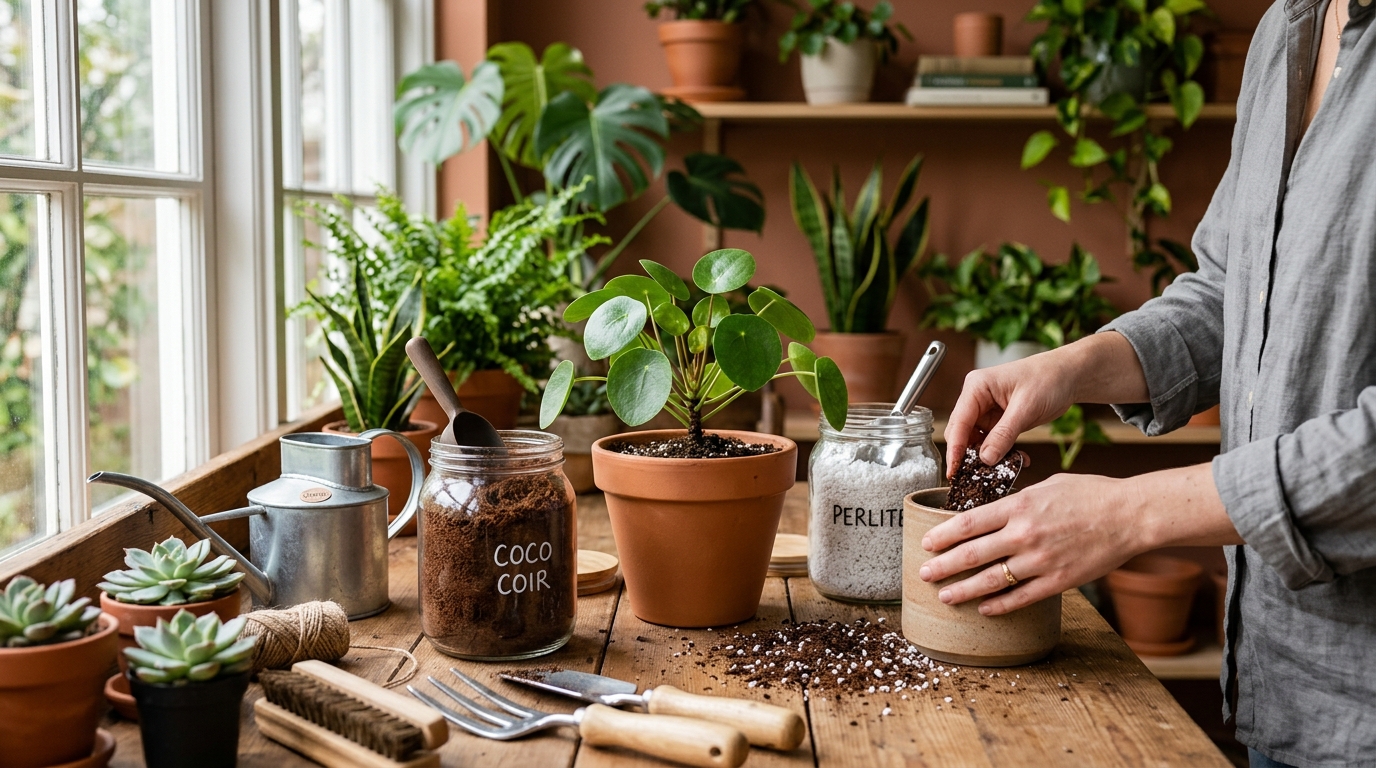
The quick answer: perlite is a drainage amendment that belongs in almost every indoor container — coco coir is a full growing medium that replaces soil entirely. For most growers the right move is both: a 70/30 or 50/50 coco-perlite blend gives faster drainage, higher root oxygen, and reusable performance that straight soil cannot match.
Quick comparison
| Product | Best for | Rating | Notes | |
|---|---|---|---|---|
| Canna Coco Professional Plus | Base substrate for herbs, tomatoes, and peppers in fabric pots | ★★★★★ | Pre-buffered, low salt content. Use at 70% of mix with 30% perlite. 50L bag runs $25-35. | Check price |
| General Hydroponics CocoTek Coir | Beginners wanting a small starter quantity of coco coir | ★★★★☆ | Compressed bricks expand to 18L. $8-12 per brick. Pre-buffered and ready to use straight from the bag. | Check price |
| Mother Earth Coarse Perlite | Mixing into coco or soil for maximum drainage and aeration | ★★★★★ | Coarse grade holds larger air pockets than fine perlite. $15-22 for a 4-cubic-foot bag. Widely available. | Check price |
| General Hydroponics Coarse Perlite | Hydroponic and coco growers needing a consistent perlite grade | ★★★★★ | Uniform coarse grade works well at 30-50% in coco mixes. $12-18 per 8-qt bag. Consistent quality batch to batch. | Check price |
| Pre-mixed Coco Perlite 70/30 | Growers who want a ready-to-use blend without mixing their own | ★★★★☆ | Several brands offer pre-blended 70/30. Convenient but more expensive per volume than mixing yourself. $20-30 for 12 qt. | Check price |
What is coco coir?
Coco coir is the fibrous material from the outer husk of coconuts — a renewable byproduct of the coconut processing industry that would otherwise go to waste. It comes in three physical forms:
- Coco pith (coco peat) — Fine particles with the highest water retention. Excellent moisture buffering but can compact over time if used alone.
- Coco fiber — Long strands that add structure and drainage channels to the mix. Breaks down faster than pith but improves initial aeration.
- Coco chips — Chunky pieces similar to orchid bark. Maximum aeration and drainage, used in specialized blends and mixes for large-rooted plants.
Commercial indoor growing grades typically blend pith and fiber in a ratio that balances moisture retention with aeration. Products like Canna Coco Professional Plus are pre-buffered at the factory to remove excess sodium salts and stabilize pH at 5.8-6.2 before they leave the warehouse.
Coco coir is inert — it contains zero nutrients. From the first watering, plants in pure coco need a complete liquid nutrient solution at every feeding. This is what makes pairing coco with perlite so effective: both are inert, pH-neutral materials that let you control exactly what the root zone receives.
Buffering: the step beginners skip most often
Raw coco coir contains elevated potassium and sodium levels along with low calcium. Before planting in raw coco, you must “buffer” it by soaking in a calcium-magnesium solution so sodium ions are displaced by calcium, creating a stable medium that will not lock out nutrients. Pre-buffered commercial brands like Canna Coco or CocoTek handle this step for you. If you buy a cheap unbuffered compressed brick, plan to soak it in a cal-mag solution for 24 hours before planting.
What is perlite?
Perlite is a naturally occurring volcanic glass that is expanded at high temperatures — around 900°C (1650°F) — until it pops like popcorn. This process creates millions of tiny air pockets inside each white granule, producing an extremely lightweight, pH-neutral material that holds almost no water and creates permanent aeration channels in any mix it joins.
Perlite comes in three grades:
- Fine perlite (1-3mm) — best for seed starting and rooting cuttings where small particle size supports delicate root systems.
- Medium perlite (3-6mm) — the general-purpose grade, suitable for most container growing when mixed at 20-30%.
- Coarse perlite (6-12mm) — best for mature plants in larger pots and for mixing into coco, where larger air pockets prevent compaction and support high-frequency watering without waterlogging.
Unlike coco coir, perlite does not compress or degrade structurally over time. It can be cleaned and reused indefinitely — rinse old perlite with water, soak in a diluted hydrogen peroxide solution for 30 minutes to kill pathogens, rinse again, and it performs the same as new.
How coco coir and perlite compare on every major factor
Water retention
Coco coir retains water extremely well — roughly 8-10 times its dry weight. This moisture retention is a feature: it keeps the root zone consistently hydrated between waterings. The trade-off is that in pure coco with high watering frequency, the medium can stay too wet near the bottom of the pot, creating risk of root rot.
Perlite retains essentially no water — around 5-10% of its weight. What it does instead is create macro-pores that fill with air immediately after drainage. When you mix perlite into coco, the perlite granules form permanent drainage channels throughout the mix so excess water passes through rather than pooling.
Practical result: pure coco in a 5-gallon pot stays wet enough that daily watering is productive but risky for less experienced growers. Add 30% coarse perlite and the same pot becomes far more forgiving — water drains faster, the mix dries more evenly, and you can water slightly imprecisely without the same root rot risk.
Aeration and root oxygen
Root oxygen is one of the highest-leverage variables in plant growth. The faster roots can access oxygen, the faster they expand and the more nutrients they can absorb. Both coco coir and perlite outperform standard potting soil in aeration, but perlite is the more direct contributor.
Coco coir holds 8-30% of its volume as air even at full saturation — compared to 1-8% for most dense potting soils. Perlite adds another layer: its internal pores and the macro-channels between granules keep air circulating through the root zone even in a freshly watered pot.
A 70/30 coco-perlite blend typically holds 20-35% air volume at field capacity, which sits in the ideal range for most edibles. This is a key reason why coco-perlite blends produce noticeably faster growth than soil for tomatoes, peppers, cucumbers, and similar plants.
pH
Both materials are pH-neutral, which is one reason they pair so well. Coco coir sits naturally at pH 5.8-6.5. Pre-buffered coco arrives at 5.8-6.2 and holds that range when fed a balanced nutrient solution. Perlite runs pH 7.0-7.5 out of the bag — which sounds high, but it has no buffering capacity and quickly equilibrates to whatever pH your nutrient solution carries.
In a coco-perlite blend, you still need to adjust the pH of your nutrient solution before each watering. Target 5.8-6.2 for most edibles. Adding perlite does not remove the need for pH management in a coco-based system.
Weight and pot dynamics
Perlite is dramatically lighter than coco coir by volume. A cubic foot of dry coco coir weighs roughly 10-15 pounds; the same volume of dry perlite weighs 3-5 pounds. Adding 30% perlite to a coco mix makes your pots significantly lighter, which matters if you grow on weight-limited shelving or need to move containers regularly.
Lighter pots also make it easier to gauge moisture level by lifting — a technique that works well in coco-perlite but poorly with dense soil. A light pot means dry and ready to water; a heavy pot means it is still holding moisture.
Reusability
Both materials are reusable, but differently:
- Perlite: clean and reuse indefinitely. Rinse with plain water, soak in a 1% hydrogen peroxide solution for 30 minutes to kill pathogens and root debris, rinse again, and it is ready for the next cycle. No structural degradation.
- Coco coir: reusable for 2-3 grow cycles. After that, coco pith compresses and drainage slows. Flush coco with plain water after harvest, dry it completely, then re-buffer with a calcium-magnesium soak before reuse. Signs it needs replacing: water drains slowly and the medium stays wet longer than a fresh batch would.
First-cycle cost comparison
| Item | Cost |
|---|---|
| Canna Coco Pro Plus (50L) | $25-35 |
| Coarse perlite (8 qt) | $12-18 |
| Nutrients (two-part, per cycle) | $15-25 |
| Cal-Mag supplement | $12-18 |
| Total first cycle (coco-perlite blend) | $65-95 |
Subsequent cycles drop to $30-45 once the growing medium is being reused and equipment is already in hand. Adding 30% perlite to the blend is worth the extra $12-18 outlay for the drainage insurance it provides.
The right ratio: how much perlite to add to coco coir
The ideal coco-perlite ratio depends on the plant, pot size, and how often you water:
70% coco / 30% perlite — The standard blend for most indoor edibles. Retains enough moisture to allow daily watering while draining fast enough to prevent waterlogging. Recommended for tomatoes, peppers, herbs, and leafy greens in 3-7 gallon pots.
50% coco / 50% perlite — Maximum drainage for growers who water multiple times per day or run automated drip systems. Also a good choice for large containers (10+ gallons) where the center of the pot dries more slowly than the edges. Can become too dry too quickly if you only water once a day.
80% coco / 20% perlite — Works for plants that prefer more consistent moisture, like basil and shallow-rooted herbs. Best in smaller pots (1-2 gallons) or with a drip system delivering small amounts frequently.
For a starting point, the 70/30 blend is hard to beat. It is forgiving enough for once-daily manual watering while delivering the drainage performance that coco grows are known for. Several brands offer a pre-blended 70/30 if you want to skip the measuring step.
When to use coco coir without adding perlite
There are specific situations where straight coco coir — without any perlite addition — makes sense:
- Automated drip systems with high frequency: if a drip timer delivers small volumes of nutrient solution every 1-2 hours, pure coco drains and re-oxygenates on its own without needing perlite to prevent waterlogging. Commercial greenhouse operations often run pure coco with timed drip.
- Compressed coco plugs for cloning: seedling plugs and cloning domes use small compressed coco peat forms with no perlite. The small volume dries quickly enough that extra aeration is not needed.
- Plants preferring higher moisture: some tropical houseplants and orchids in small pots benefit from slightly higher moisture retention than a perlite-heavy blend provides. Pure coco holds moisture longer and can suit these plants.
When to use perlite without coco coir
Perlite alone — without coco as the base — has its own specific uses:
- Cloning and propagation: many growers root cuttings directly in pure coarse perlite, kept moist with plain water or a diluted cloning solution. The high aeration keeps cuttings from rotting while holding enough moisture at the stem base for root initiation.
- Amending potting soil: adding 20-30% perlite to any standard potting mix dramatically improves drainage without requiring a switch to a full coco growing system. This is the simplest upgrade for soil growers experiencing root rot or slow growth.
- Kratky passive hydroponics: perlite is a common choice in net cup inserts for kratky jars, supporting the plant stem while roots grow down into the nutrient solution below.
- Top-dressing against fungus gnats: a 1-inch layer of pure perlite on the surface of any growing medium creates a dry, inhospitable top layer that deters fungus gnats from laying eggs in the substrate.
What you need to run a coco-perlite grow
To successfully grow in a coco-perlite blend indoors, here is the complete equipment list:
- Pre-buffered coco substrate: Canna Coco Professional Plus or CocoTek bricks. Avoid unbuffered bricks without a 24-hour cal-mag pre-soak.
- Coarse perlite: Mother Earth Coarse Perlite or General Hydroponics Coarse Perlite. Coarse grade (6-12mm) outperforms fine grade in most container sizes at 30%.
- Liquid nutrients: a two-part or three-part hydroponic nutrient solution applied at every watering. Coco-perlite is inert and provides zero nutrition.
- Cal-Mag supplement: coco fibers bind calcium ions, creating a consistent calcium and magnesium demand at every feeding. Add 3-5 ml per gallon of GH CaliMagic at every watering in coco.
- Digital pH meter: test and adjust every nutrient solution to 5.8-6.2 before watering. An Apera PH20 ($35-50) holds calibration well and is the standard grower choice.
- pH Down solution: most tap water runs 7.0-8.0 and needs adjusting before use in an inert coco system.
- Fabric pots: coco-perlite and fabric pots are an ideal pairing. Air pruning from the fabric sides keeps root tips healthy and prevents root circling. Use 3-5 gallon fabric pots for most indoor edibles.
FAQ
Frequently asked questions
Can I mix coco coir and perlite together, or do I use them separately?
Do I need to pH my water if I use a coco perlite mix?
How often should I water plants in a 70/30 coco perlite blend?
Does adding perlite change the nutrient requirements in coco?
Is it possible to use too much perlite in a coco mix?
Can I reuse the coco perlite blend after a grow cycle?
Bottom line
Coco coir and perlite are not competing choices — they are complementary materials that work best together. Use coco coir as your primary growing medium and perlite as the aeration amendment that prevents it from holding too much moisture.
Start with a 70/30 coco-perlite blend using pre-buffered coco like Canna Coco Professional Plus and Mother Earth Coarse Perlite. Add cal-mag at every watering, pH your nutrient solution to 5.8-6.2, and grow in fabric pots. This combination outperforms straight soil for most indoor edibles and is the setup most experienced indoor growers run.
Explore further: soil vs coco coir for a full comparison of coco against potting soil, how to fertilize indoor plants for nutrient schedules that work in coco-perlite blends, diy hydroponics guide if you want to take the next step beyond substrate growing, and how to set up a grow tent to build the ideal controlled environment for your indoor garden.