guides
Soil vs Coco Coir: Which Growing Medium Is Better?
Coco coir drains better and grows faster than potting soil, but needs nutrients from day one. Here is when to use each for indoor plants.
 Priya Anand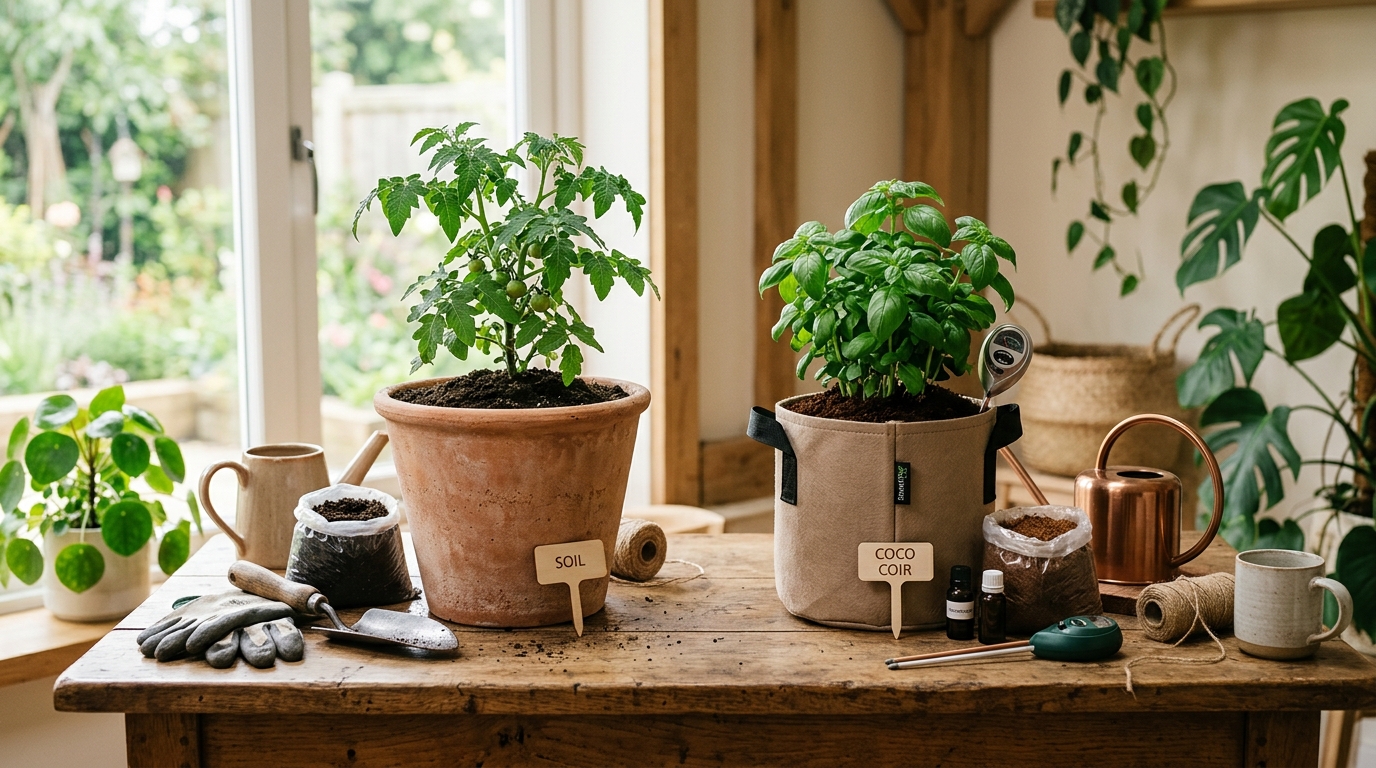
The verdict up front: for most indoor gardeners, quality potting soil is the better starting point — it comes with nutrients, forgives watering errors, and works without a separate fertilizer regimen. Coco coir grows plants faster with better drainage and less root rot risk, but demands nutrients from day one and pH management at every watering.
Quick comparison
| Product | Best for | Rating | Notes | |
|---|---|---|---|---|
| FoxFarm Ocean Forest Potting Soil | First indoor garden and plants needing minimal intervention | ★★★★★ | Pre-loaded with earthworm castings and bat guano. No fertilizer needed for 4-6 weeks. $13-20 for 12 qt. | Check price |
| Espoma Organic Potting Mix | Organic growing and plants you want to keep long-term | ★★★★★ | OMRI-listed, mycorrhizae included for root development. $10-15 for 8 qt. Great all-around indoor mix. | Check price |
| Canna Coco Professional Plus | Fast-growing herbs, tomatoes, and peppers in fabric pots | ★★★★★ | Pre-buffered, low salt content, no extra preparation needed. 50L bag runs $25-35. The standard choice for coco grows. | Check price |
| General Hydroponics CocoTek | Beginners wanting a smaller coco coir starter quantity | ★★★★☆ | Available in compressed 5L bricks that expand to 18L. $8-12 per brick. Good entry point for a first coco trial. | Check price |
| 50-50 Coco and Perlite Blend | Maximizing drainage while keeping moisture for heavy feeders | ★★★★★ | Mix coco coir 50/50 with perlite. Ideal for tomatoes and peppers in 3-5 gallon fabric pots. Cheapest customizable option. | Check price |
What is coco coir?
Coco coir is the fibrous material extracted from the outer husk of coconuts. It is a byproduct of coconut processing — material that would otherwise be discarded — which makes it more sustainable than peat moss, which comes from slow-regenerating bogs.
Coco coir comes in three textures:
- Coco pith (coco peat) — Fine, soil-like particles with the highest water retention. Holds moisture well but can become compacted on its own.
- Coco fiber — Long fibers that improve aeration and drainage but dry out quickly and break down over time.
- Coco chips — Chunky pieces similar to orchid bark. Excellent drainage and aeration, suitable for orchids and larger-rooted plants.
Most commercial coco mixes for indoor growing use a blend of pith and fiber. Products like Canna Coco Professional Plus are pre-buffered to remove excess salts and stabilize pH at 5.8-6.2 before they leave the factory.
Buffering: the step most beginners skip
Raw coco coir contains high levels of potassium and sodium and low levels of calcium and magnesium. Before use, raw coco must be “buffered” — soaked in a calcium-magnesium solution so sodium ions are displaced by calcium, creating a stable medium that will not lock out nutrients. Pre-buffered brands handle this step for you. If you buy a cheap unbuffered brick, plan to soak it in a cal-mag solution for 24 hours before planting.
What is potting soil?
Potting soil — more accurately called “potting mix” since most commercial products contain no actual field soil — is a blend of materials engineered for containers. A good indoor potting mix contains some combination of peat moss or coco coir, perlite or vermiculite for drainage, and organic matter like compost, bark, or worm castings.
Quality indoor mixes like FoxFarm Ocean Forest come pre-loaded with nutrients that feed plants for 4-6 weeks. After that window, you begin liquid fertilizer on a schedule. The buffering capacity of organic matter in soil gives you significantly more time to respond to pH swings, nutrient imbalances, and watering mistakes before damage shows up in leaves.
The key is using a quality potting mix rather than cheap garden soil. Outdoor soil in containers compacts over time, restricts drainage, and can introduce outdoor pests and pathogens indoors.
How soil and coco coir compare on every major factor
Drainage and root health
Coco coir wins on drainage. Coco holds 8-30% of its volume as air even when fully saturated — meaning the root zone stays oxygenated even immediately after watering. This property makes coco far harder to waterlog than most soil mixes. For growers who tend to water frequently, coco actually provides a measure of safety: you can water daily without drowning roots, as long as there are drainage holes in the pot.
Potting soil drainage varies by brand. Premium mixes like FoxFarm Ocean Forest include perlite and drain well. Cheap potting soils can become heavy and waterlogged in small pots. Adding 20-30% extra perlite to any soil mix significantly improves drainage and root oxygen availability.
Nutrient management
Soil wins on simplicity. A quality potting mix feeds plants for the first 4-6 weeks with no input from you. For beginners growing herbs or leafy greens, this is a significant practical advantage.
Coco coir is inert and provides zero nutrients. From the first watering, you need to mix and apply a complete nutrient solution every time. For coco growing, this means a two or three-part liquid fertilizer (like General Hydroponics Flora Series) mixed at feeding strength every watering session. There is no grace period the way there is with pre-loaded soil.
Coco also has a specific calcium-magnesium demand. Coco fibers bind calcium ions, pulling them away from plant roots. You need a cal-mag supplement ($12-18) added to every feeding in coco, or plants will show magnesium deficiency — yellowing between leaf veins — within a few weeks.
Growth speed
Experienced coco growers report 20-40% faster growth compared to equivalent soil setups, thanks to higher oxygen availability at the root zone and the ability to deliver precise, high-frequency nutrition. The more often you feed, the faster plants can grow — coco enables daily or twice-daily fertigation (watering with nutrients mixed in) that soil cannot sustain without waterlogging.
For beginners feeding once or twice per week, the growth difference over soil is minimal. The speed advantage of coco is closely tied to how frequently you water and how precisely you dial in your nutrient solution.
pH management
Coco coir runs at a natural pH of 5.5-6.5, which is ideal for most vegetables and herbs — especially when paired with hydroponic-style nutrients. Soil runs pH 6.0-7.0, which suits a broad range of plants but is slightly higher than the optimal nutrient uptake window for many edibles.
In practice, pH management in soil is passive. The organic matter buffers pH changes naturally, and most plants in a quality potting mix never show pH-related deficiencies if you are using a balanced fertilizer. In coco, you need to measure and adjust the pH of your nutrient solution before every single watering, targeting 5.8-6.2. If your tap water runs above 7.0 (typical in most cities), you will need pH Down solution ($8-12) and a digital pH meter at every feeding.
Reusability and sustainability
Coco coir wins on both counts. Coconut husks are a renewable byproduct of an existing food industry rather than mined from irreplaceable peat bogs. After a grow cycle, flush coco thoroughly with plain water to remove salt buildup, allow it to dry, and store it for reuse. Most coco substrates remain viable for 2-3 grow cycles before texture degrades and drainage slows.
Standard potting soil is harder to reuse. Organic matter breaks down and compacts over time, and you cannot restore it to original structure without significant re-amendment. Most indoor gardeners replace potting soil every 12-18 months.
First-time cost comparison
| Item | Soil setup | Coco coir setup |
|---|---|---|
| Growing medium (per 12 qt equivalent) | $13-18 (FoxFarm Ocean Forest) | $8-12 (coco brick expands to 18L) |
| Nutrients needed from day one | No (4-6 weeks pre-loaded) | Yes ($20-35 starter nutrients) |
| pH meter needed | No | Yes ($25-45) |
| pH Down solution | No | Yes ($8-12) |
| Cal-Mag supplement | Optional | Required ($12-18) |
| Total first-time cost | $15-30 | $75-120 |
After the first cycle, coco becomes more cost-efficient because the medium is reused and the equipment is already paid for.
When to choose coco coir
Choose coco coir when:
- You are growing fast-maturing edibles — tomatoes, peppers, fruiting herbs — and want to push growth rates as high as possible.
- You already have experience keeping plants alive and want the next level of control over nutrition and root health.
- Root rot or overwatering has been a recurring problem. Coco drainage makes it structurally harder to waterlog roots.
- You want to reduce peat usage. Coco is the standard eco-friendly alternative to peat-based mixes.
- You are setting up a drip or automated watering system. Coco works exceptionally well with high-frequency, low-volume drip feeding.
- You plan multiple grow cycles per year. Reusability makes coco increasingly cost-efficient per harvest over time.
The most practical coco starter: Canna Coco Professional Plus in 3-gallon fabric pots, fed with General Hydroponics Flora Series and cal-mag at every watering.
When to choose potting soil
Choose potting soil when:
- This is your first indoor garden. Pre-loaded nutrients and pH buffering let you focus on learning light and watering cadence rather than nutrient chemistry.
- You grow ornamentals or houseplants alongside edibles. Soil handles the widest range of plant types without adjustment.
- You water infrequently or inconsistently. Soil holds moisture longer and forgives gaps in your routine better than coco.
- You want minimal equipment. No pH meter, no nutrient mixing, no cal-mag required.
- Budget is limited. A $15-20 soil setup gets you growing the same day versus $75-120 for a proper coco setup.
- You grow woody herbs or long-lived plants. Rosemary, thyme, lavender, and similar plants do best in well-draining soil with stable, organic pH buffering that coco does not provide on its own.
The hybrid approach: coco-soil blends
Many indoor growers settle on a blend rather than choosing one medium exclusively. A practical mix is 30-40% coco coir added to a quality potting mix, which improves drainage and aeration without requiring the full coco nutrient management system.
This hybrid approach gives you:
- Faster drainage than pure soil
- Some buffering from the soil organic matter
- Reduced waterlogging risk compared to plain soil
- No requirement for separate pH adjustment or cal-mag at typical watering frequencies
Mixing equal parts FoxFarm Ocean Forest and coco coir, plus 20-30% perlite for extra drainage, creates a versatile substrate for herbs to tomatoes that performs well with moderate watering. This is arguably the best upgrade for someone who wants better results than plain soil but is not ready for full coco growing.
What you need if you go full coco
If coco is the right choice for your setup, here is the minimum equipment list:
- Pre-buffered coco substrate: Canna Coco Professional Plus or CocoTek bricks. Avoid unbuffered generic bricks without a 24-hour cal-mag soak first.
- Two or three-part nutrient solution: General Hydroponics Flora Series is the most widely used for coco. Start at half-strength while plants establish.
- Cal-Mag supplement: Add 3-5 ml per gallon at every watering in coco. GH CaliMagic is the standard option.
- Digital pH meter: The Apera Instruments PH20 ($35-50) holds calibration well and is worth the investment.
- pH Down solution: Brings tap water from the typical 7.0-8.0 down to the 5.8-6.2 target range.
- Fabric pots: Coco and fabric pots pair extremely well — fabric allows air pruning and helps prevent salt buildup. 3-5 gallon fabric pots are the right size for most indoor edibles.
FAQ
Frequently asked questions
Can I use coco coir straight out of the bag without buffering?
How often do I need to water plants in coco coir?
Do I need a pH meter for coco coir?
Is coco coir the same as peat moss?
Can I reuse coco coir after a grow cycle?
Which is better for indoor tomatoes — soil or coco?
Bottom line
For first-time indoor gardeners and anyone growing a single herb pot or ornamentals, start with quality potting soil — it requires less equipment, less daily monitoring, and lets you build the habit of consistent care without managing nutrient chemistry. FoxFarm Ocean Forest or Espoma Organic Potting Mix are strong first choices.
For anyone growing edibles at volume, running multiple crop cycles per year, or who has already mastered basic indoor plant care, coco coir delivers measurably faster growth and better drainage with the right nutrient system in place. The $50-80 equipment cost (pH meter, nutrients, cal-mag) pays back through faster harvests and a reusable medium.
The best middle ground: mix 30-40% coco coir into your existing potting soil to gain drainage and aeration benefits without switching to full coco management.
Explore further: hydroponics vs soil for a comparison of the next growing method step up, best potting soil for vetted soil recommendations, how to fertilize indoor plants for nutrient schedules that work in both mediums, and how to water indoor plants to master the habit that matters most regardless of which medium you choose.