guides
Aquaponics vs Hydroponics: Which Should You Choose?
Aquaponics adds fish to create a self-sustaining ecosystem; hydroponics is faster and cheaper to start. Here is how to choose for your indoor garden.
 Priya Anand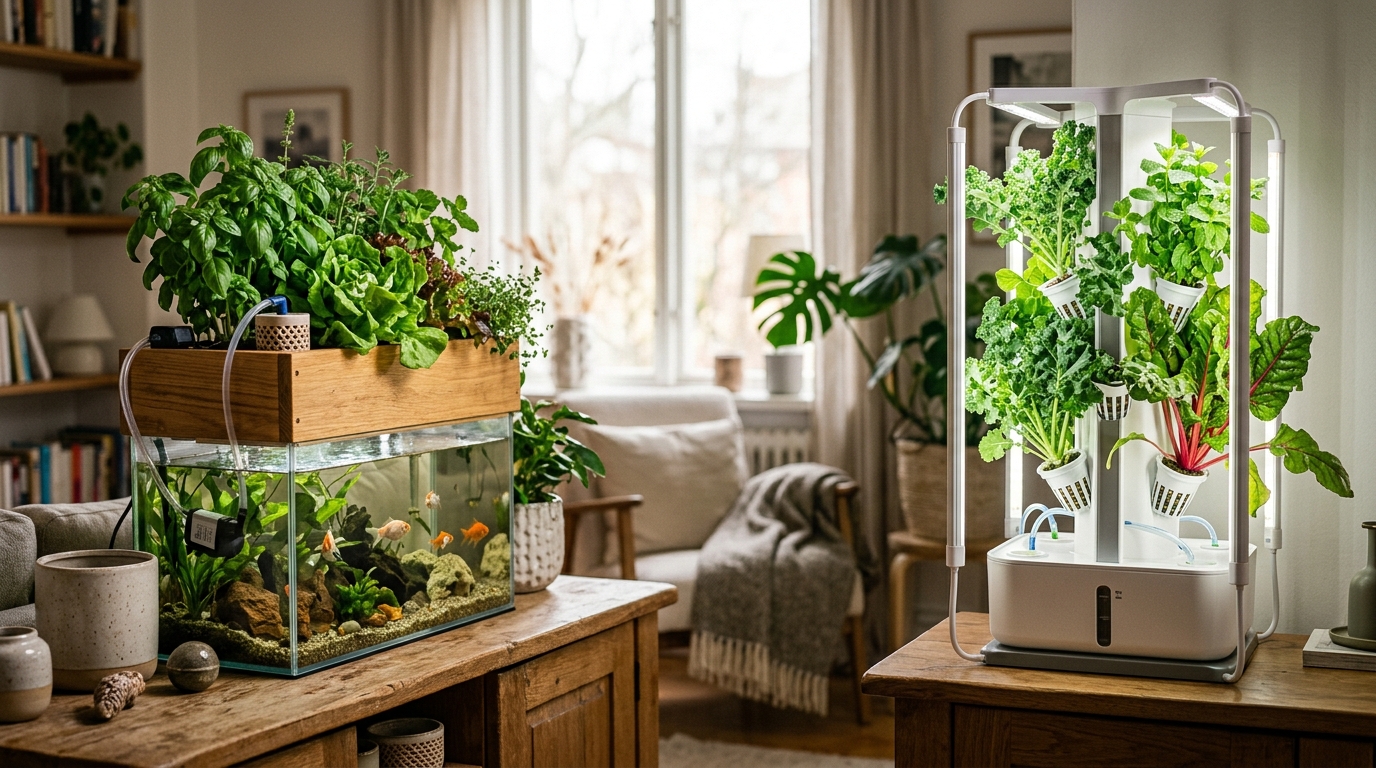
The verdict up front: hydroponics is the better choice for most indoor growers — lower startup cost ($50-300), faster plant growth, and no live animals to care for. Aquaponics builds a self-sustaining fish-plant ecosystem that is nearly fertilizer-free once running, but requires a $300-800 investment and fish husbandry knowledge that adds real complexity.
Quick comparison
| Product | Best for | Rating | Notes | |
|---|---|---|---|---|
| Kratky passive hydroponics | Beginners wanting the simplest possible hydroponic start | ★★★★☆ | Mason jar plus net cup plus nutrient solution. No pump, no electricity beyond a grow light. $15-30 to start per plant. | Check price |
| AeroGarden Bounty (9-pod) | Turnkey hydroponic herb and lettuce garden with no setup complexity | ★★★★★ | $130-170. Integrated LED, auto-watering alerts, Wi-Fi app. Best plug-and-play hydroponic system. | Check price |
| General Hydroponics WaterFarm DWC | Single-plant deep water culture for faster tomato and pepper growth | ★★★★☆ | $40-70. Air pump, 4-gallon bucket, drip ring. Proven DWC format used by home and commercial growers. | Check price |
| Aquaponics starter kit (10-20 gallon) | Growers who want a fish-plant ecosystem and are comfortable with tank care | ★★★★☆ | $150-350. Includes grow bed, fish tank, pump, and media. Typically grows goldfish or tilapia with lettuce and herbs. | Check price |
| Aquaponics system (50-100 gallon) | Serious home aquaponics with enough fish to meaningfully fertilize plant production | ★★★★☆ | $300-800. Supports 5-15 fish and 10-30 plant sites. Needs dedicated space and a stable room temperature. | Check price |
How hydroponics works
Hydroponics grows plants in a water-based nutrient solution without soil. Roots are suspended in or periodically flooded with oxygenated, pH-balanced water that contains every element the plant needs — nitrogen, phosphorus, potassium, calcium, magnesium, and trace minerals — in exact ratios you control.
The most common indoor hydroponic methods:
Kratky (passive) — The simplest method. Fill a mason jar or opaque container with nutrient solution, suspend a net cup with a seedling, and let roots grow down as plants consume the water. No pump or electricity beyond a grow light. Cost: $15-30 per plant. Best for lettuce and herbs.
Deep Water Culture (DWC) — Roots hang in aerated nutrient solution continuously. An air pump and air stone keep water oxygenated. Faster than Kratky and handles larger plants like tomatoes and peppers. Entry cost: $40-80 per single-bucket setup. See the best hydroponic systems guide for full DWC comparisons.
NFT (Nutrient Film Technique) — A thin stream of nutrient solution flows continuously over bare roots in channels. Common in vertical tower setups. Efficient but pump-dependent; a power outage can kill plants in hours.
All-in-one smart gardens (AeroGarden, LetPot) — Pre-engineered systems with integrated LED, pump timer, and nutrient alert. The AeroGarden Bounty is the benchmark model: 9 pods, 30W LED, Wi-Fi, $130-170. Best plug-and-play entry into hydroponics.
Hydroponics grows leafy greens, herbs, cherry tomatoes, peppers, and strawberries exceptionally well indoors. Root vegetables and large vining crops are poor fits.
How aquaponics works
Aquaponics combines hydroponics and aquaculture (fish farming) into a single recirculating system. Fish produce ammonia-rich waste. Beneficial bacteria convert that ammonia first into nitrites, then into nitrates — the primary nitrogen source that feeds plants. Plant roots absorb the nitrates, cleaning the water, which returns to the fish tank.
The cycle works like this:
- Fish eat and produce waste in a tank, releasing ammonia into the water
- Nitrifying bacteria (Nitrosomonas, Nitrobacter) colonize grow media and convert ammonia to nitrite, then nitrate
- Plant roots absorb nitrates as fertilizer while filtering the water
- Cleaned water returns to the fish tank via pump or gravity flow
This loop becomes largely self-sustaining once the system cycles — the 4-6 week startup period during which bacterial colonies establish. You add an ammonia source (either from fish or a cycling supplement like Dr. Tim’s Ammonium Chloride) during this period while monitoring ammonia, nitrite, and nitrate levels daily until bacteria stabilize.
Common fish for home aquaponics:
- Goldfish — Coldwater, widely available, tolerant of beginner mistakes. Not edible but ideal for learning the system without pressure.
- Tilapia — The standard aquaponics fish. Fast-growing, warm-water (72-82°F), edible, and tolerant of dense stocking. Require a heater in most climates.
- Catfish — Tolerant, edible, and bottom-feeding so they clean waste from the tank floor efficiently.
- Koi — Ornamental and cold-tolerant. Used in outdoor or semi-outdoor aquaponics setups.
Common grow systems used in aquaponics:
- Media beds — Gravel, hydroton, or lava rock-filled troughs flooded and drained in cycles. Bacteria colonize the media. Grow nearly any plant, including tomatoes and peppers. Best approach for beginners.
- Raft (DWC) beds — Floating foam boards with net cups over a deep water channel. Excellent for leafy greens at volume. Requires a separate biofilter tank for bacterial colonization.
- NFT channels — Same as hydroponic NFT but fed with fish-conditioned water instead of synthetic nutrients.
An indoor aquaponics starter kit typically includes a fish tank, a grow bed, a pump, growing media, and sometimes a basic test kit. Expect to spend $150-350 for a 10-20 gallon starter and $300-800 for a 50-100 gallon system capable of producing meaningful fish and plant harvests.
The critical differences
Cost to get started
Hydroponics wins on startup cost, and the gap is significant:
- Kratky hydroponic (per plant): mason jar + net cup + hydroton + pH-adjusted nutrients = $15-30
- AeroGarden Bounty (9 plants, integrated light): $130-170
- DWC bucket (single plant): $40-80
- Aquaponics starter (10-20 gallon, 2-6 plant sites): $150-350
- Aquaponics (50-100 gallon, 10-30 plant sites): $300-800
Aquaponics systems cost more because they include both a fish tank and a grow system, plus a biofilter or bacterial-colonization substrate. You also need a water test kit ($20-40 for a liquid reagent kit like API Freshwater Master Test Kit), a heater if you use warm-water fish ($15-30), and fish food ($10-20 for a starter bag).
Ongoing costs
This is where aquaponics has a long-term edge. Once the bacterial colony establishes:
- Aquaponics ongoing: fish food (~$1-3 per week), water top-off for evaporation loss, occasional pH adjustment, electricity for pump and light. Near-zero fertilizer cost.
- Hydroponics ongoing: nutrient solution ($20-50 per bottle, lasts 3-6 months for small setups), pH adjustment solution ($8-12 per bottle), growing media replacement, electricity for pump and light.
For a small 6-plant hydroponics setup, ongoing nutrient costs run $50-100 per year. Aquaponics replaces this with fish food and minimal inputs once the system is established. Over 2-3 years, aquaponics can reach a lower total cost of ownership — but only if the system runs without major fish losses or disease events.
Plant growth speed
Hydroponics consistently outgrows aquaponics by 20-30% for lettuce and herbs in comparable setups. The reason: with synthetic nutrients, you dial in exact concentrations at every stage of plant growth. Aquaponics nutrient levels fluctuate with fish load, feeding rate, bacterial efficiency, and seasonal temperature changes. You can optimize an aquaponics system to narrow this gap, but you cannot eliminate it without adding supplemental nutrients — which partially defeats the purpose.
The difference matters less than it sounds for home growers. Both systems grow lettuce in 4-6 weeks and basil to full harvest size in 5-7 weeks. Neither speed is the primary reason most people choose aquaponics.
Maintenance and monitoring
A well-tuned hydroponics system requires:
- pH testing every 3-7 days (target 5.5-6.5)
- EC/TDS (nutrient concentration) testing every 1-2 weeks
- Reservoir refills every 1-2 weeks
- Weekly visual inspection for pests and root health
Aquaponics requires all of that plus:
- Daily fish observation — are they eating? showing abnormal behavior? color changes?
- Ammonia, nitrite, and nitrate testing (critical during cycling; weekly once stable)
- Water temperature monitoring (especially for warm-water fish like tilapia)
- Feed regulation — uneaten food rots and spikes ammonia rapidly
- Contingency planning for fish illness or sudden die-off
Fish are living animals that require consistent care. A week-long vacation requires someone to feed the fish and monitor the tank. You cannot pause aquaponics the way you can reduce a hydroponic reservoir and lower light intensity to stretch between maintenance visits.
What goes wrong
Hydroponic failure modes: pH drift (most common beginner issue), nutrient burn from over-concentration, root rot from inadequate oxygenation, pump failure, algae bloom from light reaching the reservoir. All are recoverable with prompt diagnosis and correction.
Aquaponics failure modes: failed cycling (the most common beginner mistake — fish die before bacteria establish), fish disease (ich, fin rot, bacterial infections), ammonia spike from overfeeding or overstocking, power outage killing warm-water fish if pump stops for more than a few hours. Fish die-off is often sudden, and replacing fish repeatedly before cycling completes is the top reason beginners abandon aquaponics altogether.
Yield and what you can harvest
Both systems grow the same plant varieties well — leafy greens, herbs, compact fruiting plants. Aquaponics adds a food source that hydroponics never offers: edible fish. A 100-gallon aquaponics system stocked with tilapia at a reasonable density (1 lb of fish per gallon of water is the common stocking guideline) can produce 10-15 lbs of tilapia per year alongside continuous herb and greens harvests.
If home protein production is part of your goals, this changes the economics significantly. Aquaponics becomes a different category of home food production — not just a growing method for vegetables.
When hydroponics is the right choice
Choose hydroponics when:
- This is your first soilless garden. The learning curve is real but manageable. Aquaponics adds fish husbandry on top, doubling the variables to manage simultaneously.
- You want the fastest possible plant growth. Synthetic nutrients at dialed-in concentrations beat fish-fertilized water every time.
- Your budget is under $200. A complete Kratky or DWC setup with nutrients and a grow light runs $50-150. Aquaponics does not start well below $200.
- You travel or cannot guarantee daily care. A well-sealed hydroponic reservoir can go 10-14 days with minimal attention. Fish cannot.
- Space is very limited. An AeroGarden on a kitchen counter is a legitimate hydroponics setup. Aquaponics needs a fish tank plus a grow bed — minimum 3-5 sq ft of dedicated space.
- You want herbs and greens, not fish. There is no meaningful advantage to aquaponics if you have no interest in the fish output.
The best entry points: a Kratky starter setup at $15-30 per plant (no pump required) or the AeroGarden Bounty for an all-in-one system with integrated lighting.
When aquaponics is the right choice
Choose aquaponics when:
- You want a self-sustaining ecosystem. Aquaponics is genuinely fascinating as a miniature closed-loop food system. The biology is rewarding in a way that hydroponics is not.
- You want edible fish alongside your greens. Tilapia from a 50-100 gallon home system is a real, meaningful protein source.
- You are comfortable with aquarium care. If you have kept a healthy aquarium, aquaponics is a natural next step — the fish-keeping skills transfer directly.
- Long-term fertilizer cost is a concern. A well-established aquaponics system produces plant nutrients essentially for free (beyond fish food) indefinitely.
- You have dedicated space. A 50-100 gallon system needs 10-20 sq ft and a stable room temperature of 65-82°F depending on fish species.
- You want an educational system for children. The visible connection between fish, bacteria, and plants makes aquaponics an outstanding learning tool about ecosystems.
For setup guidance, the DIY hydroponics guide covers nutrient management fundamentals that transfer directly to aquaponics water chemistry, and is a good starting point before building or buying an aquaponics kit.
Can you run both at the same time?
Yes, and the combination makes practical sense if you have the space. Many experienced growers use:
- An aquaponics system (50+ gallons) for lettuce, kale, spinach, and tilapia as the primary food-production hub
- AeroGarden or Kratky setups for fast-cycling herbs (basil, cilantro, parsley) that benefit from precise nutrient control and more targeted light than a large aquaponics raft system typically provides
The two methods do not compete for the same inputs or maintenance time. Aquaponics becomes the backbone of a home food operation; compact hydroponics handles the fast-turnover culinary herbs.
What you need to get started
To start with hydroponics
- Nutrient solution — General Hydroponics Flora Series or MaxiGro for single-part simplicity
- pH meter — Apera Instruments PH20 ($35-50); more reliable than cheap pH pens
- pH Down solution — Most tap water runs 7.0-8.0; bring it to 5.5-6.5 ($8-12)
- Net cups plus hydroton or rockwool — $10-15 for a starter pack
- Grow light — See best grow light bulbs for options from $15 to $200+
Total Kratky setup: $45-85 for a 4-6 plant system.
To start with aquaponics
- Fish tank plus grow bed — An indoor aquaponics kit at $150-350 is the easiest starting point
- Cycling supply — Dr. Tim’s Ammonium Chloride or hardy goldfish to cycle the system before adding target fish
- Water test kit — API Freshwater Master Test Kit ($20-35); liquid reagent kits are far more accurate than test strips
- Fish food — Floating pellets appropriate to your fish species ($10-20 for a starter bag)
- Aquarium heater — Required for tilapia; optional for goldfish in rooms above 65°F
- Grow light — Same as hydroponics; see best grow lights for panel options
Total cost for a 20-gallon aquaponics starter: $250-450 all-in with light.
FAQ
Frequently asked questions
Is aquaponics harder than hydroponics?
Can I convert a hydroponic system to aquaponics?
What fish are easiest for beginners in aquaponics?
Do I need sunlight for aquaponics or hydroponics?
Can aquaponics produce enough food to matter?
Which method uses less water?
Bottom line
For most indoor growers, start with hydroponics — it is faster, cheaper to set up, requires no live animals, and produces excellent herbs and greens year-round. A Kratky setup at $15-30 per plant or an AeroGarden Bounty at $130-170 is the right entry point for the vast majority of people exploring soilless growing.
Choose aquaponics if you specifically want a self-sustaining fish-plant ecosystem, are comfortable with aquarium maintenance, and have the space and patience for a 4-6 week cycling period before the system becomes productive. The fish-protein output and reduced ongoing fertilizer cost are real advantages — but only if the system runs reliably over months and years, which takes genuine commitment.
The core question: do you want to grow herbs and greens efficiently, or do you want to build a living ecosystem? Both are legitimate goals that call for different systems.
Explore further: hydroponics vs soil for the comparison that matters first, best hydroponic systems for full system picks and reviews, DIY hydroponics guide for building your own setup on a budget, and how to set up a grow tent for scaling either method in a dedicated indoor space.