guides
Hydroponics vs Soil: Which Is Better for Indoor Growing?
Hydroponics grows plants 2-3x faster and uses 90% less water; soil costs less and forgives mistakes. Here is how to choose for your indoor garden.
 Priya Anand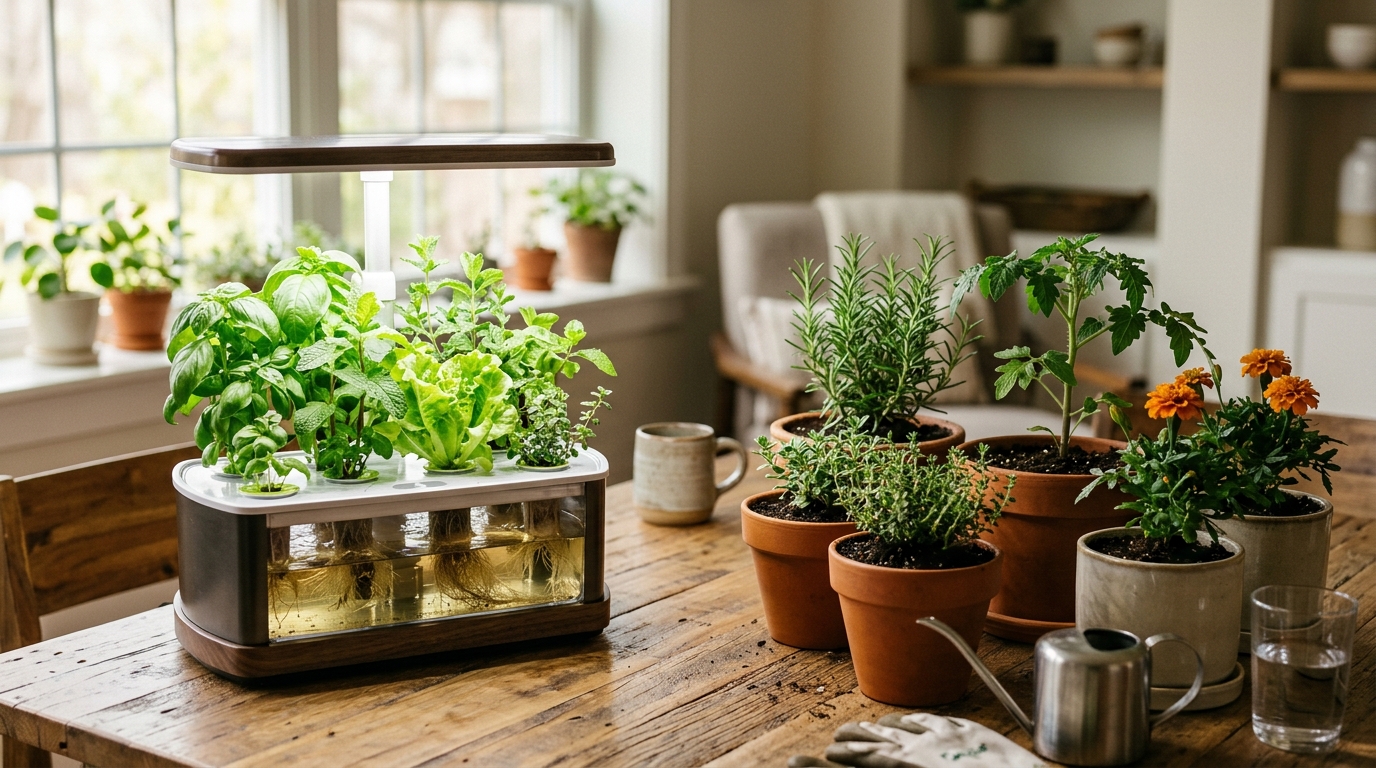
The verdict up front: hydroponics grows most herbs and greens 2-3x faster than soil and uses 90% less water, but requires a $50-500 upfront investment and close attention to pH and nutrients. Soil costs $15-40 to start, forgives more errors, and is the smarter choice for a first indoor garden. Most experienced growers end up running both.
Quick comparison
| Product | Best for | Rating | Notes | |
|---|---|---|---|---|
| Kratky passive hydroponics | Lettuce and herbs with near-zero maintenance | ★★★★☆ | Jar + net cup + nutrient solution. No pump. $5-15 per setup. Best first hydroponic method. | Check price |
| AeroGarden Bounty (9-pod) | Turnkey herb and lettuce garden for any kitchen | ★★★★★ | $200-280. Integrated LED, auto-watering alerts, pod kit included. Best all-in-one system. | Check price |
| DWC (deep water culture) bucket | Larger plants and faster growth than Kratky | ★★★★☆ | $30-80 for a single-bucket setup. Air pump required. Best for tomatoes and peppers indoors. | Check price |
| Soil in pots (FoxFarm Ocean Forest) | First indoor garden and single plants | ★★★★★ | $15-30 for pots plus a bag of soil. Most forgiving. No pH meter or nutrient mixing required. | Check price |
| Fabric grow bags plus potting mix | Larger plants such as tomatoes and peppers in soil | ★★★★☆ | $10-25 for a pack of 5-10 bags. Better drainage than plastic pots. Pair with quality potting mix. | Check price |
How hydroponics works
Hydroponics is any growing method where plant roots grow directly in a nutrient-rich water solution rather than in soil. Without soil particles to slow absorption, roots take up nutrients more efficiently, which is why hydroponic plants grow faster.
The most common indoor hydroponic methods:
Kratky (passive) — The simplest method. Fill a container with nutrient solution, suspend a net cup with a seedling over it, and let roots grow down into the water. No pump, no electricity beyond a grow light. As plants drink the water, an air gap forms that provides oxygen to roots. Works best for lettuce, herbs, and spinach. A single setup costs $5-15.
Deep Water Culture (DWC) — Roots hang in aerated nutrient solution continuously. An air pump and air stone keep the water oxygenated. DWC grows plants faster than Kratky and handles larger plants like tomatoes and peppers. Expect to spend $30-80 for a single-bucket system. Check out the best hydroponic systems for vetted DWC options.
Nutrient Film Technique (NFT) — A thin film of nutrient solution flows constantly over bare roots in channels. Common in commercial growing. Less practical for home growers due to pump dependency, but vertical tower gardens (like the Tower Garden) use a variation of this principle.
All-in-one smart gardens (AeroGarden, LetPot) — These pre-engineer the entire system: LED panel, pump timer, nutrient reminders, and pod slots. The AeroGarden Bounty is the most documented home model. Plug-and-play simplicity at $200-280 makes these the easiest entry into hydroponics.
What hydroponics grows well: leafy greens (lettuce, spinach, arugula, kale), herbs (basil, cilantro, dill, parsley, mint), and compact fruiting plants (cherry tomatoes, peppers, strawberries). Large-rooted plants like carrots and beets are poor fits.
How soil growing works
Soil growing means planting in a growing medium — potting mix, coco coir, or a blend — that holds moisture, provides physical root support, and contains or buffers nutrients. Indoors, the key distinction is between outdoor garden soil (too dense, compacts in pots, attracts pests) and quality indoor potting mix (light, well-draining, pre-fertilized for containers).
The best indoor soil mixes for containers:
- FoxFarm Ocean Forest ($12-18 for 12 qt) — Pre-loaded with earthworm castings, bat guano, and kelp. Feeds plants for 4-6 weeks without any supplementation. Top choice for beginners.
- Espoma Organic Potting Mix ($10-15 for 8 qt) — OMRI-listed, good structure, contains mycorrhizae to boost root development.
- Coco coir blends — Technically not soil, coco is a soil-less medium that behaves more like hydroponics in terms of water management while offering similar forgiveness for new growers.
Pot choice matters as much as soil choice. Terracotta pots dry faster (good for herbs, bad if you forget to water), plastic pots hold moisture longer, and fabric grow bags offer the best drainage and prevent root circling. Fabric grow bags in 2-5 gallon sizes are the best option for most indoor edibles grown in soil.
What soil grows well: virtually everything that hydroponics can grow, plus woody herbs (rosemary, thyme, oregano), succulents, and root vegetables. Soil is also better for plants you want to pot up over time without rebuilding a system.
The critical differences
Growth speed
Hydroponic plants consistently outpace soil-grown plants by 2-3x in controlled studies and in real home growers’ experience. Lettuce goes from seed to harvest in 25-30 days in a well-tuned Kratky setup versus 45-60 days in soil. Basil reaches full harvest size in 4-5 weeks hydroponic versus 7-9 weeks in soil.
The reason is simple: in soil, plant roots have to push through particles to find water and nutrients. In hydroponics, nutrients come directly to the root zone in oxygenated water, so the plant spends more energy on above-ground growth and less on root expansion.
Startup cost
Soil wins on cost, and it is not close for a simple setup:
- Soil: 6-inch pot ($1-3) + bag of FoxFarm ($12-18) = $15-25 per plant slot
- Kratky hydroponic: mason jar ($2) + net cup + hydroton ($8-15) + nutrients ($15-25) = $30-45 per plant, but one bottle of nutrients covers 50+ setups
- AeroGarden Bounty: $200-280 but grows 9 plants simultaneously with integrated lighting
The economics shift at scale. If you want to grow 9 herbs simultaneously, an AeroGarden at $250 with integrated lighting may cost less than 9 individual soil setups with a separate grow light.
Water use
Hydroponics uses 90% less water than soil growing, despite what the name implies. In a closed hydroponic system, the same water recirculates continuously — plants drink it, you top off the reservoir, and almost nothing evaporates compared to soil watering. A single 5-gallon DWC bucket might need only 2-3 gallons of top-off per week for a mature plant. The same plant in soil might require daily watering or 3-4 waterings per week.
Learning curve and failure speed
This is where soil wins clearly. Soil acts as a buffer. pH can drift for days or weeks before it causes visible problems. Overwatering kills slowly enough that you can often catch it and correct course. Nutrient imbalances cause gradual yellowing rather than sudden collapse.
Hydroponics has almost no buffer. If the reservoir pH drifts above 7.5 or below 5.0, roots lock out nutrients within 24-48 hours. A malfunctioning air pump in a DWC system can kill plants overnight. Nutrient burn from over-mixing shows up in 48-72 hours and cannot be undone once roots are damaged.
First-time indoor gardeners who start with hydroponics and do not monitor pH face a 50-70% failure rate. First-time soil growers who use a quality potting mix and check moisture before watering face a much lower failure rate.
Flexibility and scalability
Soil is more flexible. You can grow a wider variety of plants, repot easily, move plants around without system dependencies, and scale up simply by buying another pot. Hydroponics requires every plant to live within the system — changing system size or type usually means starting over.
However, hydroponics scales up more efficiently in terms of plant density. A 2x2 ft vertical tower can produce 20 plants in the same floor space as 2 large pots. For maximum yield per square foot, hydroponics wins.
When hydroponics is the right choice
Choose hydroponics when:
- Speed matters. You want herbs and greens as fast as possible — 2-3x faster than soil is real and meaningful for frequent harvesters.
- Space is limited. A vertical tower or AeroGarden produces far more per square foot than individual soil pots.
- You want low-touch watering. A Kratky setup or AeroGarden can go 1-2 weeks without attention once established, outperforming most soil setups.
- You already know how to grow plants. If you have successfully kept soil plants alive, the step to hydroponics is manageable. The pH learning curve is real but short.
- You want to grow lettuce and herbs at volume. This is the sweet spot for indoor hydroponics.
The simplest entry point: Kratky mason jar setups at $5-15 each, or the AeroGarden Bounty for a complete plug-and-play system.
When soil is the right choice
Choose soil when:
- This is your first indoor garden. The forgiveness factor is worth the slower growth.
- You want to grow a single plant. The cost and complexity overhead of hydroponics is not worth it for one basil plant.
- You are growing woody herbs or larger edibles. Rosemary, thyme, sage, and larger tomato or pepper plants generally do better in quality soil with room to establish.
- You want less daily monitoring. Soil in a self-watering planter or fabric grow bag with a moisture meter is genuinely low maintenance.
- Budget is tight. A $15 setup (pot + FoxFarm) gets you started today.
Best first soil setup: 4-6 inch pots or 2-gallon fabric grow bags filled with FoxFarm Ocean Forest, a soil moisture meter ($5-12) to prevent overwatering, and a basic LED grow bulb ($12-20) in a standard lamp if your window gets fewer than 4 hours of direct sun.
Can you run both at the same time?
Yes, and most serious indoor gardeners do. The two methods complement each other:
- AeroGarden or Kratky for high-turnover crops: lettuce, basil, cilantro, and other herbs you harvest constantly.
- Soil pots for slower, larger plants: rosemary, thyme, larger tomato or pepper plants, or ornamental edibles you want to keep for months.
The division of labor works because the two systems do not compete for the same space or time investment. An AeroGarden on the kitchen counter and two 5-gallon soil pots under a grow light in a closet is a practical setup that covers nearly every indoor growing goal.
If you outgrow that and want to scale further, a grow tent setup guide walks through adding a dedicated hydroponic or soil tent to your space.
What you need to get started
To start with hydroponics
- Nutrient solution: General Hydroponics Flora Series (3-part) or MaxiGro for a simpler single-part option
- pH meter: The Apera Instruments PH20 ($35-50) is accurate and reliable for home use
- pH Down solution ($8-12): Most tap water runs 7.0-8.0; you need to bring it to 5.5-6.5
- Net cups + growing medium (hydroton or rockwool): $10-15 for a starter pack
- Light: See the best grow lights guide for panels that work above hydroponic systems
For a Kratky setup, you need only items 1-4 plus mason jars or any opaque container. Total cost: $45-85 for a 4-6 plant setup.
To start with soil
- Pots or fabric grow bags: 2-4 gallon size for most herbs; 5+ gallon for tomatoes and peppers
- Potting mix: FoxFarm Ocean Forest or comparable quality indoor mix — never use outdoor garden soil in containers
- Moisture meter ($5-12): A basic analog meter eliminates the most common cause of plant death (overwatering)
- Fertilizer: Only needed after 4-6 weeks when the pre-loaded nutrients in quality potting mixes are depleted
- Light: Same as hydroponics — adequate light is the biggest success factor regardless of growing method
Total soil setup cost: $15-35 for a basic 2-3 plant start.
FAQ
Frequently asked questions
Is hydroponics really that much faster than soil?
Do hydroponic plants taste different from soil-grown plants?
How difficult is pH management for hydroponics?
Can I convert my soil garden to hydroponics?
What plants should not be grown hydroponically indoors?
Is organic hydroponics possible?
Bottom line
For most first-time indoor gardeners, start with soil — lower cost, more forgiving, and still capable of producing excellent herbs and greens year-round. Once you have kept soil plants alive for a season, add a Kratky setup or AeroGarden for faster lettuce and herb cycles.
For anyone who wants maximum yield per square foot, is already comfortable keeping plants alive, and does not mind learning pH management, hydroponics is the clear winner on speed and efficiency.
The real answer for serious indoor growers is to run both. They are not competing methods — they solve different problems in the same space.
Explore further: best hydroponic systems for full setup recommendations, the indoor gardening setup guide for everything else you need to get started, how to fertilize indoor plants for soil nutrition details, and how to set up a grow tent when you are ready to scale.