roundups
Best Humidifiers for Plant Cabinets 2026
Best humidifiers for enclosed plant cabinets, IKEA terrarium builds, and bioactive setups. Ultrasonic, misting, and fogger options compared.
 Priya Anand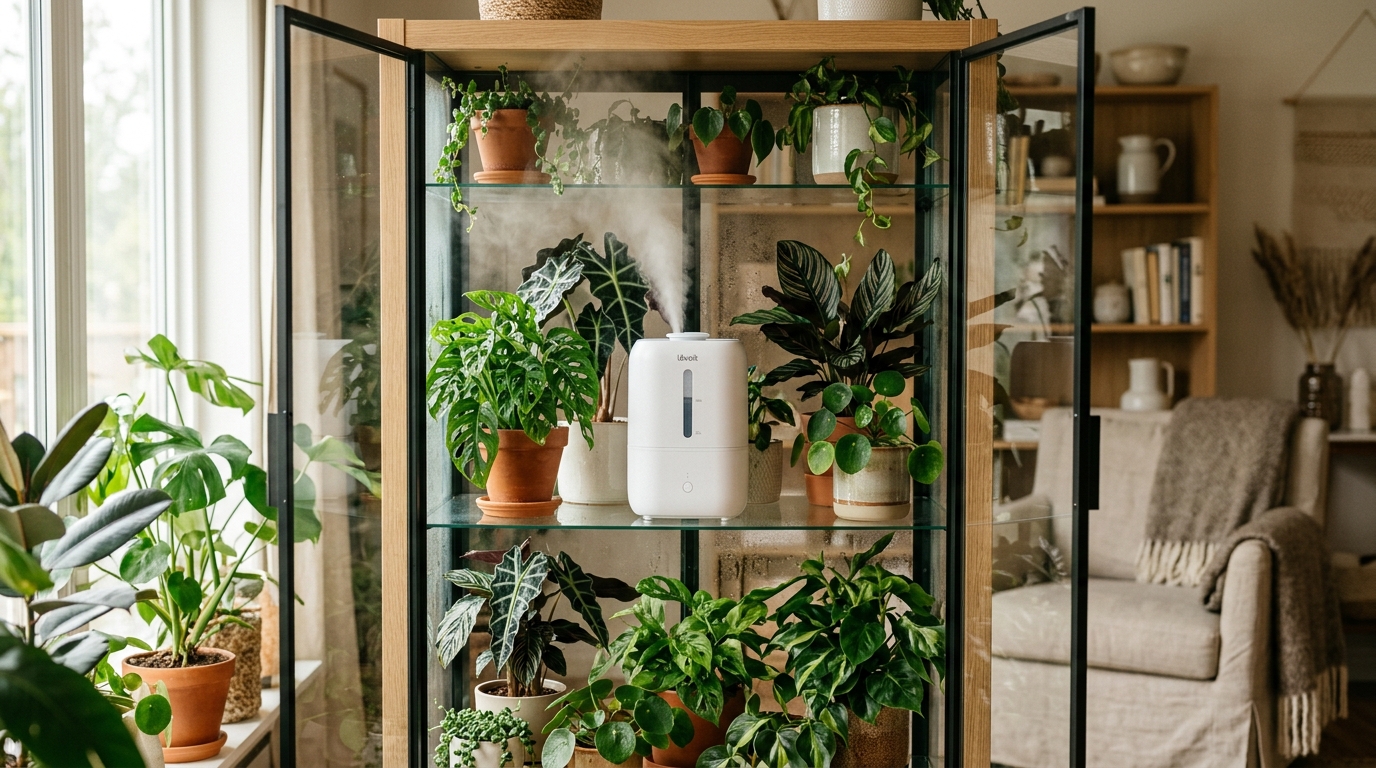
The Exo Terra Monsoon Solo is the best humidifier for most enclosed plant cabinets — its programmable misting nozzle mounts inside the cabinet and cycles on a timer, delivering fine mist bursts that hold humidity at 70–90% without waterlogging the substrate. For larger IKEA Billy bookcase conversions and open-front shelving, the LEVOIT Classic 200S ultrasonic humidifier ($40–55) placed at the base is the simplest high-capacity option and pairs perfectly with an Inkbird humidity controller for automated on/off cycling.
Why plant cabinets need a dedicated humidity solution
A standard living room runs at 30–50% relative humidity — well below the 60–90% most tropical houseplants, ferns, orchids, carnivorous plants, and mosses require. Open shelving cannot hold elevated humidity because the air volume is too large and ventilation keeps moisture escaping into the room continuously.
Enclosed plant cabinets solve this by creating a smaller sealed air volume you can actually humidify with a compact device. An IKEA FABRIKÖR glass display cabinet holds roughly 7–10 gallons of air. A Billy bookcase conversion with plexiglass doors holds 15–25 gallons. Humidity in these small volumes responds quickly to a fogger or ultrasonic humidifier — and stays elevated if the seals are reasonably tight.
The challenge is choosing the right humidifier type. Misting systems are precise and controlled but require internal nozzle mounting. Ultrasonic humidifiers produce higher output but generate fine mist that causes root rot if the cabinet lacks drainage and airflow. Evaporative (wicking) humidifiers suit open rooms but cannot reach the 70–90% RH levels enclosed plant spaces need.
What humidity level does your cabinet need?
| Plant Type | Target RH | Notes |
|---|---|---|
| Orchids (Phalaenopsis) | 50–70% | Higher at night; tolerates drier periods during the day |
| Ferns and mosses | 70–90% | Require consistent high humidity to prevent browning |
| Tropical aroids | 65–80% | Higher RH improves leaf size and fenestration on Monstera |
| Carnivorous plants | 65–85% | Distilled water only; minerals burn traps |
| Tillandsia (air plants) | 50–70% | Misting twice weekly often sufficient |
| Begonias | 60–75% | High humidity prevents crisping of decorative foliage |
A cabinet with mixed tropical aroids and ferns should target 70–80% RH. A cabinet focused on tillandsia can get by with lighter maintenance. A moss-heavy terrarium with carnivorous plants needs a fully sealed enclosure at 80–90% with a precision misting system.
Quick comparison
| Product | Best for | Rating | Notes | |
|---|---|---|---|---|
| Exo Terra Monsoon Solo | Best overall for sealed cabinets needing programmable timed misting | ★★★★★ | $70-90. Up to 8 timed cycles per day, 2-120 sec each. Nozzle mounts inside cabinet. Ideal for ferns, mosses, carnivorous plants, sealed terrariums. | Check price |
| LEVOIT Classic 200S | Best for large IKEA Billy bookcase and open-front cabinet builds | ★★★★★ | $40-55. 3-liter tank. 360-degree mist nozzle. App control with scheduling. Pair with Inkbird controller for automated on/off cycling. | Check price |
| Zoo Med Repti Fogger | Best budget fogger for small 5-15 gallon sealed terrariums | ★★★★☆ | $20-30. Continuous fog via ultrasonic. Tube routes into enclosure. Use with Inkbird controller. Good for FABRIKOK builds and small glass terrariums. | Check price |
| Inkbird IHC-200 Controller | Best add-on for precise automated humidity control with any humidifier | ★★★★★ | $35-50 for the controller; pair with any humidifier. Turns device on/off based on probe reading inside cabinet. Wi-Fi monitoring and app alerts. | Check price |
The picks
Best overall for sealed cabinets: Exo Terra Monsoon Solo
Best for fully enclosed cabinets, sealed terrariums, and bioactive plant builds needing timed fine-mist bursts
Exo Terra Monsoon Solo Programmable Misting System
The Exo Terra Monsoon Solo is the standard recommendation among serious plant cabinet builders because it was engineered for reptile terrariums — enclosed spaces with the same humidity management challenges as a sealed plant cabinet. It delivers fine mist in programmable timed bursts rather than continuous output, which is essential: continuous humidification in a sealed cabinet saturates the substrate, promotes rot, and leaves standing water on foliage. The Monsoon Solo connects to any standard water bottle or reservoir, runs tubing into the enclosure, and mounts a single nozzle on the interior wall with a suction cup bracket. The programmable timer allows up to 8 misting cycles per day with duration adjustable from 2 to 120 seconds. Most tropical plant cabinets run 2–4 cycles daily at 15–30 seconds each, depending on cabinet seal quality and plant load. The nozzle produces fog-like mist that disperses through the air volume without heavy droplet fallout on leaves. For ferns, mosses, orchids, and high-humidity aroids in a sealed cabinet, the Monsoon Solo holds 70–90% RH consistently with minimal intervention. Setup takes about 30 minutes: attach the pump to the reservoir, route tubing through a small gap in the cabinet frame, mount the nozzle inside, and program the timer. The main limitation is reservoir size — 1-liter bottles need refilling every 3–6 days. Connecting a 2-liter external bottle via the same tubing extends the interval.
★★★★★ 4.6 · 4,200 reviews
Check current price on Amazon→Pros
- Programmable timed bursts prevent over-humidification and substrate waterlogging that causes rot in sealed enclosures
- Fine fog-like mist does not leave heavy water droplets on foliage; sensitive fern fronds and orchid blooms stay clean
- Up to 8 timed cycles per day with 2-120 second duration; enough precision for demanding high-humidity species
- Suction-cup nozzle bracket repositions without tools for different cabinet configurations and nozzle angles
- Quiet pump at under 40 dB; not audible from the next room during misting cycles
Cons
- Small reservoir requires refilling every 3-6 days; a 2-liter external bottle helps but needs a DIY tubing extension
- No built-in humidity sensor — pair with a separate hygrometer or Inkbird controller to monitor actual RH inside the cabinet
- Tubing requires a small entry point through the cabinet, typically a gap at a hinge or a drilled hole in a back panel
- Overkill for a single small terrarium with hardy plants; the $70-90 cost is better justified for serious builds
Best for large open-front builds: LEVOIT Classic 200S
Best for IKEA Billy bookcase conversions and large open-front plant shelves needing elevated ambient humidity
LEVOIT Classic 200S Ultrasonic Cool Mist Humidifier
The LEVOIT Classic 200S is the best choice for plant cabinet builds where the enclosure is larger or the front is not fully sealed — IKEA Billy bookcase conversions with plexiglass doors, multi-tier open shelving with side panels, or any setup where doors open regularly for plant care. Rather than mounting inside the enclosure, the 200S sits at the base of the shelf unit with its 360-degree mist nozzle directed upward into the cabinet space. The 3-liter tank provides 24–36 hours of runtime on the low setting, drastically reducing the refill frequency that makes small foggers inconvenient for daily-use builds. The app control and built-in timer allow scheduling humidification for overnight periods when plants transpire less and ambient room temperatures are lower. Ultrasonic vibration generates a cool mist, which means distilled or filtered water is mandatory to prevent white mineral dust from settling on leaves and glass. In a sealed cabinet, white dust from tap water accumulates on foliage within a week. In an open-front build with more air movement, it disperses more readily but still degrades leaf appearance over time. For orchid and tropical aroid collections running an IKEA Billy build, the 200S paired with an Inkbird IHC-200 controller sustains 60–75% RH with doors closed without continuous monitoring.
★★★★★ 4.5 · 8,900 reviews
Check current price on Amazon→Pros
- 3-liter tank provides 24-36 hours of runtime on low; far less refilling than reptile foggers with 0.5-1 liter reservoirs
- 360-degree adjustable nozzle positions at the base of a cabinet with mist directed upward into the growing space
- App control with scheduling allows automated overnight cycles without manual operation; works with Alexa and Google Home
- Auto-shutoff when the tank empties protects the ultrasonic plate and motor from dry-running damage
Cons
- Requires distilled or RO water — tap water leaves white mineral deposits on leaves and glass within a week
- No built-in humidity sensor; add an Inkbird IHC-200 to prevent over-humidification in sealed builds
- For fully sealed small enclosures, output capacity is too high — runs a 10-gallon cabinet above 90% RH in under an hour without a controller
- Ultrasonic mist is slightly cooler than ambient air; in rooms below 65 degrees F, very fine mist can chill cold-sensitive foliage
Best budget fogger for small terrariums: Zoo Med Repti Fogger
Best for small 5-15 gallon sealed terrariums and IKEA FABRIKOK glass cabinets on a budget
Zoo Med Reptifogger Terrarium Humidifier
The Zoo Med Repti Fogger is the entry-level solution for small sealed plant cabinets and glass terrarium builds. The fogger connects to a standard 2-liter bottle via a silicone tube and uses ultrasonic vibration to generate continuous fog that routes into the enclosure through any small gap. No internal mounting is required — the external unit sits beside the terrarium and the tube enters through the door gap or a drilled vent hole. For a sealed IKEA FABRIKÖR cabinet or a small glass terrarium targeting 70%+ RH, the Repti Fogger raises and maintains humidity effectively. The unit produces fog continuously while powered on; it has no built-in timer or humidity sensor, so pairing it with an Inkbird IHC-200 controller is essential to automate on/off cycles and prevent substrate saturation. The main advantage is price: at $20–30 it is the lowest entry point for enclosed plant cabinet humidification. Use distilled water and rinse the vibrating plate monthly to prevent calcium buildup that reduces fog output. The fog tube is 18 inches long, sufficient for most cabinet setups without extension.
★★★★☆ 4.2 · 6,700 reviews
Check current price on Amazon→Pros
- Lowest cost entry point at $20-30; correct for small sealed terrariums where more expensive systems are not cost-justified
- External fogger sits outside the cabinet; no internal mounting or drilling required to route the fog tube
- Standard 2-liter bottle reservoir is inexpensive to replace and easy to refill without removing the fogger from position
- Quiet operation under 35 dB; not disruptive in bedroom or office environments where plant cabinets often live
Cons
- No built-in timer or humidity sensor; an Inkbird controller is required to prevent continuous over-humidification in sealed cabinets
- Fog output clogs within 1-2 weeks of tap water use; distilled water is mandatory and the fogger plate needs monthly cleaning
- Not adequate for any cabinet over 20 gallons without a second unit; one Repti Fogger is underpowered for full Billy bookcase builds
- Continuous output means a sealed enclosure reaches target humidity quickly — without a controller it will always overshoot
Best for precision automated control: Inkbird IHC-200 + Humidifier
Best for any plant cabinet where humidity must stay within a precise RH band — pairs with any humidifier you choose
Inkbird IHC-200 Wi-Fi Humidity Controller
The Inkbird IHC-200 is not a humidifier itself — it is a smart controller that turns any humidifier into a precisely managed automated system. The controller has two outlets: one switches the humidifier ON when RH drops below your set minimum, and one switches a fan or dehumidifier ON when RH rises above your set maximum. A probe inside the cabinet reads humidity every 10 seconds and cycles the humidifier to keep RH within your configured band. This solves the biggest failure mode in plant cabinet builds: overshooting. An uncontrolled ultrasonic running in a sealed 10-gallon cabinet hits 95–100% RH within an hour — standing water forms on every surface and root rot accelerates. With the IHC-200, you set 75% as the minimum and 85% as the maximum; the humidifier runs until 85% is reached, then shuts off automatically. The IHC-200 includes Wi-Fi for remote monitoring and app alerts, a 1-meter probe cable that routes into the cabinet, and temperature monitoring alongside humidity data. It pairs with any standard plug-in humidifier: the LEVOIT Classic 200S plus the IHC-200 is the best combination for large Billy bookcase builds. For small terrariums, the Zoo Med Repti Fogger plus the IHC-200 delivers automated control for under $60 total. The controller itself runs $35–50; budget for the humidifier separately.
★★★★★ 4.7 · 3,100 reviews
Check current price on Amazon→Pros
- Keeps cabinet RH within a precise band (e.g. 75-85%) — eliminates overshooting and the root rot that saturated enclosed air causes
- Wi-Fi connected with app alerts when the probe reads out of range or the humidifier reservoir runs dry
- Two outlet plugs allow simultaneous control of a humidifier (on when low) and a USB fan or dehumidifier (on when high)
- Works with any plug-in humidifier or fogger; upgrades any existing device from uncontrolled to precision automated operation
Cons
- Does not include a humidifier; total system cost is the controller plus $20-90 for the humidifier you pair it with
- Probe placement matters — mounting near the misting nozzle reads spikes during cycles; position the probe mid-cabinet away from the nozzle
- Wi-Fi setup requires a 2.4 GHz network; 5 GHz-only routers require a temporary network switch during initial pairing
- Controller body is larger than a standard outlet plug; blocks the adjacent outlet on a duplex unless you use an extension cord
How to set up humidification in an IKEA plant cabinet
IKEA FABRIKÖR (12x37 inches, roughly 7–9 gallons air volume): This small glass-door cabinet is the most popular entry point for orchids and small tropicals. Use the Zoo Med Repti Fogger with an Inkbird IHC-200 controller. Route the fog tube through the top vent or gap at the hinge. Set the controller to 65–75% for orchids or 75–85% for ferns and small aroids. Refill the 2-liter bottle every 3–5 days.
IKEA Billy bookcase with plexiglass doors (roughly 15–25 gallons air volume): The Billy conversion is the standard large-collection build. The plexiglass doors are not fully airtight. Place the LEVOIT Classic 200S at the base of the unit with the nozzle directed upward. Pair with an Inkbird IHC-200. Expect to maintain 60–75% RH with doors closed; opening doors for plant care drops humidity quickly, so schedule watering during the low-cycle window.
Fully custom glass or acrylic cabinet (sealed, any size): For a fully sealed custom build with silicone-sealed panels, use the Exo Terra Monsoon Solo with the nozzle mounted in the upper third of the cabinet (humidity stratifies; top is always higher). Program 2–3 misting cycles per day at 20–30 seconds each and check with a hygrometer. Adjust cycle duration weekly until you find the equilibrium that holds target RH between cycles without pooling at the base.
What to skip
Room humidifiers aimed at an open cabinet — whole-room humidifiers like the Honeywell HCM-350 are designed for 400–500 square foot spaces. Running one pointed at an open cabinet raises room humidity modestly while achieving minimal concentration inside the cabinet. The air volume is too large and ventilation keeps moisture from building. Use a room humidifier only if you want to raise ambient room RH broadly alongside a cabinet setup.
Ultrasonic foggers with tap water — ultrasonic devices work well for plant cabinets, but tap water deposits white calcium and mineral dust on leaves within days. On delicate foliage — orchid blooms, carnivorous plant traps, fern fronds — mineral deposits are cosmetically damaging and block stomata over time. Distilled water costs $1 per gallon at most grocery stores; it is a non-optional input cost for any ultrasonic device in a plant cabinet. Never skip it.
Warm mist or steam humidifiers — warm mist humidifiers boil water to produce steam, adding 5–10°F of heat alongside humidity. Most plant cabinet setups are already at or near the ideal temperature range; adding heat stress alongside humidity management is counterproductive. Cool mist and ultrasonic designs are the correct choice for plant cabinet applications.
FAQ
Frequently asked questions
What humidity level should a plant cabinet be?
Can I put a regular humidifier inside a plant cabinet?
How often do I need to refill the humidifier for a plant cabinet?
Why is white dust appearing on my plant cabinet leaves?
Should I use a humidity controller with my plant cabinet humidifier?
What is the difference between a fogger and a misting system for plant cabinets?
Bottom line
For most enclosed plant cabinet builds, the Exo Terra Monsoon Solo ($70–90) is the most reliable choice — programmable timed misting is the correct approach for sealed enclosures, and the system was engineered for exactly these conditions. For larger IKEA Billy bookcase builds or any open-front shelving, the LEVOIT Classic 200S paired with an Inkbird IHC-200 controller gives you the capacity and automation to hold a precise RH band without manual monitoring. If you are starting small with a budget FABRIKÖR or glass terrarium build, the Zoo Med Repti Fogger at $20–30 plus the $35 Inkbird controller reaches 90% of a fully automated setup for under $60 total.
Whatever humidifier you choose: use distilled water, place a hygrometer inside the cabinet at mid-height, and ensure at least minimal airflow with a small USB fan to prevent stagnant wet air that accelerates mold and rot.
For related reading: best plant humidifiers for general room and open-shelf humidity options, how to control humidity for plants for the complete indoor humidity management guide, best grow tents as an enclosed growing alternative with purpose-built climate control infrastructure, and how to control fungus gnats on houseplants since high-humidity environments attract fungus gnats that require a targeted management approach.