guides
How to Control Fungus Gnats on Houseplants
Learn how to get rid of fungus gnats on houseplants with sticky traps, BTi soil drenches, and watering adjustments that stop infestations fast.
 Priya Anand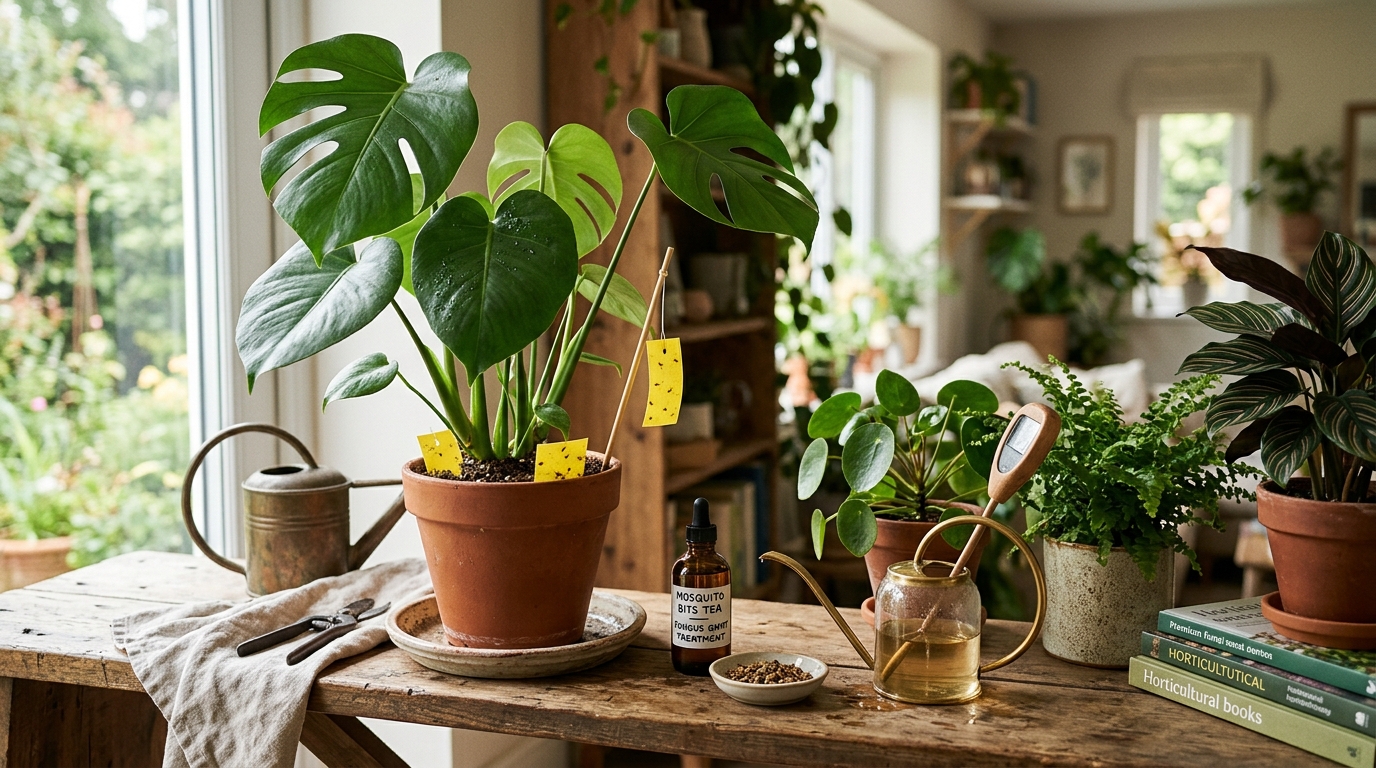
The fastest way to control fungus gnats is to let the top inch of soil dry out completely between waterings — gnats breed only in moist soil and cannot complete their life cycle in dry conditions. Pair that with yellow sticky traps above the soil surface to catch adults, and a Bacillus thuringiensis israelensis (BTi) soil drench to kill larvae already in the potting mix. Most infestations clear within three to four weeks using this combination.
What are fungus gnats and why do they appear on houseplants?
Fungus gnats (family Sciaridae) are tiny dark-winged flies measuring 2–3mm long that are attracted to moist, organically rich potting soil. The adult gnats themselves cause more frustration than damage — they hover around soil surfaces and occasionally cluster near windows or grow lights. The real problem comes from larvae, which are 5mm long, white with a black head capsule, and live in the top 2–3 inches of potting mix. Larvae feed on fungal threads in the soil, decaying organic matter, and root hairs. Heavy larval populations chew through fine feeder roots, causing wilting, yellowing, and stunted growth in seedlings and young plants that looks indistinguishable from watering or fertilizer problems.
They appear because indoor potting mixes — particularly peat-heavy or coconut coir blends — stay moist at the surface for extended periods after watering. Eggs are laid by female adults in the top inch of moist soil. Each female lays 100–150 eggs over her short life. Those eggs hatch in 4–6 days at room temperature, larvae feed for 2–3 weeks, pupate for about a week, and emerge as adults ready to start the cycle again. The full life cycle runs 3–5 weeks indoors, meaning a small infestation compounds quickly if conditions remain favorable.
They arrive most commonly through:
- New plants purchased from nurseries or big-box stores where communal growing conditions make infestations common
- Fresh potting mix bags that were stored in damp conditions — this is not a product defect, just a risk to be aware of with all new bagged soil
- Open windows — adults fly readily and home in on the volatile compounds released by damp organic soil
How to identify fungus gnats versus other houseplant flies
Fungus gnats are frequently confused with fruit flies and shore flies. Here is how to tell them apart:
| Pest | Size | Body color | Where they congregate | Larvae location |
|---|---|---|---|---|
| Fungus gnat | 2–3mm | Dark gray or black | Soil surface, near plants | Top 2 inches of soil |
| Fruit fly | 3–4mm | Tan or orange-brown | Near fruit, trash, drains | Fermenting organic matter |
| Shore fly | 3–4mm | Black | Soil surface | Wet soil with algae growth |
The simplest field test: place a yellow sticky trap flat on the soil surface. Fungus gnats will land on the trap within hours if present. Fruit flies are drawn upward toward fruits and beverages, not toward soil. Shore flies are thicker-bodied and more robust than fungus gnats and less common in home collections.
Confirming larvae: water the pot thoroughly and watch the soil surface for 5–10 minutes. Fungus gnat larvae sometimes come to the surface when disturbed by water. You can also carefully dig into the top inch of soil and examine it under bright light — white larvae with distinct black heads are visible to the naked eye in heavily infested pots.
Why fungus gnats are a genuine problem for seedlings
Adult fungus gnats cause no direct plant damage. The case for treating an infestation promptly is about larvae and root health. Root feeding by heavy larval populations causes:
- Wilting in small plants despite moist soil — feeder roots are damaged faster than the plant can grow replacements
- Yellowing lower leaves as root damage reduces nutrient and water uptake
- Stunted, halted growth that is difficult to explain by other means in otherwise healthy-looking plants
- Secondary disease entry: wounded root tissue from larval feeding creates entry points for Pythium (root rot) and Fusarium wilt
Mature specimens with large, established root systems often tolerate light infestations with no visible symptoms. Small plants, seedlings, newly propagated cuttings, and any plant already stressed by other factors are most vulnerable. If you are germinating seeds or rooting cuttings, eliminate gnats promptly — larval feeding can kill seedlings before they establish a functional root system.
Step-by-step: How to get rid of fungus gnats
Step 1: Let the soil dry out between waterings
This is the single most effective intervention and the one most growers skip because it feels counterintuitive. Fungus gnat eggs cannot hatch without moisture in the top inch of soil. Larvae in an already-dry surface layer die or move deeper where conditions are insufficient for development. Adult females will not lay eggs in dry soil surface conditions.
Water thoroughly but then allow the top 1–2 inches to dry completely before watering again. The lift test is reliable: pick up the pot after watering and remember the weight, then lift it again before your next watering session. A noticeably lighter pot signals dry soil throughout. For plants that prefer more consistent moisture — ferns, calatheas — this adjustment is harder to make without stressing the plant. For most tropicals (pothos, monsteras, philodendrons, peace lilies, snake plants), allowing the top inch to dry between waterings is already best practice and causes no harm.
Stop misting the soil surface if you have been doing so. If you use misting for humidity, redirect it away from the soil and toward the air above the plant canopy, or switch to a pebble tray or room humidifier. See our how to control humidity for indoor plants guide for alternatives that do not keep the soil surface wet.
Step 2: Set yellow sticky traps at soil level
Yellow sticky traps capture adult gnats and serve two purposes: reducing the adult population (which slows egg-laying) and functioning as population monitors so you can track whether the infestation is declining from week to week.
Place traps horizontally at soil level, flat on the soil surface or just above it. Adults spend the majority of their time at and near the soil surface, not flying through the air. A trap standing upright on a stick catches some adults but misses far more than a horizontal trap placed flat on the soil. Check and replace traps weekly.
If a trap fills quickly with adults within 48–72 hours, the infestation is active and you need to add a larval treatment from the steps below. Traps that collect only a handful of adults after a week signal the population is crashing and your treatment is working.
Step 3: Apply a BTi soil drench
Bacillus thuringiensis israelensis (BTi) is a naturally occurring soil bacterium that produces proteins toxic to fungus gnat larvae when ingested, but is completely safe for plants, beneficial soil organisms, earthworms, pets, and people. It is the most targeted and broadly recommended larval treatment available. It is sold under the brand names Mosquito Bits and Gnatrol, and is widely available at garden centers and online.
How to use Mosquito Bits for fungus gnats:
- Soak 2 tablespoons of Mosquito Bits in 1 gallon of water for at least 30 minutes — the BTi leaches out of the granules and into the water
- Strain out the granules or leave them in the solution; they continue releasing BTi as they soak
- Water each infested plant thoroughly with the BTi solution until it runs from the drainage holes
- Repeat every 7–10 days for three to four applications total
Larvae that ingest BTi-treated soil die within 24–48 hours. Because BTi degrades in soil within a few days at room temperature, repeat applications are necessary to catch newly hatched larvae across the full gnat life cycle. After three to four treatments spaced a week apart, new adults stop emerging and the sticky trap count drops to near zero.
BTi does not kill adult gnats — those die naturally within 7–10 days, and your sticky traps handle the adult population in the meantime.
Step 4: Use a hydrogen peroxide soil drench for fast knockdown
If the infestation is severe — sticky traps filling completely within 48 hours or visible larvae at the soil surface — a hydrogen peroxide drench provides faster initial knockdown than BTi alone.
Mix 1 part standard 3% hydrogen peroxide (standard drugstore H2O2) with 4 parts water. Water affected pots thoroughly with this solution until it drains from the drainage holes. The hydrogen peroxide reacts with organic matter in the soil, releasing oxygen that kills larvae on contact. It dissipates quickly and does not persist in harmful concentrations.
This treatment temporarily disrupts beneficial soil biology, which is why BTi is preferable for mild-to-moderate infestations. For severe cases, an H2O2 drench followed by a BTi program starting five days later delivers the fastest complete clearance: the H2O2 knocks down the existing larval population immediately and the BTi prevents reinfestation through subsequent hatch cycles.
Step 5: Top-dress with sand or diatomaceous earth
Covering the top inch of soil with a 1/4-inch layer of coarse horticultural sand or food-grade diatomaceous earth creates a hostile surface environment for adult gnats and a dry barrier that disrupts egg-laying.
Coarse sand dries rapidly after watering, discouraging adults from approaching the soil to lay eggs. Use horticultural sand or coarse builder’s sand — not fine beach or play sand, which compacts into a water-repelling crust that causes drainage problems over time.
Diatomaceous earth (DE) is made from fossilized algae with razor-sharp edges at the microscopic level. The sharp particles tear the soft cuticle of fungus gnat larvae and eggs that contact it, causing desiccation. Sprinkle a visible layer across the soil surface and reapply after watering once the surface dries, since DE loses effectiveness when wet.
Sand top-dressing also improves the aesthetic of potted plants and works well as a permanent preventive measure after an infestation clears. It is one of the simplest changes you can make to reduce gnat problems long-term.
How to prevent fungus gnats from returning
Water management is the long game. Fungus gnats return when the conditions that support them return. Consistent overwatering or surface moisture — not plant species, pot size, or soil brand — is the root cause of recurring infestations. Establish a habit of checking soil moisture before every watering session rather than watering on a fixed schedule.
Inspect new plants before bringing them home. Examine the soil surface and the underside of leaves of any plant you purchase. Avoid plants sitting in visibly saturated, soggy soil. Quarantine new arrivals for two weeks in a separate area of your home so a hitchhiking infestation does not spread to established plants.
Repot plants that are overdue. Old, heavily decomposed potting mix stays wetter longer and contains far more organic matter to sustain gnat populations. Repotting into fresh, well-draining mix every two to three years — or whenever soil compresses significantly and drains slowly — resets the baseline. See our how to repot indoor plants guide for the full process.
Add perlite to your potting mix. A ratio of 1 part perlite to 4 parts potting mix improves drainage and causes the soil surface to dry more rapidly after watering. Well-aerated, faster-drying mix is inherently less hospitable to fungus gnat larvae.
Keep Mosquito Bits on hand for prevention. A monthly BTi drench during the warmest months — when gnats are most active indoors — maintains larval populations at zero without any harm to plants or soil biology.
FAQ
Frequently asked questions
What kills fungus gnats in soil?
How long does it take to get rid of fungus gnats?
Can fungus gnats kill houseplants?
Do yellow sticky traps get rid of fungus gnats?
Does hydrogen peroxide kill fungus gnats?
Why do I keep getting fungus gnats no matter what I do?
Bottom line
Fungus gnats are a watering problem before they are a pest problem. Let the top inch of soil dry completely between waterings and the population will collapse on its own over a few weeks as adults die and larvae cannot reproduce. Accelerate recovery with yellow sticky traps to capture adults, a BTi soil drench (Mosquito Bits) applied every 7–10 days to eliminate larvae, and a sand or diatomaceous earth top-dressing to prevent re-infestation at the surface. For severe infestations, add a hydrogen peroxide drench as a fast-reset treatment before starting the BTi program. Most infestations are fully resolved within a month with this approach.
For more on keeping your indoor garden thriving: common indoor plant problems to diagnose exactly what your plants are showing, how to water indoor plants for the watering fundamentals that prevent most pest issues, how to repot indoor plants for refreshing potting mix and inspecting root health after an infestation, and how to fertilize indoor plants to restore plant vigor once roots recover.