roundups
Best Grow Lights for Succulents 2026
Best grow lights for succulents: Barrina T5 LED bars, Mars Hydro TS 600 panel, clip-on picks for etiolation-prone cacti and indoor succulent shelves.
 Priya Anand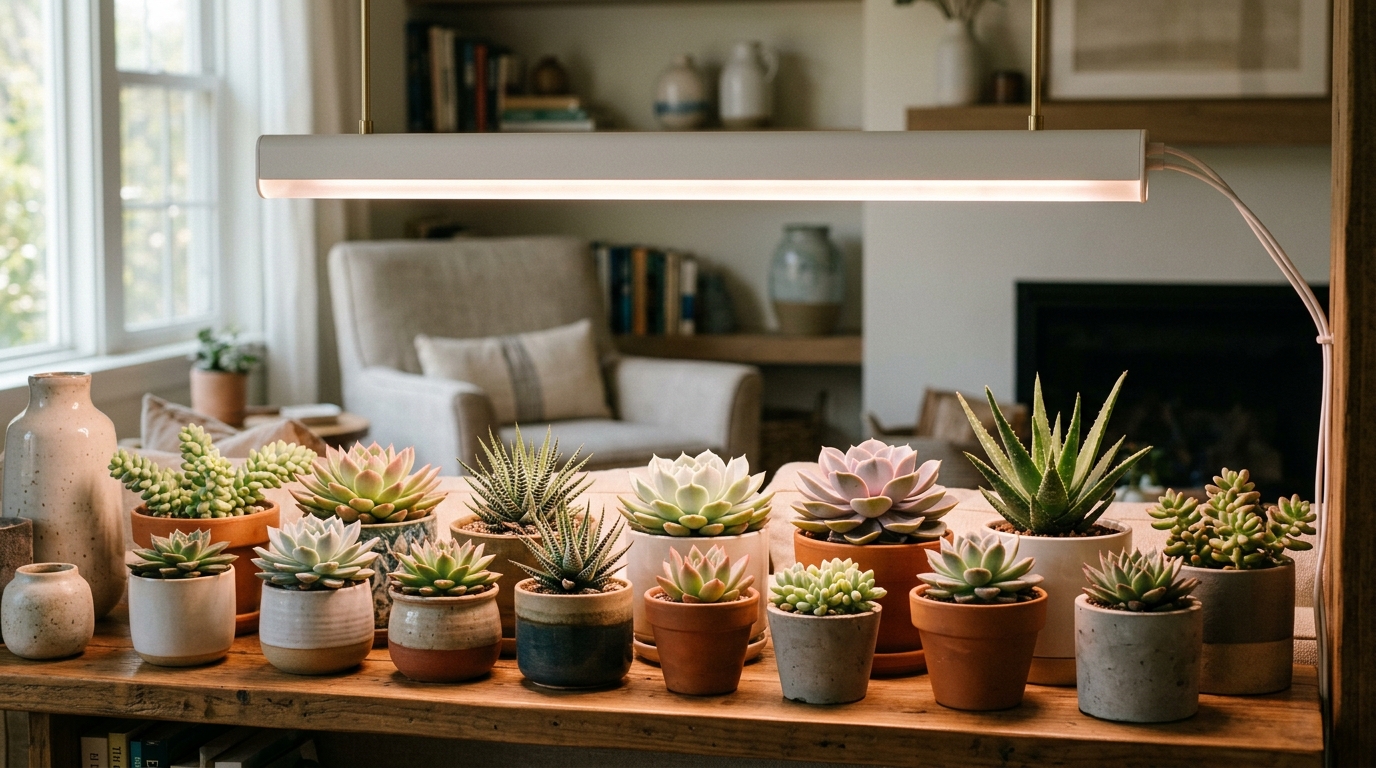
The best grow light for most indoor succulent and cactus collections is a Barrina T5 LED bar setup — mounted under shelves, it delivers the 200-400 PPFD succulents need to stay compact and colorful year-round. For a single plant or small windowsill group, a Sansi 36W E26 screw-in gives enough output without buying a full fixture. Either option beats leaving sun-hungry succulents on a dim shelf where they stretch, fade, and lose their stress coloring.
How much light do succulents actually need?
Succulents evolved in bright desert environments. Outdoors in summer they receive 6-8 hours of direct sun at 2,000-5,000 PPFD. That is impossible to match indoors with any consumer grow light. What indoor grow lighting achieves is the 200-400 PPFD range succulents need to stay compact and healthy when direct sun is unavailable.
Light-starved succulents etiolate. The stem stretches upward, leaves space out, and the rosette loses its tight form as the plant reaches for more light. This is irreversible — the elongated stem cannot be compressed — but the plant can produce new compact growth from the top when light levels improve.
Colorful succulents fade in low light. The red, purple, and orange pigments in echeveria, sedum, and kalanchoe are a stress response to strong light and temperature shifts. In dim conditions these varieties revert to plain green. Adequate grow lighting restores and maintains the characteristic coloring many growers prize.
Cacti need the same or more. Most cacti want 300-600 PPFD and benefit from up to 16 hours of light per day indoors. A single low-wattage clip-on is rarely enough for a serious cactus collection; a full LED bar or compact panel is the right starting point.
Low-light succulents exist. Haworthia, gasteria, and most aloe varieties are native to shadier spots under desert scrub. They tolerate 100-200 PPFD and can thrive with a clip-on supplemental light near a window. The iconic tight rosettes of echeveria and the columnar forms of cereus need the higher end of the range.
Quick comparison
| Product | Best for | Rating | Notes | |
|---|---|---|---|---|
| Barrina T5 LED Grow Light Bars | Succulent shelves with multiple plants | ★★★★★ | About $35-55 per 4-pack. Linkable. Best watt-per-dollar for shelf setups. | Check price |
| Mars Hydro TS 600 LED Panel | Dedicated succulent grow space or cacti needing higher PPFD | ★★★★★ | About $65-80. 100W actual draw. Full-spectrum white. Higher ceiling than T5 bars. | Check price |
| Sansi 36W Full Spectrum E26 | Single lamp setup for 2-5 succulents | ★★★★☆ | About $20-25. Highest-output screw-in bulb. Fits any E26 fixture. | Check price |
| Juhefa Clip-on LED Grow Light | Single desk succulent or windowsill cactus supplement | ★★★★☆ | About $15-20. Built-in timer. Works for shade-tolerant varieties with window backup. | Check price |
| Spider Farmer SF-300 LED Panel | Mid-size succulent collection in a compact dedicated space | ★★★★★ | About $45-60. 30W actual draw. Full-spectrum. Good step between bars and the TS 600. | Check price |
The picks
Best for shelves: Barrina T5 LED Grow Light Bars
Best for succulent shelves, cactus collections, and multi-plant displays with several vertical levels
Barrina T5 LED Grow Light Bars for Succulents
Barrina T5 LED bars are the most common grow light choice among succulent collectors for good reason: they mount under shelves, link together with included cables, and provide even PPFD distribution across the full shelf footprint. A 4-pack of 4-foot T5 bars at 6-8 inch shelf spacing delivers 200-300 PPFD at plant level — right in the target range for echeveria, sedum, haworthia, and most cactus varieties. The full-spectrum white light lets you see true leaf color and catch etiolation, pests, or disease early. At $35-55 for a 4-pack, this is the best watt-per-dollar setup for a dedicated shelf of 10-30 succulents.
★★★★★ 4.6 · 5,800 reviews
Check current price on Amazon→Pros
- Linkable design: connect multiple bars from one outlet for clean cable management
- Even PPFD distribution prevents bright spots and dim corners across the shelf
- Full-spectrum white makes leaf color, etiolation, and pest damage easy to see
- Low-profile mounting under shelves does not impede access to plants
- Best watt-per-dollar for a dedicated succulent or cactus shelf display
Cons
- Visible grow-light hardware — fine for a plant room, intrusive in a main living space
- Needs shelf mounting; not suitable for standalone floor plants or corner specimens
- At 8-inch spacing, PPFD may fall short for high-demand cacti needing 400+ PPFD
Best panel: Mars Hydro TS 600
Best for a dedicated succulent grow space, grow tent, or large cactus collection needing higher PPFD
Mars Hydro TS 600 LED Grow Light Panel
When T5 bars are not enough — active-growth cacti, lithops, mammillaria, or any high-PPFD succulent variety — the Mars Hydro TS 600 is the smallest panel that delivers 300-500 PPFD at 18-24 inch hanging height. At 100W actual draw it runs efficiently, and the full-spectrum white output (combined 3000K, 5000K, and 660nm red) renders plant colors accurately for daily health checks. Hang it 18 inches above a 2-by-2-foot footprint and it covers a succulent grow tent through a full winter season without etiolation. At $65-80 it is the right step up from shelf bars when you need more light intensity.
★★★★★ 4.5 · 12,500 reviews
Check current price on Amazon→Pros
- Higher PPFD ceiling than T5 bars — suitable for cacti and lithops needing 300-500 PPFD
- Full-spectrum white output: see true leaf color without blurple distortion
- Covers a 2-by-2-foot footprint at 18 inches — adequate for a dedicated grow space
- Efficient 100W actual draw with consistent output over thousands of hours
- Well-documented brand with strong warranty and support resources
Cons
- Panel form factor requires hanging setup — not suitable for open shelf display
- Overkill for a small collection of low-to-medium-light succulents like haworthia
- Runs warm; requires adequate ventilation in an enclosed grow space
Best screw-in: Sansi 36W Full Spectrum
Best for 2-5 succulents in a floor lamp or table lamp when a shelf setup is not practical
Sansi 36W Full Spectrum E26 Grow Light Bulb
For a succulent owner who does not want a dedicated shelf or panel setup, the Sansi 36W is the screw-in option that actually delivers adequate output. At 36W actual draw it produces roughly 250-350 PPFD at 12-18 inches — enough for most echeveria, sedum, and haworthia varieties. Screw it into an open floor lamp or table lamp without a shade, position it 12-18 inches above the succulent grouping, and run it 14-16 hours on a timer. It runs warm, so keep it in an open fixture. For 2-5 succulents clustered together on a table or floor, this is the fastest and cheapest dedicated grow solution without buying any new fixtures.
★★★★☆ 4.4 · 1,200 reviews
Check current price on Amazon→Pros
- Fits any E26 lamp already in the home — zero fixture cost
- Delivers 250-350 PPFD at 12-18 inches — adequate for most succulent varieties
- Full-spectrum white output; plants remain visible in natural color
- Fastest and cheapest way to add proper succulent lighting without new equipment
Cons
- Runs warm — maintain 12-18 inch minimum distance; open fixture required, no shades
- Heavier than standard bulbs; may not fit lightweight clip-on lamps
- Covers only 2-5 succulents at close range — not scalable to larger collections
Best clip-on: Juhefa LED Grow Light
Best for a single windowsill succulent or desk cactus when supplementing window light, not replacing it
Juhefa Clip-on LED Grow Light for Plants
The Juhefa clip-on works for succulents with one important caveat: treat it as a supplement, not the sole light source. Its output is adequate for haworthia, gasteria, and other shade-tolerant varieties at 6-8 inches of distance, but it does not produce enough PPFD for compact echeveria or most cactus varieties without window light backing it up. Where it performs well is the single-plant desk or windowsill setup — clamp it onto a nearby shelf, direct the gooseneck at the plant, and set the built-in timer to extend photoperiod beyond what the window provides on short winter days.
★★★★☆ 4.2 · 3,100 reviews
Check current price on Amazon→Pros
- Clip-on design needs no permanent installation and repositions in seconds
- Built-in timer automates the daily light schedule without an external outlet timer
- USB or outlet powered for flexible placement on any desk or windowsill
- Low-cost entry under $20 for single-plant supplemental lighting
Cons
- Output insufficient as the sole light source for most high-light succulents
- Effective only for shade-tolerant varieties (haworthia, gasteria) without window backup
- Covers one plant at a time; not a solution for a collection of any size
Best mid-size panel: Spider Farmer SF-300
Best for a medium-sized succulent collection in a small dedicated space without committing to a full grow tent
Spider Farmer SF-300 LED Grow Light
The Spider Farmer SF-300 sits between shelf bars and the TS 600: at 30W actual draw it delivers 200-350 PPFD over a 1.5-by-1.5-foot footprint at 12-18 inches, making it the right size for a compact grow cabinet, a dedicated corner shelf, or a 10-20 plant collection that has outgrown a single T5 bar but does not justify a full grow tent. The Samsung LM301H diodes are among the most efficient available at this price point, and the full-spectrum white output renders succulent coloration accurately. At $45-60 it is the sweet spot for intermediate collectors who want a real panel without the TS 600 footprint.
★★★★★ 4.5 · 3,400 reviews
Check current price on Amazon→Pros
- Samsung LM301H diodes — among the most efficient available at this price tier
- Right size for a compact grow cabinet or corner dedicated to succulents
- Full-spectrum white output with accurate plant color rendering
- More flexible placement than shelf bars; works without an existing shelf structure
Cons
- Smaller footprint than the TS 600 — not sufficient for a full 2-by-2-foot grow tent
- Panel still requires a hanging or mounting solution; not plug-and-plant simple
- Cost premium over Barrina T5 bars for similar PPFD on an equivalent footprint
What to skip
Standard LED bulbs under 20W. GE BR30 and similar 9-15W grow bulbs do not produce enough PPFD for sun-loving succulents as a sole light source. They can supplement a south window but will not prevent etiolation in a dim interior room. The minimum effective screw-in bulb for succulents used as the primary light source is 30-36W.
Red-blue blurple grow lights. These function for photosynthesis but make succulent stress coloring invisible — the purple-pink light hides the reds and oranges that indicate whether your echeveria is thriving or stressed. Full-spectrum white is the right choice for monitoring a succulent collection.
Low-output T8 bars designed for general houseplants. Some T8 bar kits marketed for general houseplants deliver 50-100 PPFD — fine for pothos, inadequate for succulents. Confirm the listed PPFD at 6-inch distance before buying. Barrina T5 bars deliver noticeably more output per fixture than most T8 alternatives in the same price bracket.
Grow lights without timers. Running grow lights manually is unreliable; most succulent etiolation problems trace back to inconsistent light schedules rather than wrong fixture choices. Always pair your setup with a digital outlet timer. See our grow light schedule guide for optimal daily hours by plant type.
Placement and setup for succulents
Distance matters more than wattage ratings. At 4-6 inches from a T5 bar, PPFD reaches 300-400 PPFD — right for most succulents. At 12 inches it drops to 150-200 PPFD — adequate for shade-tolerant varieties but not for compact echeveria. See our grow light distance guide for a plant-type reference chart.
Run time for succulents. Most succulents thrive on 14-16 hours of grow light per day. This is more than the 12-hour recommendation for low-light ornamental houseplants. A digital timer set to 6am–10pm is a reliable baseline. Cacti and lithops benefit from up to 16 hours during active growth periods.
Rotation prevents lean. Even with even PPFD distribution from shelf bars, succulents grow slightly toward the primary light source over time. Rotate pots 90 degrees every 1-2 weeks to maintain symmetrical growth — especially important for rosette-forming echeveria.
Watch for heat stress in the first week. If leaf tips bleach, turn papery, or develop white patches facing the light within days of adding a grow light, the fixture is too close. Raise it 2-4 inches and monitor for one week before adjusting further. Heat stress and light stress look similar on succulents; distance is the first variable to change.
FAQ
Frequently asked questions
Why is my succulent stretching even with a grow light?
What color spectrum is best for succulents?
Can a window replace a grow light for succulents?
How do I know if a grow light is too intense for my succulents?
How many hours per day should succulents have a grow light on?
Can I use the same shelf grow light for succulents and other houseplants?
Bottom line
Best for a succulent shelf: Barrina T5 LED bars. Best for high-PPFD cacti and dedicated grow spaces: Mars Hydro TS 600. Best mid-size panel for a compact setup: Spider Farmer SF-300. Best screw-in for 2-5 plants: Sansi 36W. Best clip-on window supplement: Juhefa ($15-20).
Succulents need more light than most houseplant guides acknowledge — 200-400 PPFD, run 14-16 hours daily, is the effective target. Match the fixture to your collection size and room layout, and use a timer from the first day.
More guides in this cluster: grow light distance positioning by plant type, grow light schedule guide for all plant types, best potting mix for succulents, and grow lights for general houseplants compared.