roundups
Best Fans for Grow Tents 2026 (AC Infinity Cloudline)
Best fans for grow tents: AC Infinity Cloudline T6, S6, T4, T8, and budget picks. Match CFM to tent size for heat and humidity control.
 Priya Anand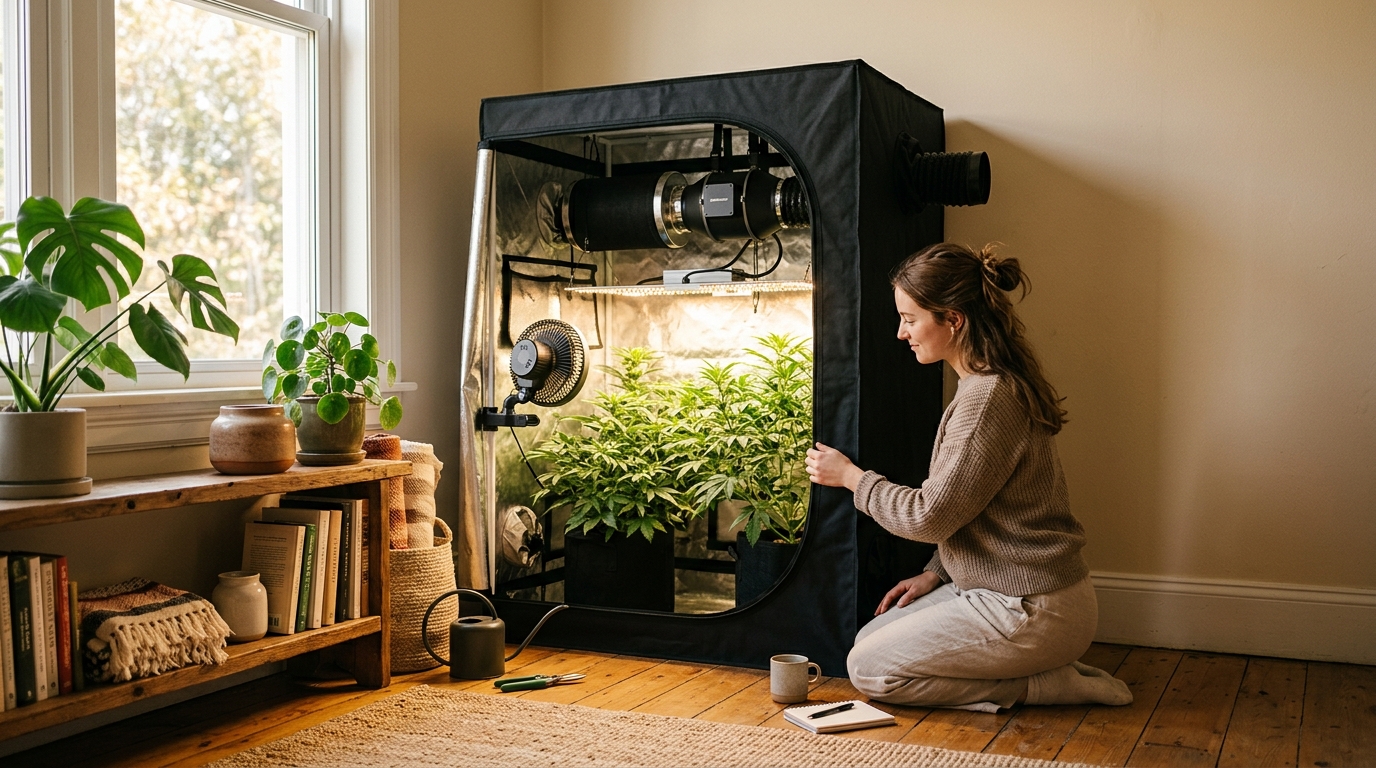
For a 4x4 grow tent, the AC Infinity Cloudline T6 is the definitive inline fan — 402 CFM, programmable 1-10 speed dial, and quiet enough at mid speeds to run continuously without disturbing a bedroom. Pair it with a 6-inch clip fan inside the tent for air circulation. On a tight budget, the VIVOSUN 6-inch 440 CFM inline fan does the same core job at roughly half the cost, with louder operation and simpler controls.
Quick comparison
| Product | Best for | Rating | Notes | |
|---|---|---|---|---|
| AC Infinity Cloudline T6 (6-inch) | best 6-inch fan; 3x3 and 4x4 tents | ★★★★★ | $90-110. 402 CFM. Programmable 1-10 speed dial. Quiet at mid speeds. | Check price |
| AC Infinity Cloudline S6 (6-inch) | quietest 6-inch fan; noise-sensitive setups | ★★★★★ | $80-100. 351 CFM. Slightly quieter than T6 at equivalent speeds. | Check price |
| VIVOSUN 6-inch 440 CFM Inline Fan | best budget inline fan; value-first growers | ★★★★☆ | $40-55. 440 CFM. Basic dial speed control. Louder than AC Infinity. | Check price |
| AC Infinity Cloudline T4 (4-inch) | best for 2x2 and 2x4 small tents | ★★★★★ | $65-80. 205 CFM. Right-sized for small tents; T6 is oversized here. | Check price |
| AC Infinity Cloudline T8 (8-inch) | best for 5x5 and larger tents | ★★★★★ | $130-150. 807 CFM. Handles large tent volumes without max-speed strain. | Check price |
| Hurricane Classic 6-inch Clip Fan | best circulation fan for inside the tent | ★★★★☆ | $20-30. Clips to tent poles. Oscillating. Strengthens stems. | Check price |
The picks
Best overall: AC Infinity Cloudline T6
Best for 3x3 and 4x4 grow tents; growers who want smart automation
AC Infinity Cloudline T6 (6-inch)
The Cloudline T6 is the standard 6-inch inline fan for home growers. Mixed-flow impeller design moves 402 CFM at max speed while drawing less power than equivalent centrifugal fans. The programmable 1-10 speed dial lets you dial in quiet operation at speed 4-5 (around 32 dB) during the day and ramp up at night or when temperatures spike. Connects to the AC Infinity Controller 67 or 69 Pro for automated speed response based on temperature and humidity readings. At 90-110 dollars, no competitor matches the combination of CFM output, quiet operation, and smart-ecosystem integration.
★★★★★ 4.8 · 12,400 reviews
Check current price on Amazon→Pros
- Mixed-flow impeller moves 402 CFM while staying quiet at mid speeds — around 32 dB at speed 5
- Programmable 1-10 speed dial with memory (holds last setting on restart)
- Integrates with AC Infinity Controller 67/69 Pro for automated temperature and humidity response
- Wide compatibility with 6-inch ducting and carbon filters from any brand
- One-year warranty; AC Infinity customer service consistently rated well in reviews
Cons
- 90-110 dollars is premium — VIVOSUN does the same core job at half the price for growers who do not need smart controls
- Controller sold separately; the automation benefit costs an additional 60-130 dollars for the controller unit
- Slightly less CFM than the VIVOSUN budget option (402 vs 440) at max speed, though the T6 operates more efficiently at lower speeds
- Heavier than budget inline fans — mounting hardware included, but the weight is noticeable in small tents
Quietest: AC Infinity Cloudline S6
Best for bedroom grows; noise-sensitive setups where the fan runs 24 hours
AC Infinity Cloudline S6 (6-inch)
The S6 is the quieter sibling of the T6. Where the T6 prioritizes maximum CFM output, the S in the S6 stands for quiet (the two series overlap significantly in practice). At equivalent speeds the S6 runs marginally quieter — meaningful in a bedroom or apartment grow where the fan runs continuously. Trade-off: 351 CFM max versus the T6 at 402 CFM. For a 3x3 or 4x4 tent where you run the fan at 50-60 percent speed anyway, the CFM difference is irrelevant. The S6 is the right call when noise is the primary concern.
★★★★★ 4.6 · 5,800 reviews
Check current price on Amazon→Pros
- Marginally quieter than the T6 at equivalent speed settings — meaningful in a shared living space
- Same programmable 1-10 speed dial and AC Infinity ecosystem compatibility as the T6
- 80-100 dollars — slightly cheaper than the T6 for comparable performance at typical operating speeds
- Right-sized CFM for 3x3 and 4x4 tents running at 50-70 percent speed
Cons
- 351 CFM max — 12 percent less than the T6; relevant if you run at max speed in a hot environment
- For most 4x4 tent setups running at mid speed, the noise difference from the T6 is negligible
- Same controller-sold-separately limitation as the rest of the AC Infinity lineup
Best budget: VIVOSUN 6-inch 440 CFM Inline Fan
Best for budget-first growers; first grow tent setups; growers who do not need smart controls
VIVOSUN 6-inch 440 CFM Inline Fan
At 40-55 dollars, the VIVOSUN 6-inch moves 440 CFM — technically more airflow than the AC Infinity T6 at max speed — with a basic rotary speed dial and standard 6-inch flanges for ducting compatibility. The trade-offs versus the T6 are real: louder operation at comparable speeds (the centrifugal design is less efficient than the T6 mixed-flow), no programmable speed memory, no smart controller compatibility. For a grower who checks on the tent manually, keeps it in a basement or garage where noise is not an issue, and does not want to spend 90-110 dollars on a fan, the VIVOSUN handles the ventilation job reliably. Thousands of successful grows have run on this fan.
★★★★☆ 4.3 · 8,900 reviews
Check current price on Amazon→Pros
- 40-55 dollars — roughly half the cost of the AC Infinity T6 for the same core exhaust function
- 440 CFM at max speed — higher than the T6 (402 CFM) at peak output
- Standard 6-inch flanges fit any 6-inch carbon filter, ducting, or grow tent port
- Speed dial provides basic airflow adjustment without any programming required
Cons
- Louder than AC Infinity at equivalent airflow output — centrifugal vs mixed-flow design
- No smart controller compatibility; manual-only speed adjustment
- No speed memory — resets to max on power cycle, requiring manual reset each time
- Build quality and longevity rated below AC Infinity in long-term grow community reviews
Best for small tents: AC Infinity Cloudline T4
Best for 2x2 and 2x4 tents; herb grows; propagation chambers; small setups
AC Infinity Cloudline T4 (4-inch)
Small tents need small fans. A 6-inch fan in a 2x2 or 2x4 tent operates so far below its efficient range that it vibrates, sounds rough, and exhausts air faster than the tent can passively replenish it — creating negative pressure that collapses tent walls. The Cloudline T4 at 205 CFM is properly sized: enough airflow to exchange a 2x4 tent (112 cubic feet) every 33-60 seconds at mid speed, quiet enough to run in a bedroom at speed 3-4, and at 65-80 dollars — cheaper than the T6. Same programmable dial and optional Controller 67 integration.
★★★★★ 4.7 · 6,200 reviews
Check current price on Amazon→Pros
- 205 CFM properly sized for 2x2 and 2x4 tents — a T6 is oversized and runs inefficiently in small spaces
- 65-80 dollars — the most affordable AC Infinity inline fan with the full smart ecosystem
- Same programmable 1-10 speed dial as the T6 and S6
- Compact size fits tighter grow tent pole configurations without cramping the space
Cons
- Underpowered for 3x3 and 4x4 tents — step up to the T6 for standard tent sizes
- Less CFM headroom if you run a heat-intensive light fixture in a small space
Best for large tents: AC Infinity Cloudline T8
Best for 5x5 and larger tents; high-wattage light setups; rooms with poor baseline airflow
AC Infinity Cloudline T8 (8-inch)
A 6-inch fan in a 5x5 or 4x8 tent runs at near-maximum speed to keep up with the air volume and the heat from 600-1000 watt light fixtures. Running a fan at max speed is the fastest path to early motor failure and the loudest possible operation. The Cloudline T8 at 807 CFM handles the same volume at 50-60 percent speed — quieter, cooler motor, longer service life. At 130-150 dollars, the premium over the T6 pays back in fan longevity and quieter operation within the first year.
★★★★★ 4.7 · 3,100 reviews
Check current price on Amazon→Pros
- 807 CFM handles 5x5 and 4x8 tent volumes at 50-60 percent speed — quieter and longer-lasting than running a T6 at max
- Same programmable 1-10 speed control and AC Infinity ecosystem integration as the T6
- Right-sized for high-wattage light setups (600W-1000W+) that generate substantial heat
Cons
- 130-150 dollars — most expensive AC Infinity inline option; T6 handles 4x4 and smaller
- Requires 8-inch ducting and carbon filter — verify your tent has 8-inch ports before buying
- Oversized for standard 4x4 tents; the T6 is the better match there
Best circulation fan: Hurricane Classic 6-inch Clip Fan
Best for inside-tent circulation; stem strengthening; hot-spot elimination
Hurricane Classic 6-inch Clip Fan
The inline exhaust fan removes air from the tent. The circulation fan moves air inside it — these are two separate jobs requiring two separate fans. The Hurricane Classic clips to horizontal tent poles, oscillates across the canopy, and runs quietly enough at low speed for round-the-clock operation. At 20-30 dollars, it costs less than the power strip it plugs into. For a 4x4 tent, one 6-inch Hurricane at medium speed on the lower canopy and one on the upper canopy (if you have tall plants) covers the circulation requirement without dead spots.
★★★★☆ 4.4 · 7,300 reviews
Check current price on Amazon→Pros
- 20-30 dollars — the least expensive piece of the complete grow tent fan setup
- Clip mount fits tent poles of most diameters; no separate bracket needed
- Oscillating motion covers a wider canopy area than a fixed-direction fan
- Three speed settings; low speed is genuinely quiet for 24-hour operation
Cons
- Clip mount can loosen over time on thinner tent poles — check tightness monthly
- Non-programmable; speed must be set manually each time power is cut
- The 6-inch size is adequate for most tents; large 5x5 and bigger tents benefit from two units
How to match fan size to your grow tent
Fan sizing in grow tents follows one rule: exchange the tent air volume once every 1-3 minutes. The formula:
Tent volume (cubic feet) ÷ target exchange time (minutes) = minimum CFM needed
Common tent sizes and the right fan:
- 2x2 tent (2×2×6 = 24 cubic feet): 8-24 CFM minimum → Cloudline T4 at speed 2-3
- 2x4 tent (2×4×6 = 48 cubic feet): 16-48 CFM minimum → Cloudline T4 at speed 3-4
- 3x3 tent (3×3×6 = 54 cubic feet): 18-54 CFM minimum → Cloudline T6 at speed 2-3
- 4x4 tent (4×4×7 = 112 cubic feet): 37-112 CFM minimum → Cloudline T6 at speed 3-5
- 5x5 tent (5×5×7 = 175 cubic feet): 58-175 CFM minimum → Cloudline T8 at speed 3-4
- 4x8 tent (4×8×7 = 224 cubic feet): 75-224 CFM minimum → Cloudline T8 at speed 4-5
Notice that most fans are running well below max speed in typical setups. This is correct — a fan at 50-60 percent speed is quieter, uses less power, and lasts longer than one at 100 percent. Size up rather than run hot.
If you run high-wattage LEDs (500W+) or live in a warm climate, use the 1-minute exchange target rather than the 3-minute target. Heat load adds significantly to exhaust requirements.
For complete ventilation setup guidance including passive intake sizing, carbon filter placement, and ducting layout, see the grow tent ventilation guide.
What to skip
Fans without a speed dial. On/off fans in grow tents are not useful — you need variable speed to dial in temperature and noise for continuous operation. Every fan listed above has speed control.
Undersized fans run at max speed. Matching a 4-inch fan to a 4x4 tent forces it to run at maximum capacity continuously. The motor burns out faster, the fan is louder, and the tent still struggles to stay cool. Buy the right size and run it at 50-60 percent.
Inline fans marketed as “carbon filter + fan combos.” These combine a low-CFM fan with a small activated carbon filter in one unit. The fan is usually undersized for the tent, and the filter volume is insufficient for meaningful odor control. Buy them separately at the right sizes.
Clip fans with fixed (non-oscillating) heads. A fixed-direction circulation fan creates a direct airflow path that leaves most of the canopy in still air. Oscillating fans serve a grow tent much better for the same price.
High-static-pressure fans marketed for grow tents. Industrial-grade inline fans built for long duct runs create more noise and draw more power than necessary in a standard home grow setup. Mixed-flow fans like the AC Infinity Cloudline handle the modest back pressure of a carbon filter and 4-6 feet of ducting at far lower noise and energy cost.
FAQ
Frequently asked questions
What size fan do I need for a 4x4 grow tent?
Is AC Infinity worth the extra cost over VIVOSUN?
Do I need a separate circulation fan if I have an inline fan?
Should I run the fan 24 hours a day?
What happens if my fan is too powerful for my tent?
Can I use the same fan for intake and exhaust?
Bottom line
Best overall: AC Infinity Cloudline T6 for 4x4 tents. Best budget: VIVOSUN 6-inch 440 CFM for growers who want exhaust without spending 100 dollars. Best for small tents: Cloudline T4. Best for large tents: Cloudline T8. Best circulation fan: Hurricane Classic 6-inch clip fan.
Every setup needs both an inline exhaust fan and a clip or oscillating circulation fan — buy both. Size the inline fan to exchange tent volume every 1-3 minutes, and run it at 50-60 percent speed for quieter, longer-lasting operation.
More grow tent setup: grow tent ventilation guide for airflow setup details, best grow tents for the enclosure itself, dehumidifiers for grow tent for humidity control, and AC units for grow tent for temperature control in hot climates.