roundups
Best AC Units for Grow Tents 2026
Best AC units for grow tents: portable single-hose, dual-hose, and mini-splits compared for 2x2 to 8x8 tents. Keep temps in the 70-80°F grow zone.
 Priya Anand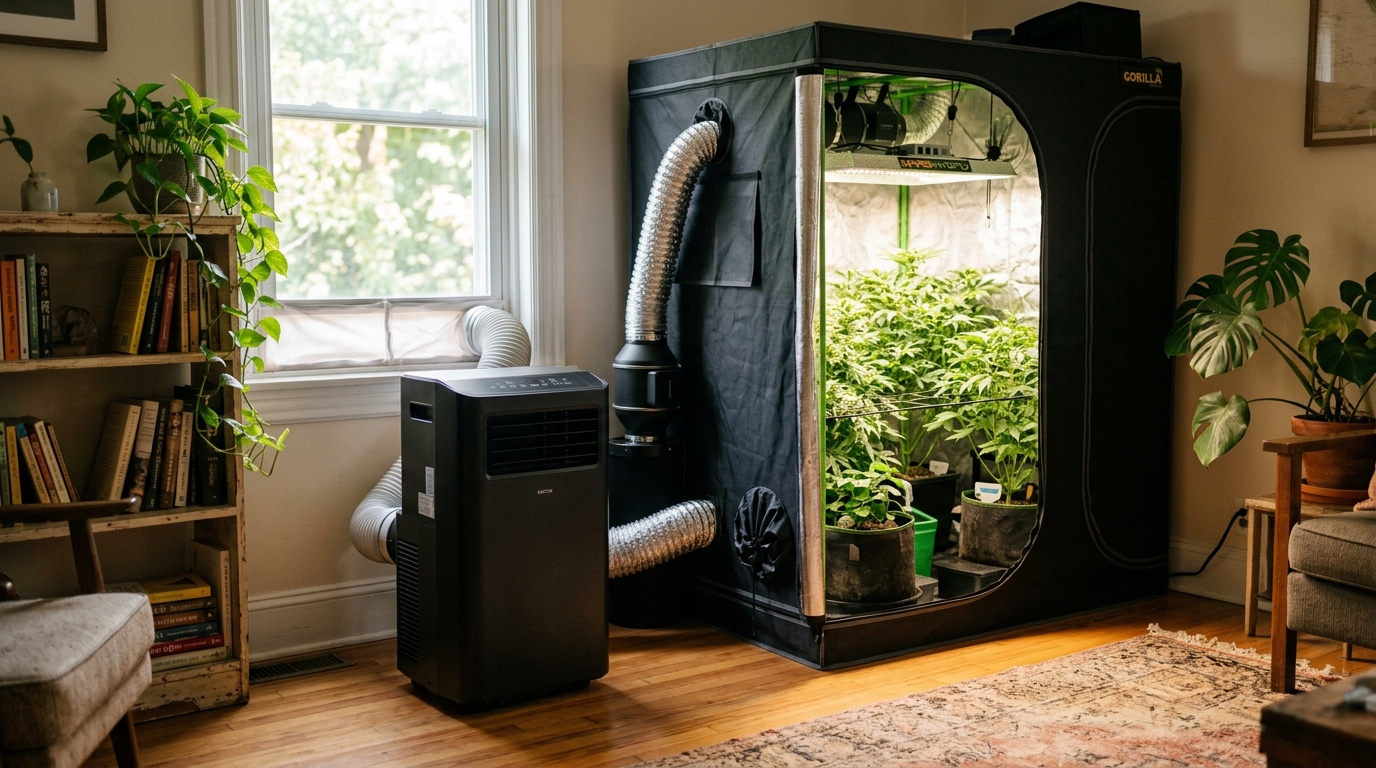
For most 4x4 grow tents running a 600–1000W LED, an 8,000–10,000 BTU dual-hose portable air conditioner is the correct cooling solution — dual-hose models pull intake air from outside the room rather than re-cooling air the grow tent already humidified, making them 25–30% more efficient than single-hose units in warm rooms. The Whynter ARC-14S handles tents up to 5x5; the hOmeLabs 8,000 BTU covers 3x3 to 4x4 tents at a lower price point.
Why grow tents overheat and why inline fans alone do not solve it
Inline exhaust fans control humidity and remove some heat, but they cannot cool a grow space below ambient room temperature — they can only match it. If your grow room is 75°F and your LED adds 10°F of heat load, the best an exhaust fan can do is bring the tent back to 75°F by exchanging the air. In summer, rooms regularly reach 80–90°F, making exhaust-only cooling insufficient for temperature-sensitive crops.
LEDs are far more efficient than HID lights but still convert 5–15% of power into radiant heat at canopy level. A 1,000W LED grow light generates roughly 3,400 BTU per hour — equivalent to running a small space heater inside the tent. High-power COB arrays and quantum board fixtures push tent temperatures 15–20°F above ambient without supplemental cooling.
Active cooling via a portable air conditioner or mini-split drops the air temperature directly rather than relying on air exchange with the room. For any summer grow or any grow room without air conditioning in the surrounding house, supplemental cooling is a requirement rather than an upgrade.
How to size an AC unit for your grow tent
The standard BTU calculation for grow tent cooling: multiply your grow light wattage by 3.4. A 600W LED generates approximately 2,040 BTU of heat per hour. A 1,000W LED generates approximately 3,400 BTU. Add 500 BTU for every 100 square feet of tent floor area to account for heat infiltration through the tent walls, and round up to the next available AC size.
| Tent Size | Common LED Wattage | Minimum BTU Needed |
|---|---|---|
| 2x2 ft | 200–300W | 5,000 BTU |
| 3x3 ft | 300–600W | 6,000–8,000 BTU |
| 4x4 ft | 600–1000W | 8,000–12,000 BTU |
| 5x5 ft | 1000–1500W | 12,000–14,000 BTU |
| 8x8 ft | 2000W+ | Mini-split required |
Always size up by one step if your ambient room temperature regularly exceeds 80°F in summer. An undersized AC runs continuously at full power without reaching target temperature, wearing out the compressor faster than a properly sized unit cycling on and off.
Quick comparison
| Product | Best for | Rating | Notes | |
|---|---|---|---|---|
| hOmeLabs 8,000 BTU Portable AC | best budget single-hose for 3x3 to 4x4 tents below 600W LED | ★★★★★ | $280-350. Single-hose design. Self-evaporating reservoir. Covers tents up to 4x4 with LEDs below 600W in rooms below 80 degrees F. | Check price |
| Whynter ARC-14S 14,000 BTU Dual-Hose | best dual-hose unit for 4x4 to 5x5 tents with 800-1500W LEDs | ★★★★★ | $450-550. Dual-hose design is 25-30% more efficient. Self-evaporating at 71 pints per day. Digital thermostat within 1 degree F accuracy. | Check price |
| Black+Decker BPACT06WT 6,000 BTU | best compact unit for 2x2 to 3x3 small tents below 300W | ★★★★☆ | $200-260. Lightest at 53 lbs. Correctly sized for small closet grows without short-cycling. Manual drain backup for high-humidity grows. | Check price |
| Pioneer 12,000 BTU Mini-Split | best permanent solution for large grow rooms and 5x5 to 8x8 setups | ★★★★★ | $700-1000 plus professional installation. SEER 17-19 efficiency. No hose routing, no water drainage. Correct choice for any permanent grow room over 5x5. | Check price |
The picks
Best budget portable AC for medium tents: hOmeLabs 8,000 BTU
Best for growers with 3x3 to 4x4 tents running LEDs up to 600W who want a proven, affordable portable AC
hOmeLabs 8,000 BTU Portable Air Conditioner
The hOmeLabs 8,000 BTU is the most recommended portable AC in grow tent communities for 3x3 and 4x4 setups running single LED panels below 600W. The single-hose design exhausts hot air through the provided window kit or through an unused tent port, keeping the tent cooler than the surrounding room when ambient temperatures are moderate. The self-evaporating design eliminates the need to manually empty a condensate pan in most climates — moisture collects and re-evaporates through the exhaust hose automatically. Setup takes under 30 minutes: run the exhaust hose through an unused grow tent port, position the intake grille facing the tent, and set the target temperature on the digital display. The unit operates in cooling and fan-only modes and includes an auto-restart function that resumes the last settings after a power outage — essential for unattended grows. The primary limitation is the single-hose design: because intake air is drawn from the same room the exhaust is venting heat into, efficiency is lower than a dual-hose unit. For tents above 600W or in rooms that run above 80 degrees F regularly, step up to the Whynter ARC-14S.
★★★★★ 4.5 · 12,400 reviews
Check current price on Amazon→Pros
- Proven performer in 3x3 and 4x4 grow tent applications with thousands of documented grower reviews
- Self-evaporating reservoir eliminates weekly manual draining in most moderate-humidity environments
- Auto-restart resumes the last temperature setting after power interruption — important for unattended tent grows
- Digital display with programmable timer allows scheduling to run at night when ambient temperatures are lowest
- Compact footprint compared to dual-hose units; fits beside a 4x4 tent without blocking intake or exhaust ports
Cons
- Single-hose design is less efficient than dual-hose models; efficiency drops as ambient room temperature rises above 80 degrees F
- Not sufficient for 4x4 tents running LEDs above 600W or rooms that regularly exceed 85 degrees F in summer
- Exhaust hose length of 5 feet may require a port extension in setups where the AC cannot sit directly beside the tent
- Compressor cycles loudly at startup; noise levels of 52-55 dB are audible in quiet spaces
Best dual-hose portable AC for large tents: Whynter ARC-14S
Best for serious growers with 4x4 to 5x5 tents and LEDs from 800W to 1500W who need reliable cooling all summer
Whynter ARC-14S 14,000 BTU Dual-Hose Portable AC
The Whynter ARC-14S is the standard recommendation for serious grow tent cooling. The dual-hose design is the key differentiator: one hose exhausts hot air out of the room while a second hose pulls fresh outside air in as intake. This prevents the unit from creating negative pressure inside your grow room and eliminates the efficiency loss of single-hose designs, where the unit must re-cool room air it draws in through gaps in the tent. In practice, a dual-hose unit at the same BTU rating cools a grow tent 25–30% more effectively than a comparable single-hose unit in a warm room. The ARC-14S runs a 14,000 BTU compressor adequate for 4x4 to 5x5 grow tents with LEDs up to 1,200W. The self-evaporating system handles up to 71 pints of moisture per day without a drain line — important in high-humidity grow environments. The digital thermostat holds set temperature within plus or minus 1 degree F, preventing the temperature swings that stress plants during the lights-on cycle. The unit includes a programmable 24-hour timer, three fan speeds, and auto-restart. At $450–550 it costs more than single-hose alternatives, but the efficiency advantage means lower electricity bills over a full summer season.
★★★★★ 4.6 · 6,800 reviews
Check current price on Amazon→Pros
- Dual-hose design is 25-30% more efficient than single-hose units by eliminating room depressurization and re-cooling of warm intake air
- 14,000 BTU covers 4x4 to 5x5 tents running LEDs up to 1,200W even in rooms reaching 85 degrees F
- Self-evaporating system handles 71 pints of moisture daily without a drain line — manages grow tent humidity output
- Digital thermostat with plus or minus 1 degree F accuracy prevents the temperature swings that stress fruiting plants
- Auto-restart and 24-hour timer allow fully automated temperature management without manual intervention
Cons
- Two hoses require two tent port openings; port tape and grommets are needed for a light-tight dual-hose setup
- Heavier than single-hose units at 82 lbs; requires two people to position next to the grow tent initially
- Higher purchase price of $450-550 versus $280-350 for single-hose units of comparable BTU rating
- Compressor noise at 52 dB is similar to other portable ACs; not a silent unit in a quiet grow space
Best for small 2x2 to 3x3 tents: Black+Decker BPACT06WT
Best for small 2x2 to 3x3 grow tents running LEDs up to 300W where a full-size portable AC would be oversized
Black+Decker BPACT06WT 6,000 BTU Portable AC
The Black+Decker BPACT06WT is the smallest portable AC worth considering for grow tent use. At 6,000 BTU it is sized for small 2x2 and 3x3 tents where larger units would create humidity problems by overcooling below the 70-degree target. Oversized ACs short-cycle — the compressor runs briefly, cools quickly, shuts off, then the room warms again before proper dehumidification occurs. The BPACT06WT runs a full cycle in a small space without the short-cycling problem. At 53 pounds it is the lightest unit in this comparison and fits in tight spaces beside a small closet grow. A single exhaust hose routes through any unused tent port. The manual drain option handles condensate in high-humidity environments when auto-evaporation cannot keep up. Most micro-growers running a 200W quantum board find the BPACT06WT provides adequate cooling through summer without the electrical draw and noise of a full 8,000 BTU unit.
★★★★☆ 4.3 · 3,200 reviews
Check current price on Amazon→Pros
- Correctly sized for 2x2 and 3x3 tents — avoids the short-cycling problem caused by oversized ACs in small enclosed spaces
- Lightest portable AC in this comparison at 53 pounds; fits in tight closet grows without dominating the floor space
- Lower electrical draw than 8,000-14,000 BTU units; appropriate for tent builds below 300W LED
- Single exhaust hose routes through any standard grow tent port without additional hardware or modification
Cons
- Underpowered for 4x4 tents or any setup running LEDs above 300W; temperatures will not stay in range under heavier light loads
- Manual drain required in high-humidity grow environments when condensate exceeds auto-evaporation capacity
- Digital display is less intuitive than hOmeLabs or Whynter units; timer programming requires consulting the manual
- Single-hose only configuration; efficiency limitations apply in warm rooms above 80 degrees F
Best for large permanent setups: Pioneer 12,000 BTU Mini-Split
Best for permanent dedicated grow rooms of 5x5 feet and larger where a portable AC cannot maintain target temperatures
Pioneer WYS012GMFI22RL 12,000 BTU Mini-Split
A ductless mini-split system is the right cooling solution for any serious permanent grow room over 5x5 feet. Mini-splits separate the compressor (outdoor unit) from the air handler (indoor unit), eliminating the heat the compressor itself generates from the growing environment entirely. The Pioneer 12,000 BTU system runs at SEER 17-19 — roughly twice the efficiency of a portable AC — meaning lower electricity costs over a full growing season. The indoor wall-mounted head delivers conditioned air directly into the room without hose routing limitations, provides both cooling and heating, and operates near-silently compared to portable units at 25-30 dB. The fundamental difference from a portable AC: a mini-split requires professional refrigerant line installation between the indoor and outdoor unit. Budget $700-1,000 for the unit plus $300-600 for installation. In a permanent grow room used year-round, the efficiency gains typically recover the installation cost premium within one to two growing seasons depending on local electricity rates and operating hours.
★★★★★ 4.7 · 2,900 reviews
Check current price on Amazon→Pros
- SEER 17-19 efficiency rating is roughly twice that of portable ACs; lower operating costs over a full growing season
- Outdoor compressor unit eliminates compressor heat from the growing environment entirely
- Indoor head operates at 25-30 dB — near-silent compared to portable units; no noise interference with timers or sensors
- Provides both cooling and heating in a single system; maintains grow room temperatures year-round without seasonal changes
- No hose routing required; no condensate management; no need to empty a reservoir or manage a drain line
Cons
- Professional installation of refrigerant lines required; adds $300-600 to the total cost and requires scheduling an HVAC technician
- Permanent installation; not suitable for temporary or rental setups where a portable unit can be moved or stored
- Higher upfront cost at $700-1,000 for the unit before installation; payback period is 1-2 years versus portable ACs
- Outdoor unit requires exterior wall access and a dedicated 240V circuit in most residential installations
Routing an AC unit into a grow tent
Single-hose units: Route the exhaust hose through an unused grow tent port or cut a small hole in the tent wall sized to fit the hose collar. The AC unit sits outside the tent and draws room air through its intake grille. Use tent zipper seals or mylar tape around the hose entry point to prevent light leaks during dark periods.
Dual-hose units: Run both hoses — exhaust and intake — through separate grow tent ports. The intake hose pulls air from inside the tent or from outside the room via a secondary duct; the exhaust hose vents heat out. If your tent does not have enough ports, a 4-inch hole saw creates a clean opening that can be sealed with a rubber grommet when the AC is not in use.
Mini-splits: The indoor head unit mounts directly on the wall of the grow room. No hose routing is required. Refrigerant lines run through a 3-inch hole in the wall to the outdoor compressor. Maintain 6–12 inches of clearance above and below the indoor head for proper airflow distribution across the room.
For all configurations, set the AC thermostat 2–3°F below your target grow temperature to account for the heat generated by the grow light cycling back on after the compressor turns off. A digital temperature controller with an independent sensor placed at canopy level gives more precise control than the built-in thermostat of any portable unit.
What to skip
Window air conditioners — traditional window ACs require a window opening sized to the unit and cannot connect to a grow tent without extensive duct work. They work well for cooling an entire room but offer no advantage over a properly routed portable unit for grow tent applications. The installation complexity and requirement for a specific window size make them impractical for most home grows.
Swamp coolers (evaporative coolers) — evaporative coolers add humidity as they cool, which is the opposite of what a high-humidity grow tent needs. Grow tents generating 60–80% RH from plant transpiration and reservoir evaporation cannot tolerate additional humidity loading. Evaporative coolers suit dry desert climates; they make humidity problems worse in any reasonably humid environment.
Dehumidifier-AC combo units — combo dehumidifier-air conditioner units are available in the 50–70-pint range, but the cooling capacity of these units is incidental rather than primary. They dehumidify effectively but lack the BTU rating to maintain target grow temperatures in a tent with a serious light load. If you need both dehumidification and cooling, run a dedicated portable AC alongside a standalone dehumidifier.
FAQ
Frequently asked questions
What size AC do I need for a 4x4 grow tent?
Can I put an AC unit inside my grow tent?
Is a single-hose or dual-hose portable AC better for a grow tent?
What temperature should a grow tent be?
Will an inline fan cool my grow tent without an AC?
Where should I route the AC exhaust hose from my grow tent?
Bottom line
For most indoor growers: a dual-hose portable AC is the best balance of performance and flexibility. The Whynter ARC-14S 14,000 BTU handles 4x4 to 5x5 tents with LEDs up to 1,200W and holds temperature within 1 degree F of the set point. For smaller 3x3 and 4x4 tents below 600W, the hOmeLabs 8,000 BTU delivers adequate cooling at a lower price. For 2x2 micro-grows, the Black+Decker BPACT06WT is correctly sized without the efficiency losses of short-cycling. For any permanent grow room over 5x5 feet used year-round, a Pioneer mini-split pays back its installation premium in efficiency within two seasons.
Match the BTU rating to your light load, use a dual-hose unit whenever possible, and route exhaust out of the room entirely — those three decisions determine whether a portable AC maintains your target temperature or runs continuously without reaching it.
For related reading: grow tent ventilation guide for the complete fan and carbon filter setup alongside AC cooling, dehumidifiers for grow tent for humidity control to pair with temperature management, best grow tents for tent selection that affects airflow and cooling needs, and grow tent size guide for matching tent size to grow light wattage and AC requirements.