roundups
Best Dehumidifiers for Grow Tents 2026 (Sized by Tent)
Best dehumidifiers for grow tents: Pro Breeze, SEAVON, hOmeLabs, Eva-Dry. RH targets by stage, sizing math, and peltier vs compressor explained.
 Priya Anand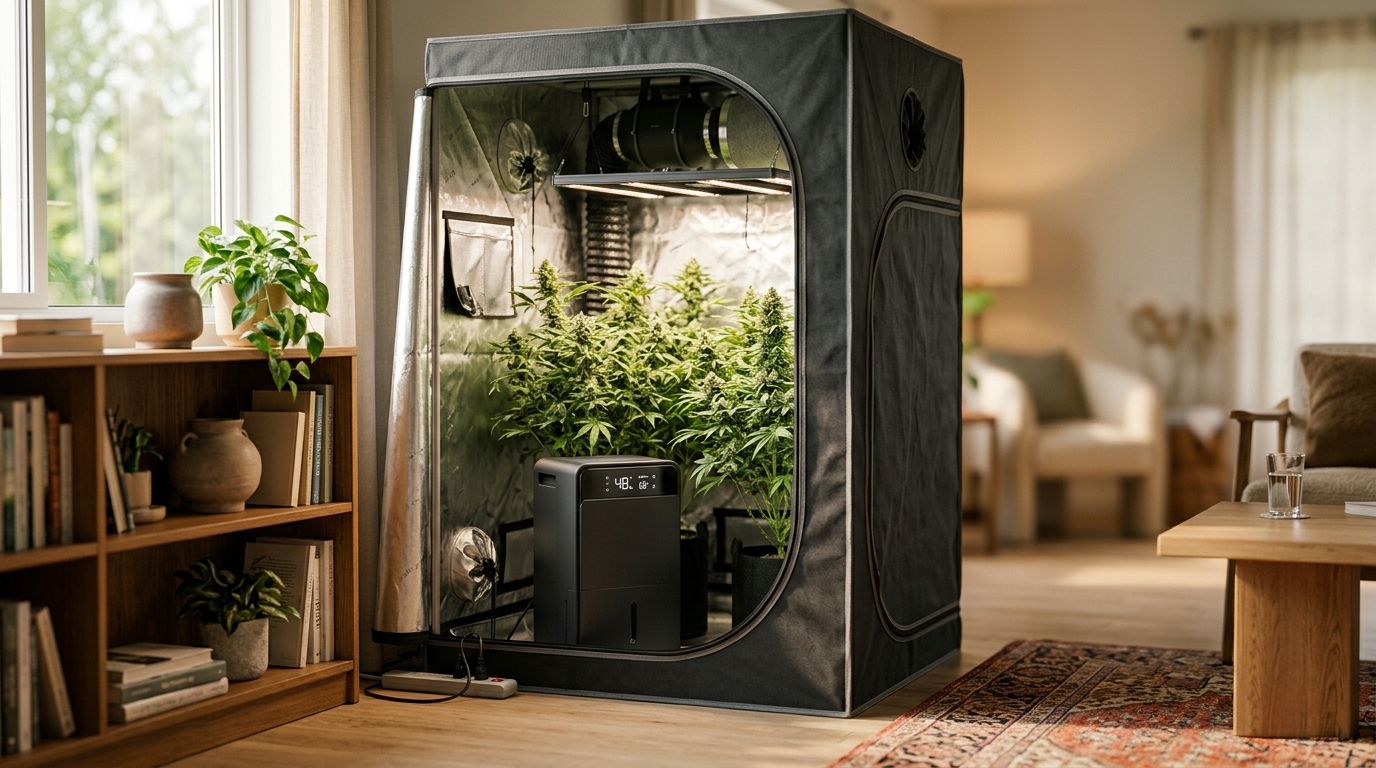
The Pro Breeze 1500ml Mini Dehumidifier handles most 2x2 to 3x3 tents for $35-45 — peltier-based, adds minimal heat, and pulls consistent moisture during vegetative and early flower. For a 4x4 tent in late flower, when plants push relative humidity above 60% and you need it below 50%, step up to a compressor-based 30- to 35-pint unit like the hOmeLabs to actually move meaningful air volume.
Why humidity control in a grow tent is non-negotiable
A sealed grow tent traps transpiration moisture. Every plant leaf releases water vapor throughout the day, and in a 4x4 tent with 6-8 plants in late veg, you can easily see 20-30% relative humidity swings over a 24-hour period. Left uncontrolled, high humidity causes three problems:
- Botrytis (bud rot) above 55% RH during flower — the most common catastrophic failure in dense flowering canopies
- Powdery mildew in the 50-80% RH window, especially with poor airflow at the canopy level
- Pythium (root rot) pressure in hydroponic systems when humidity and root zone temperature are both high
The flip side: humidity too low (below 35%) in veg causes stomata to close, slowing growth and causing leaf curl. The optimal ranges differ by growth stage, and managing them actively separates consistently successful grows from inconsistent ones.
RH targets by growth stage
| Growth stage | Target RH | Rationale |
|---|---|---|
| Seedling / clone | 65-80% | Roots not established; leaves must absorb moisture |
| Early veg | 55-70% | Plants building structure; high transpiration efficient |
| Late veg | 45-60% | Start conditioning plants toward flower environment |
| Early flower (weeks 1-3) | 40-50% | Buds beginning to form; mold risk rising |
| Late flower (weeks 4+) | 35-45% | Dense buds; any spike above 55% risks botrytis |
| Final week (flush/harvest) | Below 45% | Maximize terpene density and minimize rot risk |
Peltier vs compressor dehumidifiers: which one belongs in your tent
This is the single most important decision. The technology determines what tent size a unit can actually handle.
Peltier (thermoelectric) dehumidifiers:
- Use a temperature differential across ceramic tiles to condense moisture — no moving compressor parts
- Quiet (under 35 dB), lightweight, and low-heat output
- Real extraction rate: 500-1500ml per day in realistic humid conditions
- Works well in: 2x2, 2x4, 3x3 tents; seedling and veg stages in 4x4
- Limitation: extraction rate drops significantly below 70% RH and below 65°F (18°C) ambient temperature
Compressor-based dehumidifiers:
- Use a refrigerant cycle to cool a coil and condense large moisture volumes
- Louder (45-55 dB), heavier, generate noticeable heat (adds 3-8°F to the space)
- Real extraction rate: 20-50 pints per day regardless of ambient RH level
- Works for: 4x4, 5x5, 4x8 tents; flowering stage at any tent size
- Important: run it outside the tent when possible, with a duct port for intake and exhaust, to avoid the heat addition inside the tent canopy
For most home growers with a single 4x4 tent, the right answer is: use a peltier unit during seedling and veg, then add a small compressor unit outside the tent during flowering.
Sizing guide: what extraction rate do you actually need
Grow tent volume in cubic feet = length (ft) × width (ft) × height (ft).
- 2x2x6.5 = 26 cubic feet
- 2x4x6.5 = 52 cubic feet
- 3x3x6.5 = 58.5 cubic feet
- 4x4x6.5 = 104 cubic feet
- 5x5x6.5 = 162.5 cubic feet
A rough rule: for every 50 cubic feet of tent volume with 4-6 actively flowering plants, you need 10-15 pints/day of dehumidification capacity. A 4x4 tent at peak flower with 6 plants needs 20-30 pints/day — well beyond what any peltier unit delivers.
For veg only at any tent size, a peltier unit (Pro Breeze 1500ml = about 3 pints/day) is usually sufficient because plants are not yet transpiring at peak rate.
Quick comparison
| Product | Best for | Rating | Notes | |
|---|---|---|---|---|
| Pro Breeze 1500ml Mini Dehumidifier | best peltier pick; 2x2 to 3x3 tents | ★★★★☆ | $35-45. True 1500ml/day. Quiet peltier, minimal heat. | Check price |
| SEAVON Electric Small Dehumidifier | budget peltier; seedling and clone tents | ★★★★☆ | $25-35. Ultra-compact. Works in spaces up to 1200 sq ft. | Check price |
| Afloia Compact Electric Dehumidifier | mid-range peltier; 3x3 veg or 2x4 flower | ★★★★☆ | $50-70. 26oz tank. Larger peltier extraction than budget options. | Check price |
| hOmeLabs 35 Pint Energy Star Dehumidifier | best compressor pick; 4x4 to 5x5 flowering | ★★★★★ | $180-220. 35 pints/day. Energy Star. Run outside tent for best results. | Check price |
| Eva-Dry E-333 Renewable Mini Dehumidifier | passive supplemental; 2x2 and small clone tents | ★★★★☆ | $25-35. Silica gel, no electricity during use. Recharges in wall outlet. | Check price |
The picks
Best for small tents: Pro Breeze 1500ml Compact Mini Dehumidifier
Best for 2x2 and 3x3 grow tents; veg stage in 4x4 tents
Pro Breeze 1500ml Compact Mini Dehumidifier
The Pro Breeze 1500ml is the most consistently recommended peltier dehumidifier for small grow tents. At $35-45, it extracts a genuine 1500ml per day in 80-85% RH conditions — that is roughly 3 pints per day, enough to keep a 3x3 tent with 4 vegging plants in the 50-65% RH window. The peltier design means no compressor noise (under 35 dB), no refrigerant, and negligible heat addition to the tent — important when you have already invested in cooling. It has an auto-shutoff when the 1000ml tank is full and a continuous drain hose port if you want hands-off operation. Limitations are honest: in a 4x4 tent with 6 flowering plants pushing humidity to 70%+, it cannot keep up. Size it correctly and it is the easiest, cheapest solution for the majority of home growers.
★★★★☆ 4.4 · 8,200 reviews
Check current price on Amazon→Pros
- True 1500ml/day extraction at 80% RH — verified by real-world grower reports
- Peltier design: quiet (under 35 dB), no compressor, minimal heat addition
- Auto-shutoff when tank is full prevents overflow onto grow medium
- Continuous drain port for hands-off, no-empty operation with a hose into a bucket
- $35-45 price makes it the lowest entry cost for real humidity control
Cons
- Extraction rate drops sharply below 70% RH — ineffective for late-flower drydown below 45%
- Performance degrades below 65 degrees F; not suited for cold garages in winter
- 1000ml tank needs emptying every 16-20 hours without continuous drain setup
- Not sufficient for 4x4 tents with 6+ plants in flower — peltier physics limit the output
Best budget: SEAVON Electric Small Dehumidifier
Best for clone tents; seedling chambers; extremely tight budgets
SEAVON Electric Small Dehumidifier
The SEAVON is the budget entry for clone tents, propagation chambers, and 2x2 seedling setups. At $25-35 it is the lowest-cost electric option that actually produces measurable dehumidification. The extraction rate is lower than the Pro Breeze — closer to 800-1000ml/day in real conditions — but for a 26-cubic-foot clone tent where you want to keep humidity just below 75% without crashing it, the SEAVON does the job without spending $40. It is also exceptionally compact, fitting into corners of a small tent without blocking airflow. Expect to replace it in 12-24 months of continuous use; peltier units at this price tier have shorter lifespans than mid-tier equivalents.
★★★★☆ 4.2 · 5,100 reviews
Check current price on Amazon→Pros
- Lowest cost entry — $25-35 for real electric dehumidification
- Ultra-compact form factor fits in tent corners without blocking airflow
- Low power draw (~22W) keeps electricity cost negligible
- Good for 2x2 clone tents and seedling chambers where light dehumidification is sufficient
Cons
- Real-world extraction closer to 800-1000ml/day, not the advertised maximum
- Shorter lifespan than mid-tier peltier units — 12-24 months continuous use expected
- No continuous drain port on base models — manual tank emptying only
- Inadequate for any tent above 3x3 or any flowering stage
Best compressor for 4x4+ tents: hOmeLabs 35-Pint Energy Star Dehumidifier
Best for 4x4 and 5x5 tents during flowering; growers who need real RH reduction
hOmeLabs 35 Pint Energy Star Dehumidifier
When a 4x4 tent with 6 plants hits late flower, peltier units simply cannot lower RH by 10-15 percentage points — the physics do not allow it. The hOmeLabs 35-Pint is the compressor pick at this price ($180-220): Energy Star certified, 35 pints of daily extraction at 80% RH and 86°F, a continuous drain port for hands-off operation, and a built-in hygrometer. The critical installation decision: run it outside the tent whenever possible. A compressor unit adds 5-8°F of heat inside the tent, fighting your grow light cooling budget. Route a 6-inch duct from a tent port to the dehumidifier intake, and exhaust outside the tent. This setup lets the unit pull humid tent air, extract the moisture, and return drier air through a second port — without adding compressor heat directly into the canopy.
★★★★★ 4.5 · 14,600 reviews
Check current price on Amazon→Pros
- 35 pints/day extraction — enough for 4x4 to 5x5 tents through late flowering
- Energy Star certified — lower electricity costs than non-certified compressor units
- Built-in digital hygrometer and adjustable RH target — set it and leave it
- Continuous drain port allows 24/7 operation without manual tank emptying
- Quiet for a compressor unit (51 dB); comparable to a medium box fan
Cons
- Compressor adds 5-8 degrees F of heat — must be run outside tent or with duct isolation
- $180-220 price is a real commitment; justified only for serious 4x4+ growers in flower
- Larger footprint than peltier units — needs floor space outside the tent
- Compressor refrigerant means periodic professional service if it stops cooling effectively
Best passive supplemental: Eva-Dry E-333 Renewable Mini Dehumidifier
Best for 2x2 clone tents; supplemental humidity buffer; off-grid or silent setups
Eva-Dry E-333 Renewable Mini Dehumidifier
The Eva-Dry E-333 uses silica gel to passively absorb moisture — no electricity during operation, no noise, no heat. At $25-35 it handles spaces up to 333 cubic feet, regenerating by plugging into a wall outlet when the silica gel is saturated (indicated by a color window). In a 2x2 clone tent, the Eva-Dry works as a primary passive dehumidifier between light cycles when you want zero mechanical noise or heat. As a supplement to a peltier unit in a 3x3, it adds a buffer to prevent RH spikes during the first hour of the lights-on period when transpiration peaks. Limitation: passive silica gel systems cannot match the extraction rate of even the cheapest peltier unit under sustained high humidity. Use it for moderate-humidity management and small spaces, not for hammering humidity down 15+ points.
★★★★☆ 4.3 · 6,800 reviews
Check current price on Amazon→Pros
- Zero electricity during use — truly passive silica gel absorption
- Completely silent; no fan, no compressor, no noise
- No heat addition — ideal for temperature-sensitive seedling and clone setups
- Reusable indefinitely: plug into wall for 8-10 hours to regenerate silica gel
- $25-35 makes it a low-risk supplemental tool
Cons
- Cannot compete with peltier or compressor units for active RH reduction
- Works best as a buffer or supplement, not as sole humidity control in active grows
- Regeneration requires a 8-10 hour plug-in cycle — plan around it
- Silica gel lifespan degrades after 3-5 years of repeated regeneration cycles
Connecting your dehumidifier to a humidity controller
A standalone dehumidifier cycling on and off manually defeats much of its value. The best setup pairs any dehumidifier with a dedicated humidity controller (not a timer):
- Inkbird IHD-020 or Inkbird IBS-TH3 humidity controller: plug the dehumidifier into the controller outlet, set your target RH, and the controller turns the unit on only when humidity exceeds your threshold. This prevents over-drying and reduces electricity use by 30-50%.
- AC Infinity CONTROLLER 69 Pro: if you are already in the AC Infinity grow tent ecosystem, this controller manages both the inline fan and a humidity-triggered dehumidifier outlet — one unit managing the whole environmental loop.
- Govee smart hygrometer + smart plug: a budget DIY approach using a Govee hygrometer for monitoring and a Wi-Fi smart plug programmed to switch based on Govee alerts. Less precise than dedicated controllers but works for simple setups.
Without a controller, a dehumidifier running 24/7 can push humidity below 35% during lights-off in a small tent — especially with peltier units in winter — causing leaf curl, slow growth, and in extreme cases tip burn from moisture stress.
Placement matters more than most growers realize
- Peltier units: place on the tent floor near an oscillating fan. The fan draws humid air past the cold plate and circulates drier air back through the canopy. Never place the peltier unit directly under the canopy drip line.
- Compressor units outside the tent: use a 6-inch flexible duct through a tent port to connect the dehumidifier intake to tent interior. Run the compressor exhaust into the same room, not back into the tent. This extracts moisture without returning hot air.
- Eva-Dry passive units: hang from a top corner using the built-in hook or place on an upper shelf bracket away from direct transpiration airflow. Passive units capture moisture by contact; positioning them where air circulates through gives better performance.
- Hygrometer placement: place your humidity sensor at canopy level, not at floor level or near the dehumidifier. Floor RH can be 10-15 points lower than canopy RH in dense grows, and you are managing canopy conditions, not floor air.
What to skip
- Unknown-brand mini dehumidifiers claiming 1500+ ml/day extraction for under $20. Peltier physics constrain extraction rate to ambient humidity and temperature. Units claiming high extraction at low prices test at unrealistic 90% RH and 85°F — in a real tent at 65% RH and 72°F, they extract 200-400ml/day. Pro Breeze and Afloia test honest; the $18 Amazon generics do not.
- Desiccant rod dehumidifiers (plug-in heating rod type). These add heat to reduce relative humidity by raising temperature — not by removing actual moisture. The absolute humidity in the tent stays the same; the reading drops because warm air holds more moisture. This masks the problem without solving it and raises canopy temperature.
- Full-size household dehumidifiers (50+ pint) inside a 4x4 tent. The compressor heat alone would require a dedicated AC unit to compensate. Full-size units belong in the room, not the tent.
- Dehumidifiers without auto-shutoff. When the tank overflows without auto-shutoff, it floods grow medium, damages roots, and creates standing water that accelerates fungus gnats and pythium. Auto-shutoff is mandatory, not optional.
- Running any dehumidifier without a humidity controller. Unconstrained dehumidifiers in small tents regularly drop RH to 20-30% during lights-off in winter — severe enough to stunt growth and cause permanent leaf damage.
FAQ
Frequently asked questions
Do I need a dehumidifier for a grow tent?
Can I use a peltier dehumidifier in a 4x4 tent?
Will a dehumidifier raise the temperature inside my tent?
What humidity controller should I pair with my dehumidifier?
How do I know what size dehumidifier I need?
Can I use a household dehumidifier outside the grow tent?
Bottom line
Best small tent (2x2, 3x3): Pro Breeze 1500ml Mini Dehumidifier — peltier, quiet, $35-45, honest extraction. Best budget for clone tents: SEAVON Electric Dehumidifier — $25-35, ultra-compact, adequate for low-load environments. Best for 4x4+ in flower: hOmeLabs 35-Pint Energy Star — compressor, 35 pints/day, run it outside the tent. Best passive supplemental: Eva-Dry E-333 — silica gel, zero electricity during use, adds a humidity buffer without heat or noise.
Pair any electric dehumidifier with an Inkbird humidity controller to automate RH management and prevent over-drying during lights-off.
For the complete grow tent setup: grow tent ventilation, tent sizing guide, how to set up a grow tent, and best grow tents.