roundups
Best Watering Cans 2026
Best watering cans for indoor plants: precision long-neck pours, ergonomic 1-gallon picks, and the classic Haws that justifies its price.
 Priya Anand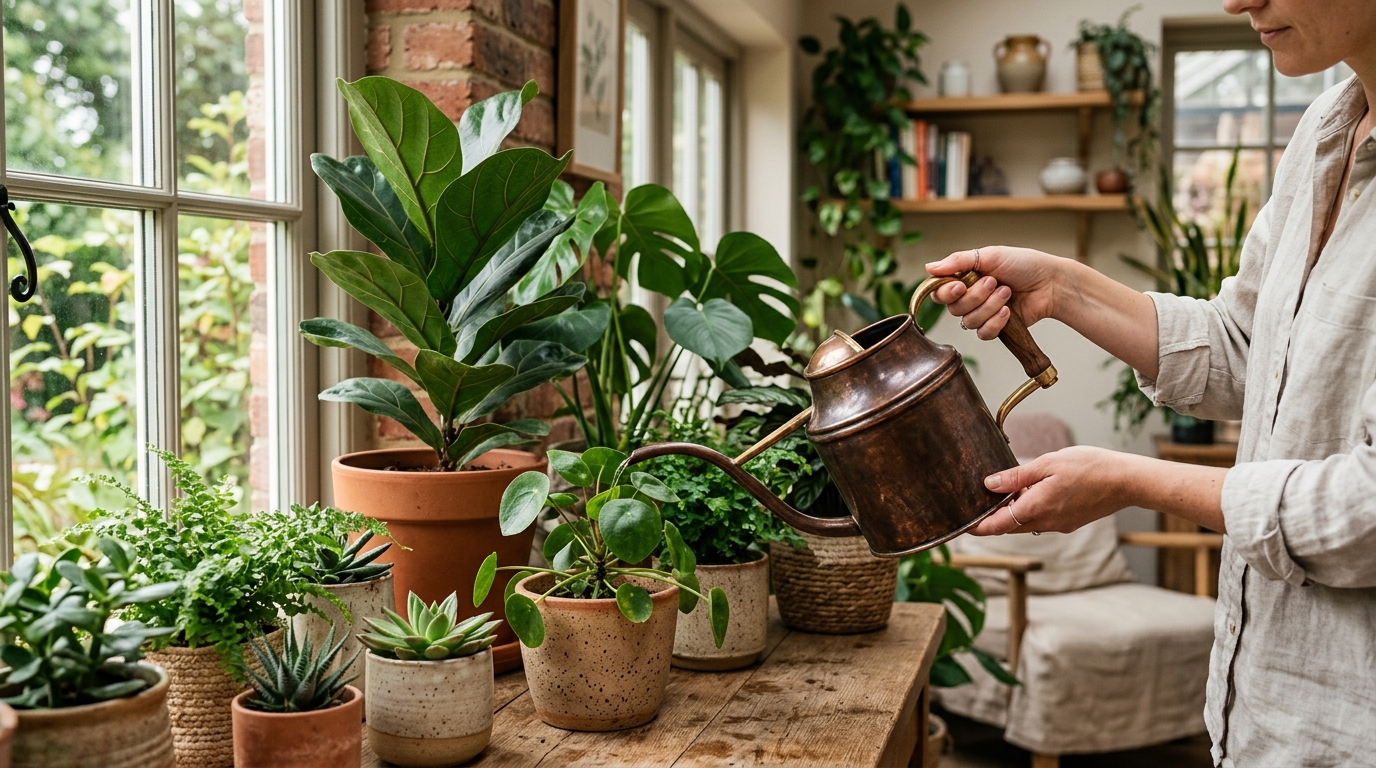
Most indoor plant problems trace back to watering — too much, too little, or landed in the wrong place. A watering can designed for indoor use makes precise, low-splash delivery genuinely easy. The difference shows up immediately: a long-neck can with a narrow spout reaches under leaves and into tight pots without soaking foliage or sending water across a shelf. A wide-mouth outdoor can does the opposite.
The specs that actually matter: spout length and aperture (determines whether you can aim precisely into a 4-inch pot), capacity (a 1-liter can is right for 3–6 plants per fill; a gallon can cuts refill trips for larger collections), and handle-to-spout balance (a poorly balanced can forces awkward wrist angles that become tiring across 10+ plants). Haws cans are genuinely better balanced than generic options — not marketing, just the result of 130+ years spent engineering only watering cans. For seedlings and microgreens, a detachable rose head (perforated spray disc) matters more than spout length: a direct stream flattens fragile new growth, while a gentle spray distributes water evenly across the tray.
This guide covers the real options: the premium Haws Slimline, the budget-precision RIEMEX gooseneck, the Dramm for seedling work, the Bloem for larger plant collections, and the H. Potter for growers who care about how the can looks on a shelf.
How watering cans actually differ
Three factors separate the useful options from the frustrating ones:
Spout design. The most important decision is gooseneck (long, curved, narrow) versus standard (short, wider opening). Gooseneck cans pour in a controlled stream you can aim directly at the soil between leaves without disturbing the canopy. Standard short spouts work outdoors on open garden beds where precision doesn’t matter. Indoors, with pots arranged on windowsills and shelves, the gooseneck almost always wins. Spout length also determines reach — a 12-inch gooseneck can access the back of a deep shelf without you moving other plants out of the way.
Capacity. A 1-liter can weighs about 2.2 lbs full — light enough to handle with one hand and hold at an angle for an extended pour. A full gallon (~3.8 liters) weighs 8 lbs and demands two hands or a dual-handle design to manage comfortably. The math for choosing: if you water 10 or fewer pots in a session, a 1-liter can is more practical than refilling a large outdoor can. If you’re touring 20+ plants, a gallon capacity cuts refill trips significantly.
Balance. A watering can’s balance point changes as it empties. A well-engineered can — Haws being the standard example — maintains a usable center of gravity from full to nearly empty because the spout length, body geometry, and handle position are calculated together. Budget plastic cans often place the handle at the wrong point relative to the spout, forcing you to over-grip or tilt awkwardly. After daily watering for a year, the ergonomic difference between a good and bad can becomes obvious.
Quick comparison
| Product | Best for | Rating | Notes | |
|---|---|---|---|---|
| Haws Slimline 1L Indoor Watering Can | best overall; daily indoor plant growers who want a precision pour for life | ★★★★★ | $35–55. Galvanized or copper. Perfectly balanced, drip-free spout, rose head included. | Check price |
| RIEMEX Long-Neck Watering Can | best budget gooseneck; indoor precision without the premium price | ★★★★★ | $12–18. Plastic gooseneck. Accurate pour at the right entry price. | Check price |
| Dramm 2-Liter Indoor Watering Can | best for seedlings; thumb shut-off valve and fine-spray rose head | ★★★★★ | $20–30. Plastic, 2L. Shut-off valve makes precision seedling watering practical. | Check price |
| Bloem Aqua Rite 1-Gallon Watering Can | best for large collections; dual handle, gallon capacity, affordable | ★★★★☆ | $15–25. Plastic, 1 gallon. Two-handle design distributes weight of a full gallon. | Check price |
| H. Potter Long-Neck Copper Watering Can | best decorative pick; gooseneck precision with a display-worthy copper finish | ★★★★★ | $35–60. Copper or galvanized. Good pour quality; looks excellent on a plant shelf. | Check price |
The picks
Best overall: Haws Slimline Indoor Watering Can
Best for daily indoor plant growers who want a can they'll buy once and use for decades
Haws Slimline 1-Liter Indoor Watering Can
The Haws Slimline is the watering can that indoor gardeners buy when they stop settling for whatever was cheapest on Amazon. It's a 1-liter British-made can with a long curved spout and a handle positioned directly above the can's center of gravity when full — which means it pours smoothly from first use to nearly empty without requiring you to actively correct your grip. That balance is the thing people can't stop mentioning in reviews, and it's real: pour with a full Haws and the can cooperates. Pour with a cheap imbalanced plastic can and you're fighting it the whole way. The spout aperture is narrow enough to aim precisely into a 4-inch pot between leaves without wetting foliage. The pour starts clean and stops clean — the tip doesn't dribble as you carry the can between plants. A fine-spray rose head is included for seedlings. Available in galvanized steel or polished copper. At $35–55 it costs 3–4x more than a generic plastic can and lasts 20x longer.
★★★★★ 4.8 · 3,200 reviews
Check current price on Amazon→Pros
- Precisely balanced over the center of gravity — pours smoothly at any fill level without wrist strain
- Narrow spout aims accurately into small pots and between leaves without splash
- Clean, drip-free stop — no trailing dribble as you carry it across the room
- Detachable fine-spray rose head included for seedlings and fragile plants
- Galvanized steel or copper finishes that last decades with minimal maintenance
- Haws has been making only watering cans since 1886; the geometry reflects that focus
Cons
- At $35–55, it costs significantly more than plastic alternatives
- Metal construction adds weight; a full Haws at 1L weighs about 3 lbs vs 1.5 lbs for a comparable plastic can
- 1-liter capacity means refilling for plant collections of 12+ unless you stage trips
- Some finishes develop surface oxidation over time — rinse and dry after use to slow this
Best budget precision: RIEMEX Long-Neck Watering Can
Best for budget-conscious indoor plant growers who need gooseneck precision without the Haws price
RIEMEX Long-Neck Indoor Watering Can
For growers who want the key indoor watering feature — a narrow gooseneck spout that reaches between plants and under leaves — without paying Haws prices, the RIEMEX is the right answer. The extended gooseneck is meaningfully longer than most sub-$20 cans, reaching to the back of dense shelf arrangements without disturbing the front plants. The pour is controlled and accurate for normal indoor plant watering. The plastic body is lighter than metal, which makes it easier to handle one-handed, though that same lightweight plastic means it's slightly front-heavy when full (the gooseneck shifts the center of gravity forward). For growers watering 5–10 plants daily, the balance difference versus a Haws is a footnote, not a dealbreaker. At $12–18, the RIEMEX delivers the feature that matters most — a spout that reaches where you need it — at an accessible price.
★★★★★ 4.5 · 6,800 reviews
Check current price on Amazon→Pros
- Extended gooseneck reaches into tight shelf arrangements and under dense foliage
- Lightweight plastic body; easy to handle one-handed for most fills
- $12–18 — the right entry price for beginners or as a secondary smaller can
- Clean enough pour for standard indoor plant watering needs
- Available in several colors to match plant shelf aesthetics
Cons
- Slightly front-heavy when full; requires more conscious grip adjustment than a Haws
- Plastic handle attachment points crack after 1–2 years of daily use
- Minor dribble at the spout tip — not ideal near wood furniture
- No rose head included; buying one separately adds $5–8
Best for seedlings and microgreens: Dramm 2-Liter Indoor Watering Can
Best for seedling trays, microgreens, and propagation work — any situation where a direct stream would damage fragile plants
Dramm 2-Liter Indoor Watering Can with Shut-Off Valve
The Dramm indoor can is built for precision seedling work, not general houseplant watering. Its differentiating feature is a thumb-activated shut-off valve on the handle: press to flow, release to stop instantly. You don't need to tilt the can back to pause between seedlings — you just release the valve. This matters when you're watering a propagation tray or a microgreens flat, moving across 20 cells without wanting to drown any of them. The included fine-spray rose head distributes water in a wide, gentle pattern that won't erode coco coir or knock over just-germinated sprouts. The 2-liter capacity is practical for seedling flats and larger indoor plant rounds. Dramm is a Dutch horticultural brand that makes equipment for professional greenhouse use; the build quality reflects that context — more durable than generic plastic, designed for repeated daily handling.
★★★★★ 4.6 · 2,100 reviews
Check current price on Amazon→Pros
- Thumb shut-off valve stops flow instantly without tilting — precise control for seedling trays
- Fine-spray rose head produces gentle wide coverage appropriate for fragile seedlings and microgreens
- 2-liter capacity handles 8–12 plants or a full 10×20 seedling tray per fill
- Dramm is a professional greenhouse brand with a track record in horticultural equipment
- More durable plastic construction than most consumer-grade watering cans
Cons
- Shorter, wider spout than a gooseneck — not the precision pick for reaching between established indoor plants
- Utilitarian plastic design looks functional, not decorative, in a plant display
- At $20–30, costs more than the RIEMEX without the gooseneck precision that general plant growers value
- The shut-off valve requires a slightly awkward grip until you build muscle memory for it
Best for large collections: Bloem Aqua Rite 1-Gallon Watering Can
Best for plant collections of 20+ where constant refilling from a 1-liter can becomes genuinely tedious
Bloem Living Aqua Rite 1-Gallon Watering Can
Once you cross 20+ indoor plants, the constant refilling from a 1-liter can stops being acceptable. The Bloem Aqua Rite holds a full gallon (3.8 liters) and uses a two-handle design — a rear grip and a top stabilizing handle — to distribute the weight of 8 lbs of water across both wrists. Single-handle 1-gallon cans are genuinely hard to pour for extended sessions; the dual-handle design makes it manageable for more people. The spout is wider than a gooseneck but has enough length to reach into standard indoor pots without excessive tilting. It won't thread under leaves into a 4-inch pot with precision, but for floor-standing fiddle leaf figs, large monstera, and patio plants, the gallon capacity is the useful metric. At $15–25 it's a durable workhorse at an affordable price.
★★★★☆ 4.4 · 4,600 reviews
Check current price on Amazon→Pros
- 1-gallon capacity cuts refill trips in half for large collections (20+ plants)
- Dual-handle design distributes weight — much more manageable than a single-handle gallon can
- Available in several colors including terracotta, sage green, white, and black
- Wide pour handles large-diameter outdoor-type pots and floor plants efficiently
- $15–25 — affordable for a can that handles a full collection
Cons
- Wider, shorter spout won't reach into tight arrangements or aim between small pot neighbors
- At 8 lbs full, it's heavy — not comfortable for people with grip or wrist limitations
- Not a precision tool for indoor watering; the Haws or RIEMEX are better for accuracy
- Plastic construction; not as durable as metal cans over a multi-year daily use timeline
Best decorative: H. Potter Long-Neck Copper Watering Can
If the watering can lives on display — visible on a plant shelf or a potting bench — the H. Potter long-neck copper or galvanized can is the pick that looks as good as it functions. The tapered body with a true gooseneck spout in copper or oxidized galvanized finish is genuinely attractive. A detachable rose spray head attaches for seedling work or removes for direct watering. At $35–60, it’s in Haws price territory but leans harder into aesthetics than engineering. The pour quality is solid: the gooseneck is long enough for indoor use and the spout aperture is appropriately narrow. Balance is acceptable. The distinction from a Haws: H. Potter prioritizes the look; Haws prioritizes the function. Both are good picks — the choice depends on whether the can is more tool or decoration in your space.
What to skip
Spray bottles marketed as watering cans. A handheld mister is for humidity and leaf-surface care, not root watering. Plants need water delivered to the soil surface where the roots are. Misting the foliage of most tropical houseplants actually promotes fungal issues rather than hydrating the plant.
Watering globes and spikes. These are self-watering inserts that slowly deliver moisture over several days — a tool for vacation coverage, not a replacement for a regular watering routine. They serve a specific use case but are not watering cans.
Large outdoor garden cans for indoor use. A 2-gallon plastic can from a big-box garden center weighs 16 lbs when full and has a spout designed for outdoor beds, not 6-inch pots. The weight and spout dimensions make indoor work unnecessarily awkward. A dedicated indoor can costs $15–55 and solves the problem permanently.
Any can with unverified drip performance. The most consistent complaint in watering can reviews is a dribbling spout — one that doesn’t stop cleanly and trails water across furniture and floors as you walk between plants. For indoor use this is genuinely damaging. Haws, RIEMEX, and Dramm all have vetted pour quality across thousands of reviews. Unknown brands often don’t.
FAQ
Frequently asked questions
What size watering can is best for indoor plants?
Why does spout length matter for indoor plants?
Do I need a rose head for indoor plants?
What's the difference between Haws watering can models?
How often should I water indoor plants?
Can I just use a regular pitcher or measuring cup to water plants?
Is the Haws Slimline worth the price over a $15 plastic can?
Bottom line
Best overall: Haws Slimline Indoor Watering Can — the most precisely balanced, drip-free indoor can available, worth buying once and forgetting about for 20 years. Best budget precision: RIEMEX Long-Neck Watering Can — gooseneck accuracy at $12–18, the right pick when the Haws price is hard to justify. Best for seedlings: Dramm 2-Liter Indoor Can — the thumb shut-off valve and fine-spray rose head make it the right tool for fragile seedling trays and microgreens. Best for large collections: Bloem Aqua Rite — a gallon capacity and dual handles for plant owners who water 20+ plants per session.
Start with the RIEMEX if you’re new to indoor plants and not sure you want to commit $40+ to a watering can. Upgrade to the Haws once daily watering is a real part of your routine and you feel the ergonomic difference every time you pick up a can.
More from the indoor gardening setup: self-watering planters to cut watering frequency for busy weeks, indoor planters that drain properly and pair with any can, potting soil that drains at the right rate to avoid root rot, and smart gardens that water themselves automatically.