roundups
Best Soil Meters for Indoor Plants 2026
Best soil meters for indoor plants: XLUX, Sonkir, and Apera picks for moisture, pH, and light—no more guessing when to water.
 Priya Anand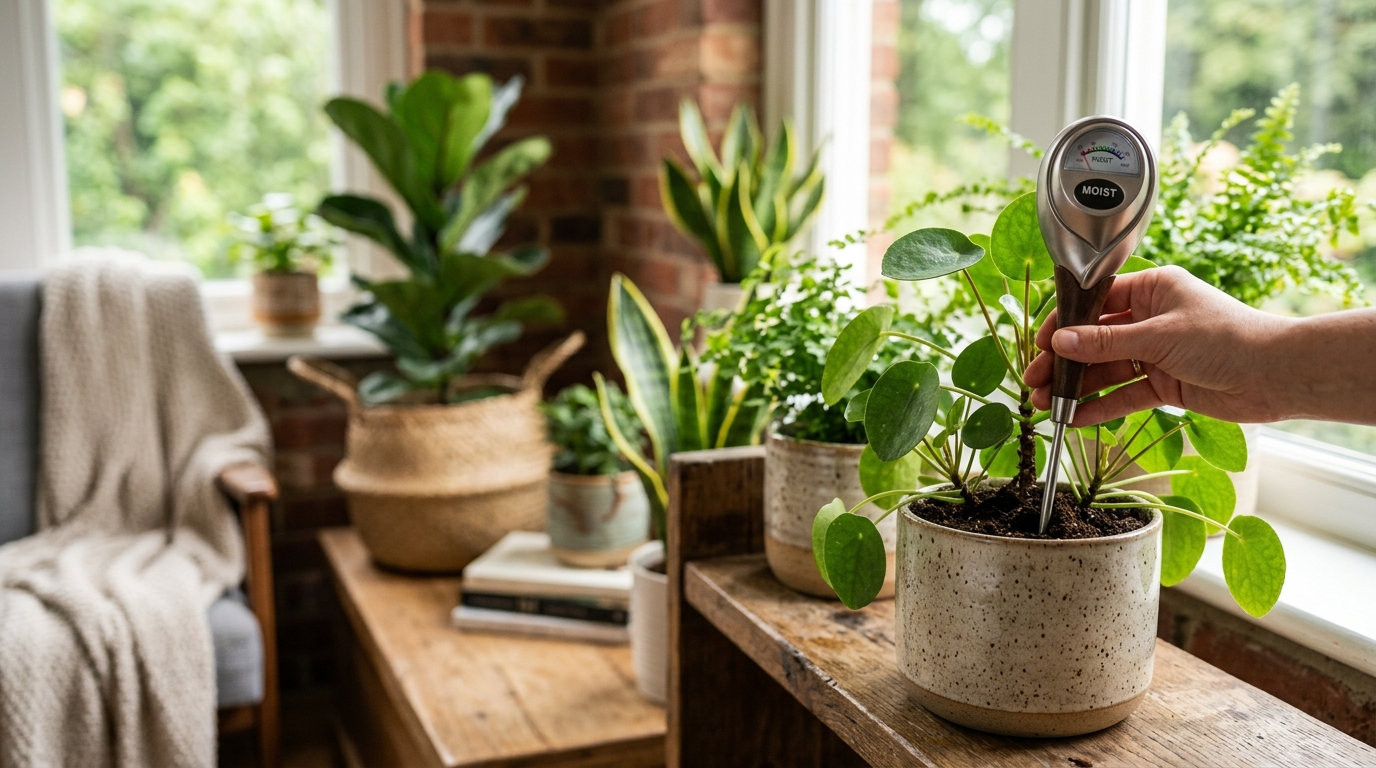
The most common reason indoor plants die is overwatering — and the most common reason growers overwater is guessing. A soil moisture meter removes the guess. Insert the probe 2–3 inches into the pot, read the scale, and know immediately whether the soil still holds enough moisture or needs water now. It takes three seconds, saves dozens of plants, and costs $10–15 for a capable tool.
Most soil meters sold for indoor plants are 3-in-1 instruments: they measure moisture, soil pH, and ambient light. The moisture function is the genuinely useful one. The pH reading is a rough indicator rather than a laboratory result, and the light sensor gives ballpark readings that are harder to act on than the moisture scale. For growers who need accurate pH data — troubleshooting nutrient deficiencies, growing edible herbs, or managing a hydroponic setup — a dedicated digital pH meter (Apera, Milwaukee) is a separate investment that replaces the analog pH probe entirely. For growers who just need to know “does this plant need water today?”, the $12 XLUX answers the question perfectly.
This guide covers the useful range: the best 3-in-1 analog meter, the best budget alternative, the cleanest moisture-only pick, and the right digital pH tool for growers who need accurate pH results.
How soil meters actually differ
Four factors determine whether a soil meter is genuinely useful or a frustrating waste of time:
1. Sensing method: analog resistance vs. digital electrochemical. Most consumer soil meters are analog resistance meters — two metal probes that pass a small current through the soil and measure resistance, which correlates to moisture content and pH. No batteries required; the soil itself completes the circuit. These work well for moisture (resistance changes significantly with water content) but are less reliable for pH (electrochemical pH sensing requires a glass membrane electrode and calibration buffer solutions to be accurate). Digital pH pens like the Apera PH60S use a proper glass electrode and calibration process — the results are meaningfully more accurate. The practical implication: use an analog 3-in-1 for moisture tracking, and a dedicated digital meter if pH accuracy is what you actually need.
2. Scale and readability. Most consumer meters use a 1–10 moisture scale, with a “Dry” zone (1–3), “Moist” zone (4–7), and “Wet” zone (8–10). The key numbers to remember: most tropical foliage plants — pothos, monstera, philodendron — want water when the reading hits 3–4 at mid-depth. Succulents and cacti should reach 1–2 before watering. Plants in small pots or unglazed terracotta dry faster than glazed ceramic. A good meter displays these zones clearly on the face; cheap meters use cryptic numbering without zone labels.
3. Probe length and diameter. A probe needs to reach the root zone — typically 3–5 inches deep in a standard 6-inch pot. Shorter probes only sample surface moisture, which is the least representative part of the container. Surface soil dries faster than the root zone and will give a falsely dry reading even when the roots are sitting in adequate moisture. Most 3-in-1 analog meters have probes adequate for pots up to 8–10 inches deep. For large floor-standing containers, a longer probe is required to get past the evaporation-dominated surface layer.
4. Material and longevity. The probes on budget analog meters corrode with regular use in moist, acidic soil. Stainless steel probes last significantly longer than plated zinc or alloy versions. Most budget meters don’t specify probe material, but the better-reviewed options at the $12–15 price point use stainless or stainless-coated probes. A secondary longevity issue: the display window fogs or delaminates on cheap meters after a year of use, making the needle unreadable regardless of whether the probe still works.
Quick comparison
| Product | Best for | Rating | Notes | |
|---|---|---|---|---|
| XLUX T10 Soil Moisture Meter | best overall; the standard 3-in-1 pick for moisture, pH, and light without batteries | ★★★★★ | $10-15. No batteries. Reliable moisture and rough pH readings. Clear 1-10 scale with zone labels. | Check price |
| Sonkir MS02 3-in-1 Soil Sensor | best budget pick; accurate moisture readings, compact, sub-$12 | ★★★★☆ | $8-12. No batteries. Dual-needle display for moisture and pH on separate scales simultaneously. | Check price |
| Gouevn Soil Moisture Meter | best moisture-only pick; simplest tool for growers who just need the watering signal | ★★★★★ | $8-14. No batteries. Single-function moisture reading — nothing to miscalibrate or confuse. | Check price |
| Apera Instruments PH60S Waterproof pH Pen | best for accurate pH; digital glass-electrode meter for nutrient troubleshooting and serious growers | ★★★★★ | $50-70. Requires calibration buffer. ATC, waterproof, ±0.01 pH accuracy. | Check price |
| Luster Leaf Rapitest Digital PLUS Soil Test Kit | best soil test kit; tests pH, nitrogen, phosphorus, and potassium with chemical reagents | ★★★★☆ | $20-30. 40 tests included. Chemical reagents for N, P, K, and pH — not an electronic probe. | Check price |
The picks
Best overall: XLUX T10 Soil Moisture Meter
Best for any indoor plant grower who wants to stop guessing about watering — the standard recommendation for casual and serious growers alike
XLUX T10 Soil Moisture Meter
The XLUX T10 has been the default soil meter recommendation in indoor plant communities for years, and it earns the position. The 3-in-1 function covers moisture, pH, and light on a single probe that switches between modes with a selector switch. No batteries — the probe generates a small current from soil contact, which means it's always ready and never dies mid-session. The moisture scale is 1–10 with clear Dry/Moist/Wet zone markings; the needle is easy to read at arm's length in normal indoor lighting. The probe length reaches appropriately to mid-depth in standard 6-inch to 10-inch pots. For the watering use case — which is what 90% of buyers actually need it for — it consistently gives readings that match the actual soil state. The pH function is an indicator, not a precision measurement, but it correctly identifies clearly acidic soil (3–5), normal range (5.5–7), and alkaline conditions (7.5+) at a resolution useful for diagnosing obvious soil chemistry problems. At $10–15 with no batteries required and a straightforward interface, the XLUX T10 is the right default pick for indoor plant growers at any experience level.
★★★★★ 4.6 · 28,400 reviews
Check current price on Amazon→Pros
- No batteries required — always ready, never interrupted by a dead AA
- Clear 1-10 moisture scale with Dry/Moist/Wet zone labels printed directly on the dial
- 3-in-1 function covers moisture, pH, and light level with a mode selector switch
- Probe length reaches mid-depth in standard 6–10 inch indoor pots
- $10–15 price point — low enough to keep a spare or buy one for each growing area
- Consistently accurate moisture readings verified across tens of thousands of reviews
Cons
- pH function is a rough indicator only — not accurate enough for professional nutrient troubleshooting
- Light sensor gives ballpark readings; a dedicated lux meter app on your phone is more precise
- Probes require rinsing and drying between plants to avoid cross-contamination of readings
- Delicate needle display — not drop-proof; store it carefully when not in use
Best budget: Sonkir MS02 3-in-1 Soil Sensor Meter
Best for budget-conscious buyers and beginners who want 3-in-1 coverage at the lowest price that actually works
Sonkir MS02 3-in-1 Soil Sensor Meter
The Sonkir MS02 is the main competitor to the XLUX T10 at sub-$12 pricing and delivers comparable moisture accuracy with a slightly different display design. Where the XLUX uses a single needle on a shared scale with a mode toggle, the MS02 uses two separate needle scales displayed simultaneously — moisture on one dial, pH on the other — with the light reading switching to the moisture scale when selected. The dual-needle display makes it faster to confirm both moisture and pH without switching modes. The build is compact, the probes are stainless-finished, and the no-battery operation is the same resistance-based measurement as the XLUX. Like all analog probes, pH accuracy is rough but adequate for identifying clearly acidic or alkaline conditions. For a beginner who wants a capable soil checker at minimal investment, the MS02 is the right entry point. For growers who've had a previous cheap meter break after 18 months, the MS02 is a solid, affordable replacement.
★★★★☆ 4.4 · 14,700 reviews
Check current price on Amazon→Pros
- Dual-needle display shows moisture and pH readings simultaneously without mode switching
- Sub-$12 price point — the lowest cost entry into reliable soil moisture tracking
- No batteries required; resistance-based analog operation
- Compact form factor fits easily in a tool drawer or potting caddy
- Stainless probe finish resists corrosion better than plated alternatives
Cons
- Simultaneous dual-needle display is slightly harder to read at a glance than one dedicated scale
- Smaller dial face than the XLUX — less readable at arm's length
- pH accuracy is comparable to XLUX — rough indicator only, not precision measurement
- Some reviewers report the selector switch loosening after several months of daily use
Best moisture-only: Gouevn Soil Moisture Meter
Best for growers who want a single-function moisture answer with zero confusion — no pH or light scales to ignore
Gouevn Soil Moisture Meter
If the only question you want answered is 'does this plant need water?', a single-function moisture meter removes every distraction from the answer. The Gouevn focuses entirely on soil moisture — a clear 1–10 scale with color-coded dry, moist, and wet zones, a probe sized for standard indoor containers, and no batteries required. There's no pH selector, no light switch, no ambiguity about which function is active. You insert it, you read the number, you know. The single-function design means the display face is larger and easier to read than multi-function meters cramming multiple overlapping scales into the same space. For growers who tried a 3-in-1 and found the pH function confusing or permanently unused, or who are buying a meter for a family member who isn't interested in soil chemistry, the moisture-only approach is genuinely better than ignoring two-thirds of a 3-in-1. At $8–14 it's in the same price range as the XLUX and Sonkir with a more focused result.
★★★★★ 4.5 · 9,200 reviews
Check current price on Amazon→Pros
- Single-function moisture reading — no unused pH or light scales to cause confusion
- Larger, cleaner display dial than multi-function meters with the same total face size
- Color-coded zones (red dry, green moist, blue wet) visible at a glance across the room
- No batteries required; analog resistance-based operation
- $8–14 price range — comparable to 3-in-1 options but focused on the one function that matters most
Cons
- No pH or light function — if you later want pH readings, you'll need a second tool
- Moisture-only meters are sometimes harder to find in physical stores than 3-in-1 options
- Build quality varies between Gouevn product generations; check recent reviews for the current version
Best for accurate pH: Apera Instruments PH60S Waterproof pH Pen
Best for growers troubleshooting nutrient deficiencies, growing edible herbs and vegetables, or managing a hydroponic or coco coir system where pH precision matters
Apera Instruments PH60S Waterproof pH Pen Tester
When analog probe pH readings don't give you the resolution you need — say, you're diagnosing whether a pothos is showing interveinal chlorosis from iron deficiency at pH 7.2 vs. 6.8 — the Apera PH60S is the right tool. It uses a glass combination electrode with automatic temperature compensation (ATC), measures pH to ±0.01 accuracy, and calibrates against standard pH 4, 7, and 10 buffer solutions. The calibration process takes about three minutes and stores in memory until reset. It's fully waterproof, the electrode is replaceable when it eventually degrades (typically 12–24 months of regular use), and the digital display shows exact pH with one decimal place plus temperature in Celsius. For soil testing specifically, the correct method is a soil slurry: mix 1 part soil with 1 part distilled water, let it settle for 30 minutes, then test the liquid phase. This gives accurate, reproducible readings that analog probes can't match. At $50–70 it's a different investment category than the $12 analog probes, but the accuracy gap is substantial and justifies the cost for anyone seriously managing soil chemistry, pH-sensitive plants, or a hydroponic system.
★★★★★ 4.7 · 6,800 reviews
Check current price on Amazon→Pros
- ±0.01 pH accuracy with glass electrode — genuinely reliable for nutrient deficiency troubleshooting
- Automatic temperature compensation (ATC) adjusts readings for ambient temperature variation
- Calibrates against standard pH buffer solutions for verified, traceable accuracy
- Waterproof IP67 rating — handles submersion during the soil slurry testing method
- Replaceable electrode extends meter life past the 12–24 month degradation window
- Apera is an established instruments brand used in educational, commercial, and laboratory contexts
Cons
- Requires calibration buffer solutions ($5–10 for a set) — the meter alone isn't enough to start
- Glass electrode degrades over time; budget for a replacement electrode ($15–25) every 1–2 years
- At $50–70, it's 4–5x the cost of an analog 3-in-1 — only justified if pH accuracy is a real need
- Soil slurry method requires planning: 30 minutes of settling time before the reading is ready
Best soil test kit: Luster Leaf Rapitest Digital PLUS
The Luster Leaf Rapitest Digital PLUS takes a completely different approach from electronic probes: it tests soil chemistry with chemical reagents in test tubes, like a chemistry kit scaled for the garden. Each test measures pH, nitrogen (N), phosphorus (P), or potassium (K) — the four numbers that define soil fertility. Add a soil sample to a test tube, add the included reagent, shake, wait three minutes, and compare the color result to the reference chart. A single kit includes 40 tests (10 per nutrient), enough for a full season of testing across multiple plants. The readings are categorical — low, medium, or high — not precise numbers, but that’s usually the resolution needed for diagnosing whether a struggling plant is nutrient-deficient or just dry. At $20–30, it’s the pick for growers who want a complete soil fertility snapshot rather than just moisture content, and it works equally well for containers and outdoor raised beds.
What to skip
Cheap no-brand meters with unverified probe materials. The plated probes on the lowest-cost meters ($5–8) corrode quickly in acidic or moist soil and start giving false readings within a few months. The cost difference between a $7 no-brand probe and the $12 XLUX is irrelevant given how much longer the XLUX lasts.
Using a soil meter in bone-dry or freshly watered soil. Analog resistance meters require some moisture to complete the circuit. In truly bone-dry soil, the needle barely moves — that’s actually confirming the soil is very dry, not that the meter is broken. In soil that was just thoroughly watered, the surface layer reads “wet” even if drainage is rapidly pulling moisture away from the root zone. The right time to check: 30–60 minutes after any watering event, or as a check before you decide whether to water.
Relying on analog probes for precision pH troubleshooting. If a plant is showing yellow leaves with green veins (interveinal chlorosis), the pH reading from an analog probe isn’t precise enough to distinguish between pH 6.5 (fine for most plants) and pH 7.5 (iron unavailable). That 1-unit difference determines whether the problem is your watering, your fertilizer, or your soil pH. Digital pH pens calibrated with buffer solutions are the right tool for that level of diagnosis.
Treating the finger test as equivalent. The classic “insert a finger 1–2 inches and check if it’s dry” works, but it’s harder to use consistently across deep pots, crowded shelves, and tight arrangements. It also provides no quantifiable reference — “damp to my finger” means something different to every grower. A soil probe gives a number on a consistent scale across every pot in the collection, which makes building watering intuition much faster.
FAQ
Frequently asked questions
When should I water according to a soil moisture meter?
Why doesn't my soil meter give a reading in completely dry soil?
Are the pH readings on analog 3-in-1 meters accurate?
Can I leave the probe in the soil permanently?
My meter readings seem wrong — how do I check if it's working?
What's the difference between a soil moisture meter and a soil test kit?
Do I need a soil meter if I have self-watering planters?
Bottom line
Best overall: XLUX T10 Soil Moisture Meter — no batteries, 3-in-1 function, accurate moisture readings, and the standard recommendation for indoor plant growers at any level. Best budget: Sonkir MS02 — dual-scale display and sub-$12 pricing for buyers who want maximum function at minimum cost. Best moisture-only: Gouevn Soil Moisture Meter — a focused, distraction-free tool for growers who just need the watering signal. Best for accurate pH: Apera PH60S — the right digital meter for growers troubleshooting nutrient deficiencies or managing soil chemistry with precision.
Start with the XLUX. Use it for 30 days and it will immediately change how you think about watering. Once you’ve noticed that some plants were consistently wetter than your schedule assumed, you’ll understand exactly why a $12 probe earns its place in every plant collection.
For more on managing indoor plant health: watering cans designed to deliver water precisely where the meter tells you it’s needed, potting soil that drains at the right rate to make moisture readings consistent, self-watering planters for plants that benefit from automatic moisture regulation, and smart gardens with built-in sensors that track conditions automatically.