guides
EC and TDS Meter Guide for Hydroponics
Learn how to use EC and TDS meters in hydroponics, find ideal ranges by crop type, and avoid common nutrient concentration mistakes.
 Priya Anand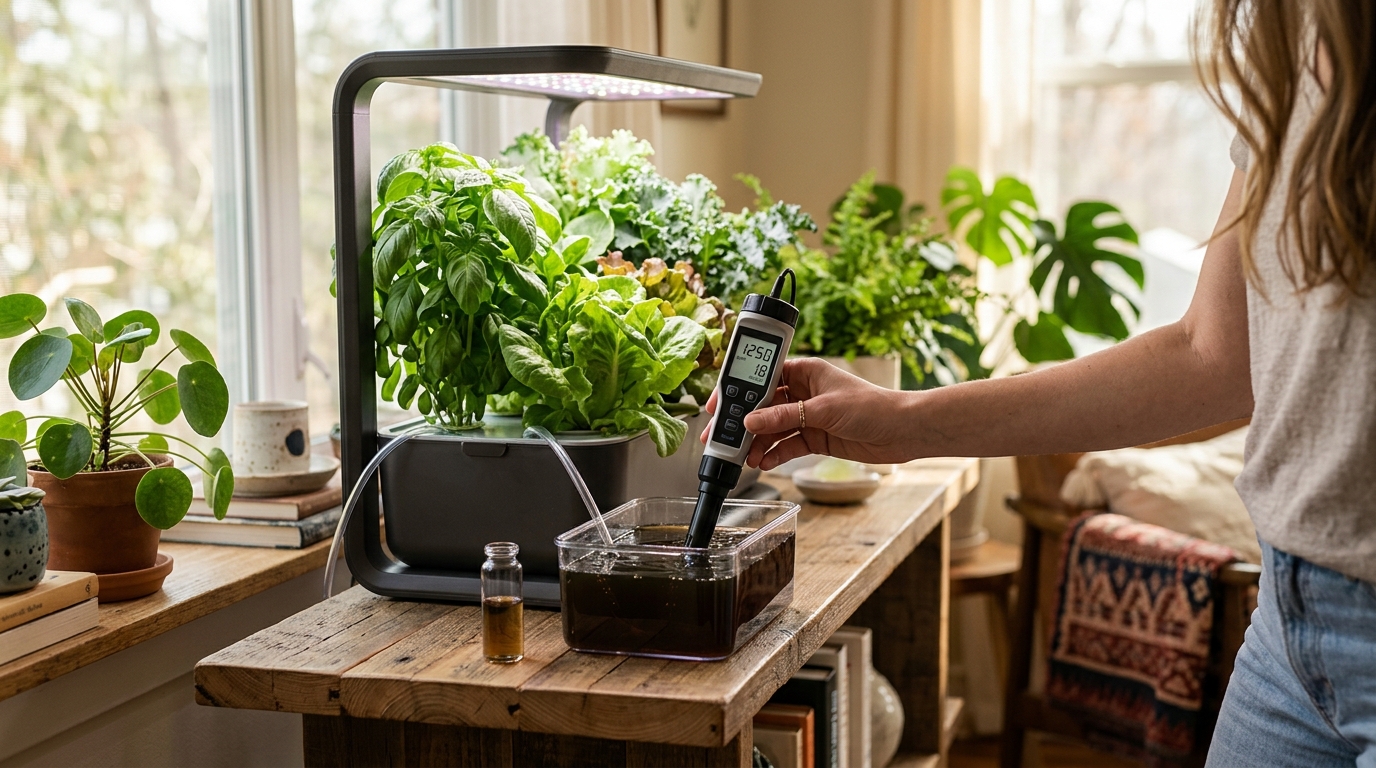
For most hydroponic crops, target an EC of 1.2 to 2.4 mS/cm — equivalent to roughly 600 to 1,200 ppm on a 500-scale TDS meter. When EC reads above your target, dilute with plain pH-adjusted water. When EC reads below target, add a measured dose of nutrient solution, wait 15 minutes, and retest.
What is EC in hydroponics?
EC stands for electrical conductivity, measured in millisiemens per centimeter (mS/cm) or microsiemens per centimeter (µS/cm). The measurement works because dissolved salts and minerals — the same ions that feed your plants — allow water to conduct an electrical current. The more nutrients dissolved in the solution, the higher the current flow, and the higher the EC reading.
In soil growing, plants can draw nutrients from the substrate and from organic matter decomposition. In hydroponics, the nutrient solution is the only source of every mineral a plant needs. This makes concentration control critical: too dilute and plants run short of specific nutrients; too concentrated and osmotic pressure reverses water flow out of the roots rather than into them, causing nutrient burn and wilting.
EC is the fastest, most direct way to check whether your nutrient solution is in the right concentration range. Unlike pH, which requires careful adjustment with acids or bases, EC management is straightforward: high EC gets diluted with plain water, low EC gets topped up with nutrient solution. The challenge is checking it consistently and responding before plants show stress.
One important note: EC tells you the total dissolved mineral load but not the composition. A solution with the correct EC could still be deficient in a specific element if your nutrient formula is off or if certain ions have been selectively depleted by plant uptake. EC management works best alongside a quality balanced nutrient formula and routine reservoir changes every 7 to 14 days.
What is TDS and how does it differ from EC?
TDS stands for total dissolved solids and is expressed in parts per million (ppm). Unlike EC, which measures a physical electrical property directly, TDS is calculated by multiplying the EC reading by a conversion factor. This makes TDS a derived estimate rather than a direct measurement.
The conversion factor your meter uses determines which scale you are on:
| TDS scale | Conversion factor | Common brands |
|---|---|---|
| 500-scale (NaCl) | EC x 500 | Hanna, HM Digital, most budget meters |
| 700-scale (KCl) | EC x 700 | Eutech, some professional instruments |
| 640-scale | EC x 640 | Bluelab Truncheon |
This distinction matters because two growers reporting ppm numbers can be reading different concentrations if they use different scales. A solution at EC 2.0 mS/cm reads as 1,000 ppm on the 500-scale and 1,400 ppm on the 700-scale. If you are following a nutrient manufacturer recommendation in ppm, confirm which scale they use before comparing your meter readings.
For this reason, the hydroponic community increasingly uses EC as the standard reporting unit rather than ppm. If you post questions in growing forums or follow nutrient manufacturer schedules, EC in mS/cm is the measurement least likely to cause confusion.
Ideal EC ranges for hydroponic crops
EC needs vary by plant type, growth stage, system type, and environmental conditions. Higher temperatures and high light levels increase plant water demand, which can raise EC as water evaporates and leaves nutrients behind. Lower temperatures and low light reduce uptake rates.
| Crop or stage | Target EC range (mS/cm) |
|---|---|
| Seedlings and clones | 0.5 to 0.8 |
| Leafy greens (lettuce, spinach, kale) | 1.0 to 1.6 |
| Herbs (basil, cilantro, mint) | 1.0 to 1.6 |
| Cucumbers | 1.7 to 2.5 |
| Peppers | 2.0 to 3.0 |
| Tomatoes (vegetative) | 2.0 to 3.0 |
| Tomatoes (fruiting) | 3.0 to 5.0 |
| Strawberries | 1.4 to 2.0 |
These are starting points, not hard limits. The right EC for your system is ultimately one at which plants are visibly healthy, growing at the expected rate, with no tip burn, wilting, or yellowing. Growers running warmer reservoirs (above 22°C) often need slightly lower EC to avoid osmotic stress, while cooler reservoirs can sustain the higher end of each range more easily.
How to use an EC/TDS meter: step-by-step
Step 1: Calibrate your meter
Most digital EC pens require periodic calibration with a reference solution of known conductivity — typically 1,413 µS/cm (1.413 mS/cm). Calibrate a new meter before first use, then every 4 to 6 weeks thereafter.
- Remove the probe from its storage
- Rinse thoroughly with distilled water and blot dry
- Dip the probe into the calibration reference solution
- Press the calibrate button and wait for the display to stabilize
- Rinse again with distilled water before testing
The Bluelab Truncheon is an exception — it requires no calibration and reads EC directly from LED indicators.
Step 2: Collect a sample
Always test a sample drawn from the reservoir rather than dipping the meter directly into a large tank, which can give inconsistent readings from stratified layers. Draw 100 to 200 ml into a clean cup and test from that. For DWC systems, draw from the center of the bucket at mid-depth for a representative reading.
Step 3: Dip and read
Submerge the probe to the marked depth — usually just the tip. Stir gently to remove air bubbles. Wait 15 to 30 seconds for the reading to stabilize before recording. Note both the EC reading and the solution temperature.
Step 4: Compare to your target and adjust
Compare your reading to the target EC range for your crop and growth stage. See the next section if the reading is outside your target.
Step 5: Clean and store the probe
Rinse with distilled water after every use. Store digital EC pens dry — unlike pH probes, most EC probes do not require wet storage and keep best in the dry protective cap.
Recommended EC and TDS meters for hydroponics
| Product | Best for | Rating | Notes | |
|---|---|---|---|---|
| Bluelab Truncheon Nutrient Meter | Growers who want a durable no-calibration EC meter for daily use | ★★★★★ | Reads EC directly on LED indicators at 0.1 mS/cm resolution with no buttons or calibration required. Waterproof and rated for long-term continuous use in commercial environments. Uses the 640-scale for any ppm conversion. Costs more upfront but outlasts most digital pen meters. | Check price |
| Apera Instruments EC60 Meter | Precise digital EC measurement with ATC and data logging in a portable pen | ★★★★★ | Reads to 0.01 mS/cm resolution with automatic temperature compensation. Single-point calibration with included 1413 µS/cm reference solution. Stores up to 25 readings for trend tracking. A strong choice for growers who want digital precision at a mid-range price. | Check price |
| HM Digital COM-80 | Budget-friendly dual EC and TDS reading with ATC for home hydroponic systems | ★★★★★ | Measures EC, TDS (500-scale ppm), and temperature simultaneously. ATC built in. Reads up to 20 mS/cm. Factory calibrated with user recalibration available. A reliable everyday meter for smaller home systems. | Check price |
Best for Growers who want maximum durability and zero calibration hassle in a dedicated EC meter
Bluelab Truncheon Nutrient Meter
The Truncheon is the closest thing to a set-and-forget EC meter in hydroponics. Dip it into the reservoir, read the LED scale, and you are done. No calibration, no probe storage solution, no buttons — it either reads correctly or tells you the probe needs cleaning. Used in commercial greenhouse operations worldwide. Its 0.1 mS/cm resolution covers all crop types from seedlings to high-EC fruiting vegetables. The higher upfront cost is easy to justify once you have replaced two or three inexpensive digital pens.
★★★★★ 4.8 · 1,870 reviews
Check current price on Amazon→Best for Growers who want a precise portable EC pen with data logging and ATC
Apera Instruments EC60 EC Meter
The EC60 reads to 0.01 mS/cm precision with automatic temperature compensation — the smallest reading increment you will actually need for hydroponic management. It stores the last 25 readings with timestamps, useful for tracking slow EC drift between reservoir changes. Comes with a 1413 µS/cm calibration solution included in the kit. Calibration takes about 30 seconds. The protective carrying case keeps the probe safe between uses. Hits the accuracy standards of meters costing twice as much.
★★★★★ 4.7 · 1,140 reviews
Check current price on Amazon→Best for Home growers who want EC and TDS readings together at a budget-friendly price
HM Digital COM-80 EC/TDS/Temp Meter
The COM-80 displays EC, TDS (on the 500-scale), and solution temperature simultaneously on a single screen — useful when your nutrient formula provides ppm targets rather than EC targets. Automatic temperature compensation is built in and the meter reads up to 20.00 mS/cm, covering every crop from leafy greens to high-EC fruiting vegetables. Factory calibrated with push-button user recalibration available when you invest in a calibration solution. A reliable workhorse for home systems.
★★★★★ 4.5 · 2,340 reviews
Check current price on Amazon→What to do when EC is too high or too low
When EC is above your target range
High EC means the solution is more concentrated than the plants need. The fix is dilution with plain water.
- Add plain pH-adjusted water (pH 5.8 to 6.2) — a 10 to 15 percent addition typically drops EC by 0.2 to 0.3 mS/cm
- Run the pump for 5 minutes to distribute the addition throughout the reservoir
- Retest and repeat in small increments until you reach the target range
- Do not attempt to correct high EC by skipping nutrient additions — high EC compounds over time as water evaporates and leaves dissolved minerals behind
When EC is below your target range
Low EC means the solution is too dilute — from heavy plant uptake of nutrients or excess plain-water top-offs.
- Mix a small amount of your standard nutrient solution at the manufacturer recommended concentration
- Add it to the reservoir with the pump running to distribute evenly
- Wait 15 minutes and retest before adding more
- If EC is more than 0.5 mS/cm below target, consider a full reservoir change with freshly mixed solution rather than adding concentrated nutrient solution to a depleted mix
How often should you check EC?
Seedling and clone stage: Check EC every day or every other day. Young roots are sensitive to EC swings, and this is when growers most often spike concentration with an accidental heavy nutrient addition.
Active vegetative and fruiting stage: Test every 2 to 3 days in a stable, well-maintained system. Check immediately after any top-off exceeding 10 percent of reservoir volume, since evaporative losses quickly shift concentration.
At every reservoir change: Before mixing a fresh reservoir, test the old solution and record both EC and pH. These readings document how the system consumed nutrients over the interval and help you fine-tune future reservoir mixes.
Common EC measurement mistakes
Not calibrating: A digital EC pen left uncalibrated for two months can read 10 to 15 percent off from the true value. This seems small but can mean operating at EC 2.5 mS/cm when you believe you are at 2.0 mS/cm — significant for sensitive crops like herbs and strawberries.
Testing from a stratified reservoir: Nutrient ions are denser than water and settle toward the bottom when the pump is off. Test with the pump running, or draw a sample after the pump has been running for several minutes to ensure the solution is well mixed.
Ignoring temperature: Solution temperature changes EC readings. A solution at 15°C reads lower than the same solution at 25°C. Meters without ATC give you an uncorrected temperature artifact in every reading. Only use a meter with automatic temperature compensation for reliable hydroponic management.
Correcting high EC by adding more nutrients: This is the opposite of what is needed and is a surprisingly common error. High EC always calls for plain water addition. Low EC always calls for nutrient solution addition.
Letting EC drift for days before correcting: A system running 1.3 mS/cm above the target for three days will show leaf tip burn even after you correct it — the damage is already done. Frequent checks and small corrections outperform infrequent large corrections in every system type.
FAQ
Frequently asked questions
What is the ideal EC for hydroponics?
What is the difference between EC and TDS in hydroponics?
How do I lower EC in a hydroponic reservoir?
How do I raise EC in a hydroponic reservoir?
Do EC meters need to be calibrated?
What happens if EC is too high in hydroponics?
Can I use a TDS meter instead of an EC meter for hydroponics?
Bottom line
EC management is the simplest high-impact daily habit in hydroponics after pH control. Get a meter with automatic temperature compensation — the Bluelab Truncheon for no-calibration durability, the Apera EC60 for digital precision, or the HM Digital COM-80 for a budget-friendly start. Test every 2 to 3 days during active growth, immediately after any significant top-off, and at every reservoir change. Correct high EC with plain pH-adjusted water and low EC with a measured nutrient addition, always in increments rather than one large correction.
For more on building and managing hydroponic systems, see the pH adjustment guide for hydroponics, DIY hydroponics guide, best hydroponic nutrients, and how to prevent root rot in hydroponics.