roundups
Best Indoor Vegetable Systems 2026
Best indoor vegetable systems for 2026: hydroponic towers, pod gardens, and grow cabinets for year-round vegetables at home.
 Priya Anand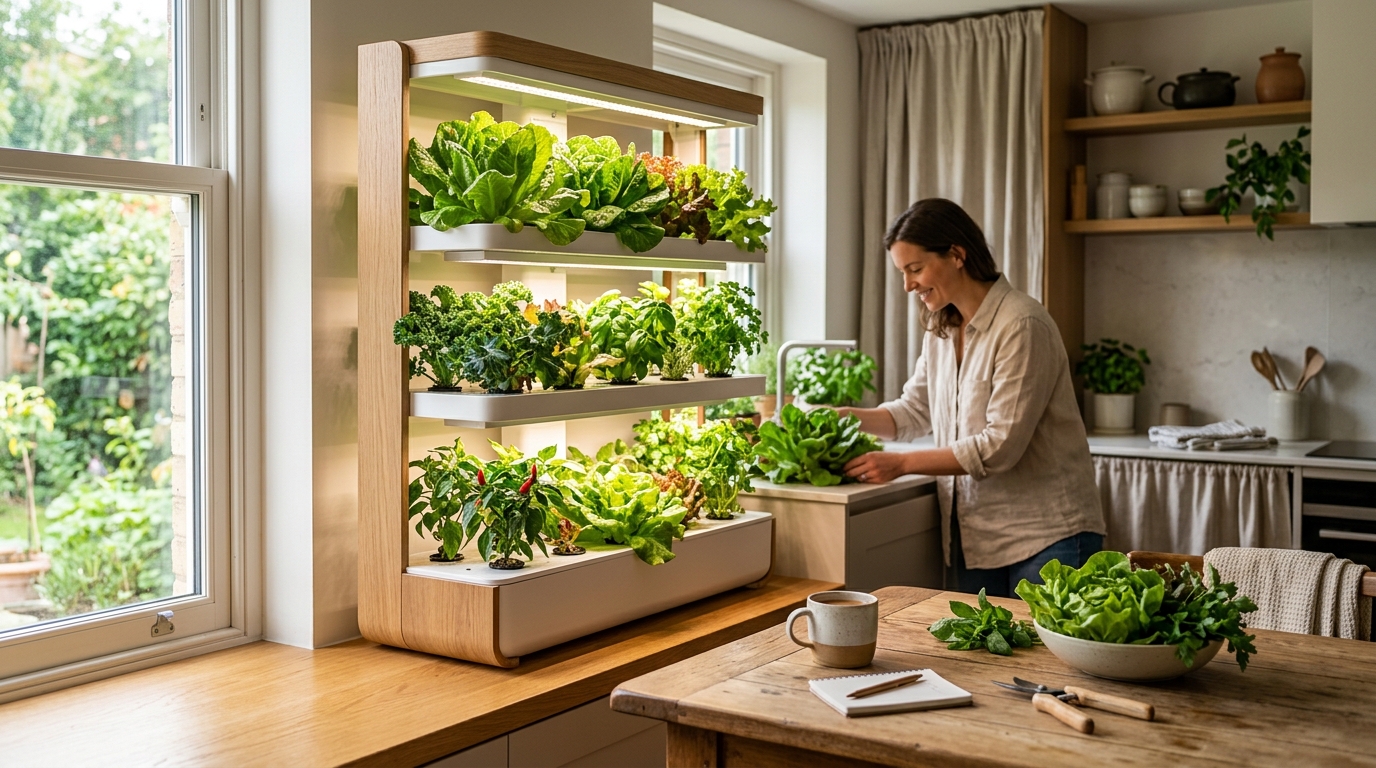
A countertop herb garden is useful. An indoor vegetable system that produces meaningful quantities of lettuce, kale, chard, cherry tomatoes, peppers, and herbs — enough to supplement your grocery shopping across seasons — is a different category of investment. The gap between the two is mostly about scale: pod count, light intensity, system height, and whether the design can support the root volume that fruiting vegetables actually need.
Indoor vegetable systems in 2026 range from 9-pod countertop units that top out at herbs and microgreens through multi-tier, floor-standing hydroponic gardens capable of running 36 pods simultaneously with dedicated grow lights, app-based nutrient tracking, and enough ceiling height for full cherry tomato vines and compact pepper plants. The critical decision point is matching system size to growing ambition — buying a 9-pod unit when you want to grow vegetables wastes money on the wrong tool, and buying a 36-pod, 3-tier unit when you want a countertop herb supply is an expensive way to grow basil.
This guide covers the systems that actually deliver vegetable production: what separates them, how to match size to output goals, and which picks are worth the investment.
How indoor vegetable systems actually differ
Five factors separate a system that produces meaningful vegetable output from one that grows herbs with a vegetable brand name on it:
1. Pod count and growing area. The math is simple: one pod, one plant. A 9-pod system runs 9 plants simultaneously — enough for an herb supply but not enough variety or volume to supplement grocery shopping with actual vegetables. A 24-pod system runs several simultaneous lettuce varieties, a few herb slots, and a couple of fruiting plants. A 36-pod, 3-tier system runs a real rotation: two tiers of lettuce and greens cycling continuously, plus a tier dedicated to tomatoes and peppers with enough light arm height to accommodate the vines. If the goal is vegetables rather than herbs, the entry-level system that makes sense is 24 pods, not 9.
2. Light arm height and adjustability. This is the single most important specification for fruiting vegetables. Herbs and leafy greens stay short — 8-12 inches — and most systems handle them without constraint. Cherry tomatoes and compact peppers grow 24-36 inches tall during fruiting. If the light arm tops out at 12 inches above the pod tray, the plant will grow into the light, burn, and stop producing. Systems designed for vegetables (Rise Gardens, AeroGarden Farm models) feature adjustable arms that extend to 24-36 inches. Systems designed for herbs (AeroGarden Harvest, most countertop pod units) do not. Check this specification before purchasing.
3. Hydroponic type: deep water culture vs. NFT vs. aeroponics. Most pod-based systems use deep water culture (DWC): roots hang into a water reservoir with liquid nutrients, and a pump circulates oxygenated water. DWC is reliable, low-maintenance, and handles a wide variety of plants. Nutrient film technique (NFT) runs a thin film of nutrient solution through shallow channels past roots — faster root development but more vulnerable to pump failure since roots aren’t submerged. Aeroponics (Tower Garden, Mist & Grow systems) mists roots in air every few minutes with a timer-controlled pump — the fastest growth of any method because roots get maximum oxygen exposure, but also the highest-maintenance: if the misting pump fails for more than a few hours during a warm day, roots dry out and plants die. For most indoor vegetable growers, DWC pod systems are the right choice. Aeroponics makes sense for experienced growers who want maximum growth rates and are prepared to monitor closely.
4. Water reservoir size and refill frequency. Larger systems with more plants consume water faster. A 9-pod AeroGarden Bounty reservoir holds about 1 gallon and needs topping off every 1-2 weeks for herbs. A 36-pod, 3-tier Rise Gardens system holds 3+ gallons across its tiers and needs attention more frequently as 36 actively growing plants consume water rapidly. Systems with water level indicators (visual or app-based) reduce the mental overhead of knowing when to add water. Any system running more than 12 pods benefits from daily water level checks during the active growing phase of fruiting plants.
5. Build quality and longevity for multi-year operation. Pod-based growing systems live in your home and run continuously. A system with a noisy pump, a flimsy light arm that droops, or reservoir connections that drip is going to be abandoned. The price premium on Rise Gardens, Lettuce Grow, and AeroGarden Farm units versus $50 Amazon hydroponics kits reflects build quality: quiet pumps, sealed connections, sturdy arms that stay adjusted, and parts support from the manufacturer. Systems you intend to run for 2-3+ years justify the higher upfront cost. Disposable systems for an experiment don’t.
Quick comparison
| Product | Best for | Rating | Notes | |
|---|---|---|---|---|
| Rise Gardens Family Garden (3-tier, 36 pods) | best overall; serious vegetable production with app-based tracking and expandable design | ★★★★★ | $550-650. 3 tiers, 36 pods, full-spectrum LED per tier. Best for lettuce, greens, tomatoes, peppers. | Check price |
| AeroGarden Farm 24 | best countertop system; 24 pods, two adjustable arms, largest single-unit AeroGarden | ★★★★★ | $300-400. 24 pods, two 30W LED arms each adjustable to 24 in. Wi-Fi. Best for herb+vegetable combos. | Check price |
| Lettuce Grow Farmstand (36-spot) | best vertical system; high-volume leafy greens and herbs in a self-contained aeroponic column | ★★★★☆ | $400-500. Self-watering aeroponic tower, 36 plant sites. Excellent for greens; limited for fruiting plants. | Check price |
| Rise Gardens Personal Garden (1-tier, 12 pods) | best compact; single-tier hydroponic system for small-space vegetable growing | ★★★★★ | $300-380. 12 pods, single tier, app-connected. Right for greens plus one fruiting tier. | Check price |
| Tower Garden Flex (20-plant) | best aeroponic tower; fastest growth rates for herbs and greens in vertical footprint | ★★★★☆ | $650-750. Aeroponic vertical tower, 20 plant sites. Fastest growth; highest maintenance. | Check price |
The picks
Best overall: Rise Gardens Family Garden (3-tier, 36 pods)
Best for households that want real vegetable production — enough lettuce, greens, herbs, and compact fruiting plants to meaningfully supplement grocery shopping year-round
Rise Gardens Family Garden
Rise Gardens built their Family Garden specifically for vegetable production, not herb supplementation, and the design reflects that priority at every level. Three tiers stack vertically with a compact footprint (roughly 24 by 18 inches at the base), each tier running 12 pods under a dedicated full-spectrum LED grow light with an adjustable arm that extends high enough for cherry tomatoes and compact peppers. The app tracks each plant individually from seed to harvest — you enter what you planted in each pod, and the system reminds you when to add nutrients, when to thin seedlings, and when specific varieties are approaching harvest window. The two lower tiers work well on continuous rotation for lettuce and leafy greens: harvest outer leaves every few days, let the plant continue growing, and replant a pod every 3-4 weeks so you're never without fresh greens. The top tier, with maximum arm height, handles cherry tomatoes, jalapeños, and larger herb varieties like full-size basil that can grow 18-24 inches tall. The reservoir system is more generous than countertop pod units — water refills are needed less frequently relative to the number of plants — and the pump runs quietly enough to keep the unit in a living space rather than a basement. At $550-650 it is a significant purchase. The output justification: 36 pods cycling continuously can realistically produce 2-3 heads of lettuce per week, a continuous herb supply across 8-10 varieties, and 2-3 fruiting plants in rotation — enough to see a real reduction in fresh produce costs within the first season.
★★★★★ 4.6 · 3,200 reviews
Check current price on Amazon→Pros
- 36 pods across 3 tiers — enough for continuous greens rotation plus dedicated fruiting plant tier
- App tracks each pod individually with nutrient, harvest, and replanting reminders
- Each tier has an independent, adjustable LED arm — top tier reaches cherry tomato and pepper height
- Compact vertical footprint for the output capacity: roughly 24×18 inches at the base
- Expandable design — additional tiers can be added later as growing ambition increases
- Quiet pump appropriate for living space use, not basement-only
Cons
- $550-650 upfront is the highest entry cost of any pod garden system
- 36 pods require 36 pods worth of seed pods or custom grow sponges — ongoing cost is proportionally higher
- Water and nutrient monitoring across 3 tiers is more involved than a single-reservoir countertop unit
- Rise Gardens pod refills are proprietary — verify current catalog and pricing before committing
- Vertical assembly requires some care; the 3-tier unit is taller than some shelves or cabinets
Best countertop system: AeroGarden Farm 24
Best for buyers who want the largest AeroGarden countertop or shelf unit — 24 pods with dual adjustable light arms and Wi-Fi for a complete herb-and-vegetable countertop garden
AeroGarden Farm 24
The AeroGarden Farm 24 is AeroGarden's step-up from the Bounty into serious vegetable-capable territory. Twenty-four pods run under two independent 30W LED arms, each adjustable to 24 inches above the pod tray — enough clearance for cherry tomatoes, compact pepper plants, and tall herb varieties on both halves of the unit simultaneously. The footprint is larger than the Bounty (roughly 20 by 10 inches at the base), designed to sit across a kitchen counter or on a dedicated shelf. Wi-Fi connectivity means the app delivers nutrient and water reminders, plant progress tracking, and light schedule control from your phone. The dual-arm design is the key differentiator from the Bounty: with two independent arms, you can run low herbs (fixed at 12 inches) on one half and cherry tomatoes (arm raised to 22 inches) on the other half without either being compromised by the other's light height requirement. The AeroGarden ecosystem is mature — the seed pod catalog runs to 30+ varieties, 'Grow Anything' blank pods accept your own seeds, and the liquid nutrient formula is available reliably in grocery stores. At $300-400 it costs significantly more than the Bounty but delivers 2.7 times the pod count and a dual-arm configuration that the Bounty simply can't match for mixed-variety growing.
★★★★★ 4.5 · 4,800 reviews
Check current price on Amazon→Pros
- 24 pods — 2.7x the capacity of the AeroGarden Bounty in a countertop-compatible unit
- Two independent adjustable LED arms allow different heights on each half — herb side and vegetable side simultaneously
- Wi-Fi + app with per-plant reminders; same ecosystem as Bounty with larger-scale management
- Dual 30W LED arrays provide strong, even light across the full pod tray
- AeroGarden ecosystem: 30+ seed pod varieties plus blank "Grow Anything" pods for custom seeds
- Countertop or shelf-compatible design — no floor space required unlike multi-tier systems
Cons
- $300-400 is a meaningful step up from the $130-170 Bounty; one-third the price of the Rise Gardens Family Garden with one-third the pod count
- Single reservoir (despite two light arms) — needs refilling more frequently as 24 plants consume water
- Still a countertop unit: height-limited compared to floor-standing multi-tier systems, can't add more pods beyond 24
- Pod refill costs scale with pod count — 24-pod seed kits cost proportionally more than 9-pod Bounty kits
Best vertical system: Lettuce Grow Farmstand (36-spot)
Best for growers who want maximum leafy green and herb output from a single vertical aeroponic column — and who are disciplined enough to maintain an aeroponic system
Lettuce Grow Farmstand 36-Spot
The Lettuce Grow Farmstand takes a different architecture than every pod-based hydroponic garden: instead of plants growing horizontally above a reservoir, plants slot into openings around the outside of a vertical aeroponic tower. Roots grow into the hollow core, where a timer-activated pump mists them with nutrient solution every few minutes. Because roots grow in air rather than submerged in water, they get maximum oxygen exposure — aeroponic root development is measurably faster than DWC systems, and leaf size and density at harvest reflect that. The 36-spot Farmstand (available in versions with an optional LED light rig for indoor use) grows a full rotation of lettuce varieties, arugula, kale, Swiss chard, herbs, and edible flowers simultaneously around the column. Harvest is ongoing: outer leaves of each plant, taken 2-3 times per week across 36 plants, add up to significant weekly greens output. The limitation is clear: the Farmstand is optimized for greens and herbs. Fruiting plants (tomatoes, peppers) don't grow well in an aeroponic tower — they need too much root volume, too much light, and a stable growing medium that a mist-only system doesn't provide. If maximum greens output is the goal and fruiting plants aren't a priority, the Farmstand is the best vertical system available. If you want to grow tomatoes and peppers, Rise Gardens is the right choice instead.
★★★★☆ 4.4 · 2,900 reviews
Check current price on Amazon→Pros
- 36-plant capacity in a vertical column footprint — high output per square foot of floor space
- Aeroponic misting delivers maximum root oxygen exposure — measurably faster growth than DWC pod systems
- Continuous harvest design — outer leaves from each plant, multiple times per week
- Self-contained aeroponic system with reservoir, pump, and (optional) LED light rig
- Wide variety support for greens: lettuce varieties, arugula, kale, chard, herbs, edible flowers
Cons
- Aeroponics requires pump reliability — if the misting pump fails for hours during warm conditions, roots dry out and plants die
- Not optimized for fruiting vegetables (tomatoes, peppers): root volume and light requirements aren't met by the tower design
- Seedling starts require separate germination before transplanting into the tower openings
- Cleaning the interior column requires disassembly — more involved than reservoir-based systems
- The optional LED light rig is an additional purchase; the base Farmstand is designed for outdoor or window-adjacent growing
Best compact: Rise Gardens Personal Garden (1-tier, 12 pods)
Rise Gardens’ entry-level Personal Garden runs the same app-connected hydroponic system as the Family Garden but in a single-tier, 12-pod configuration at roughly half the price ($300-380). The single tier with an adjustable LED arm handles herbs and leafy greens at any arm height and cherry tomatoes or compact peppers with the arm raised fully. It’s the right starting point for growers who want a real vegetable-producing system but aren’t ready to commit to the full 36-pod, 3-tier investment. The key advantage over the AeroGarden Farm 24 is the expandable design: additional Rise Gardens tiers stack on top of the Personal Garden base, so the system can grow as your interest does without replacing the entire unit. If there’s any chance you’ll want to expand to a 2 or 3-tier system in the next year, start with the Rise Gardens Personal Garden rather than a larger AeroGarden unit.
Best aeroponic tower: Tower Garden Flex
The Tower Garden Flex is the premium aeroponic tower for indoor vegetable growing — faster growing than any DWC pod system, with 20 plant sites stacked vertically and a dedicated LED tower light designed for indoor use. Growth rate advantages are genuine: the aeroponic misting cycle delivers maximum root oxygenation that DWC systems can’t match, and greens in particular reach harvest size noticeably faster in aeroponic systems than pod gardens. The Flex model is more compact than Tower Garden’s outdoor units, designed specifically for indoor spaces with a smaller footprint and lower-profile light rig. At $650-750, it is the most expensive system in this guide, and the cost is somewhat harder to justify than the Rise Gardens Family Garden — the Tower Garden excels at greens speed and quantity but has the same fruiting vegetable limitations as the Lettuce Grow Farmstand. For growers whose primary goal is fast-growing, high-volume lettuce and herbs — and who have the discipline for aeroponic maintenance — it’s a legitimate premium choice. For most buyers who want a mix of greens and fruiting vegetables, Rise Gardens is better matched to that goal.
What to skip
9-pod countertop units sold as “vegetable gardens.” The AeroGarden Bounty is an excellent herb and greens system. Marketing it as a vegetable garden is misleading: 9 pods don’t produce meaningful vegetable output, and the arm height — while sufficient for cherry tomatoes technically — leaves almost no headroom when the plant actually sets fruit. If vegetable production (not just herb supplementation) is the goal, the minimum meaningful system starts at 12 pods with a proper high-arm light configuration.
No-name Amazon hydroponic kits under $80. The failure modes are consistent: under-powered LED lights that don’t provide enough PPFD (photosynthetically active radiation) for fruiting plants, leaky reservoir fittings, pump noise that makes the system unwelcome in a living space, and zero manufacturer support when a component fails in month 3. The systems in this guide cost more because they solve these problems. Start with a legitimate brand.
Full-size tomatoes, cucumbers, and squash in any pod system. This bears repeating because it’s the single most common disappointment from first-time indoor vegetable growers. Standard tomato, cucumber, and squash varieties grow 4-6 feet tall, develop root systems that require multiple gallons of soil volume, and need light intensity levels that no countertop or even floor-standing LED can realistically deliver. The vegetable varieties that work in indoor systems are compact/dwarf/patio varieties bred specifically for container growing: cherry tomatoes (Tumbling Tom, Red Robin, Tiny Tim), compact peppers (Yummy Snack, Lunchbox varieties), and micro kale and micro chard. Any system listing “tomatoes” in the marketing is referring to cherry varieties — check before you plant.
Aeroponic systems without a backup pump plan. If you choose the Lettuce Grow Farmstand or Tower Garden Flex, identify the replacement pump before you need it. Aeroponic systems with no running water in the roots for more than a few hours on a warm day will lose plants. Keep a spare pump or know exactly which replacement to order with next-day delivery. This isn’t a reason to avoid aeroponic systems — it’s a reason to be prepared.
FAQ
Frequently asked questions
How much produce can an indoor vegetable system actually yield?
What vegetables grow best in indoor hydroponic systems?
How long does it take to grow vegetables indoors hydroponically?
How much do indoor vegetable systems cost to run per year?
AeroGarden Farm vs Rise Gardens — which is better?
Can I use my own seeds instead of proprietary seed pods?
Do indoor vegetable systems require any special setup or expertise?
Bottom line
Best overall: Rise Gardens Family Garden — 36 pods, 3 tiers, app-connected, and designed from the ground up for real vegetable production rather than herb supplementation. Best countertop: AeroGarden Farm 24 — 24 pods, dual adjustable arms, and the mature AeroGarden ecosystem for growers who want maximum output in a counter or shelf-mounted form factor. Best vertical: Lettuce Grow Farmstand — 36 aeroponic plant sites in a vertical column, delivering the fastest greens growth of any system for buyers focused exclusively on leafy vegetables and herbs.
Start with the Rise Gardens Personal Garden if you want to test a serious vegetable system before committing to the full 3-tier setup — the expandable design means you’re not starting over when your growing ambition increases.
For a complete indoor vegetable setup: grow lights to supplement natural light for systems placed away from windows, hydroponic systems for DIY-friendly builds beyond the pod garden ecosystem, pH meters to verify nutrient solution pH for consistently healthy root development, and grow light timers to automate light schedules across multiple systems.