roundups
Best Aeroponics Systems for Home Growing 2026
Top aeroponic systems for home growing: vertical towers, cloners, and mist rigs. Researched picks for food production and plant propagation.
 Priya Anand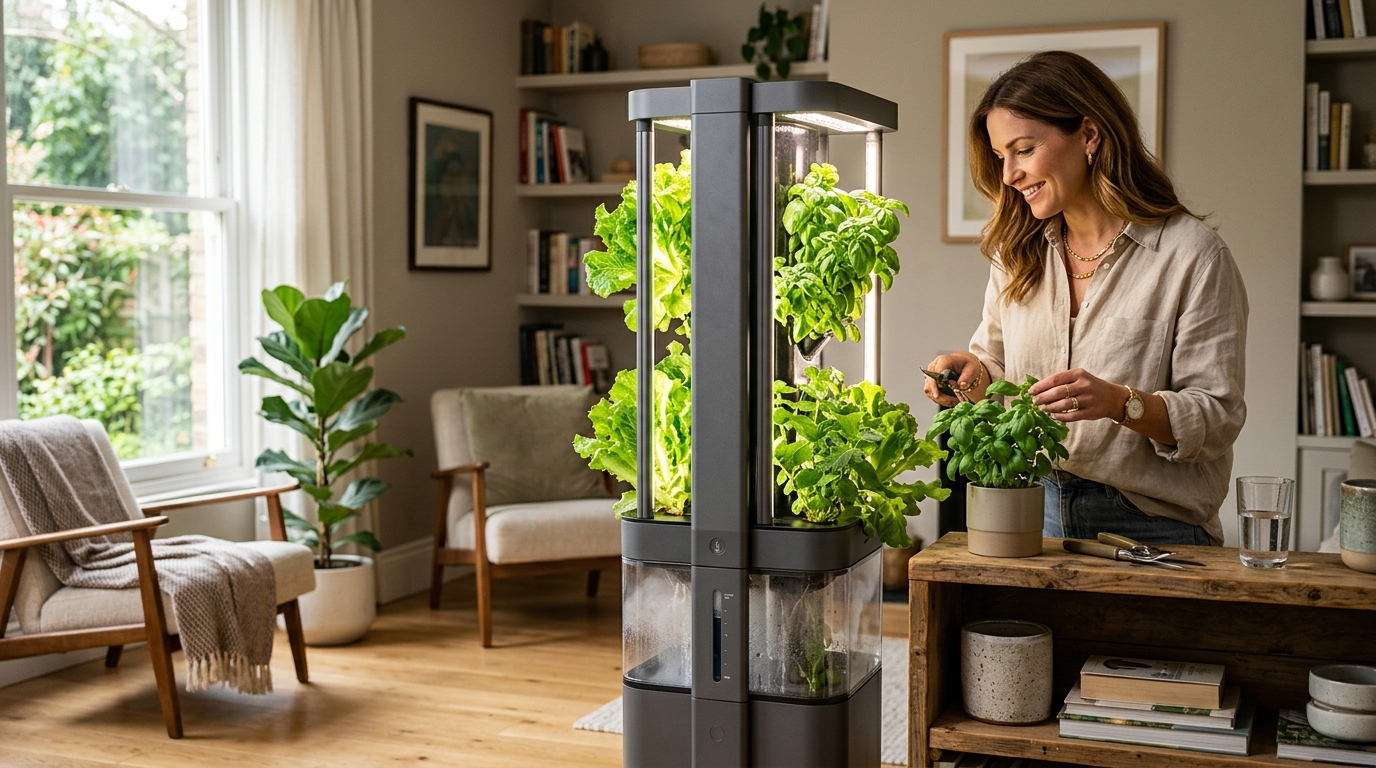
Tower Garden FLEX is the best aeroponic system for home food production — 20 plants in 2.5 sqft on 40% less water than soil. For cuttings and propagation, Clone King 36 is the top aeroponic cloner: roots develop in 7-10 days with no growing media at all. Both use true low-pressure aeroponics — mist nozzles spray roots directly with oxygenated nutrient solution, giving plants more oxygen than any soil or hydroponic substrate can match.
How aeroponics differs from hydroponics
In hydroponics, roots sit in or flow through nutrient solution. In aeroponics, roots hang in mid-air and are periodically misted — typically for 15-45 seconds every 3-5 minutes. That air gap between mist cycles provides maximum oxygen exposure, which is why aeroponic plants grow 20-30% faster than DWC hydroponics and 50-70% faster than soil.
Two types exist in practice:
Low-pressure aeroponics (LPA) is the home-grower standard. A submersible pump pushes water through mist nozzles at 30-80 PSI, producing droplets of 100-250 microns. Tower Garden FLEX and virtually all consumer aeroponic cloners are LPA systems. They are practical, affordable, and forgiving enough for everyday home use.
High-pressure aeroponics (HPA) is the commercial standard. A pressure accumulator and high-pressure diaphragm pump create 70-100 PSI and true fog droplets of 5-50 microns. Growth rates are measurably faster, but the systems cost $500-2,000 to build correctly, require specialized stainless steel fittings and nozzles, and demand real engineering knowledge to maintain. First-time growers should avoid HPA entirely.
The practical guidance: use LPA for home food production and propagation. The growth advantage of HPA over LPA is real but marginal at home scale, and the complexity gap is enormous.
Quick comparison
| Product | Best for | Rating | Notes | |
|---|---|---|---|---|
| Tower Garden FLEX (aeroponic vertical tower) | best aeroponic tower for home food production | ★★★★★ | $400-700. 20 plants. 2.5 sqft footprint. App control. | Check price |
| Clone King 36 Site Aeroponic Cloner | best value aeroponic cloner for propagation | ★★★★★ | $100-130. 36 sites. Submersible pump. 7-14 day roots. | Check price |
| EZ-Clone 30 Site Classic Cloner | best premium aeroponic cloner; flooded chamber design | ★★★★★ | $200-250. 30 sites. Reusable collars. Commercial-grade pump. | Check price |
| TurboKlone T24 Elite | best beginner aeroponic cloner with humidity dome | ★★★★★ | $80-110. 24 sites. Humidity dome included. | Check price |
| VEVOR Aeroponic Tower Garden | best budget tower for lettuces and herbs | ★★★★☆ | $80-150. 36-108 plant sites. Budget construction. | Check price |
The picks
Best aeroponic tower: Tower Garden FLEX
Best for home gardeners growing 20 vegetables and herbs in under 3 sqft of floor space
Tower Garden FLEX Aeroponic Vertical Tower (20 plants)
Tower Garden FLEX is the most-recommended consumer aeroponic system and the one professional growers recommend without reservation. A submersible pump pushes nutrient solution up a central column; it mists roots through the outer grow ports and drains back to the reservoir. The FLEX version adds a weather-resistant shield and a 20-gallon reservoir, making it suitable outdoors or indoors with the grow light accessory. It grows tomatoes, peppers, lettuce, herbs, kale, and strawberries — essentially anything except root vegetables. Setup takes 30-60 minutes; leafy greens mature in 3-6 weeks, fruiting plants in 3-4 months. At \$400-700, a household eating fresh produce 3-4 times per week typically recovers the cost in 12-18 months through grocery savings.
★★★★★ 4.7 · 2,100 reviews
Check current price on Amazon→Best aeroponic cloner: Clone King 36
Best for gardeners who propagate cuttings regularly and want the fastest available rooting method
Clone King 36 Site Aeroponic Plant Cloner
Clone King 36 is the most popular aeroponic cloner in the US and the benchmark against which others are judged. The design is straightforward: 36 neoprene collars hold cuttings with roots hanging into a spray chamber; a submersible pump runs continuously and mists those roots through individual spray heads. No growing media required — roots develop directly in open air. Most cuttings root in 7-10 days; robust hardwood cuttings root in 5-7 days. The 36-site format fits a 2x2 footprint and runs on a single small pump at \$100-130. Clone King also makes 25-site and 64-site versions for smaller or larger propagation operations.
★★★★★ 4.6 · 3,800 reviews
Check current price on Amazon→Best premium cloner: EZ-Clone 30 Site Classic
Best for serious propagators who want the most durable and low-maintenance aeroponic cloner available
EZ-Clone 30 Site Classic Aeroponic Cloner
EZ-Clone is the premium aeroponic cloner that professional propagators use when they need equipment that runs every day without fuss. Unlike Clone King, EZ-Clone uses a flooded chamber design: spray nozzles flood the bottom of the reservoir with a fine continuous mist, and there are no neoprene collars to discard between batches. Cuttings sit in reusable, dishwasher-safe EZ-Clone collars. The heavy-gauge black plastic construction blocks light penetration — critical for root health — and the pump is a commercial-grade unit designed to run 24 hours per day for years. At \$200-250 it costs roughly twice Clone King, but the build quality and reduced batch cleanup justify it for growers propagating plants weekly or running a continuous production cycle.
★★★★★ 4.5 · 1,200 reviews
Check current price on Amazon→Best compact cloner: TurboKlone T24 Elite
Best for beginners propagating up to 24 cuttings at a time who want a complete setup out of the box
TurboKlone T24 Elite Aeroponic Cloner with Humidity Dome
TurboKlone T24 Elite is the best entry-level aeroponic cloner for small grows and the easiest complete kit to get started with. The T24 ships with a UV-resistant humidity dome that maintains the 80-95% relative humidity cuttings need while roots develop — most budget cloners omit this, forcing you to source a dome separately. The spray system is simple and reliable; rooting times match Clone King at 7-14 days for most plant varieties. At \$80-110 it is the most affordable true aeroponic cloner that includes everything needed for the first run. TurboKlone also makes T48 and T96 models for larger propagation operations when the time comes to scale up.
★★★★★ 4.5 · 950 reviews
Check current price on Amazon→Best budget tower: VEVOR Aeroponic Tower
Best for budget-conscious growers who want a vertical aeroponic tower for lettuce and herbs
VEVOR Aeroponic Tower Garden (36-108 Plant Sites)
VEVOR makes the most popular budget alternative to Tower Garden FLEX. The VEVOR towers come in 36, 72, and 108-site configurations at \$80-150 — roughly three to five times cheaper than Tower Garden FLEX. The trade-off is build quality: thinner wall plastic, simpler pump connections, and mist nozzles that may clog more frequently in hard-water areas. For growers in soft-water regions growing lettuce, spinach, and herbs, VEVOR towers work reliably and represent strong value. For fruiting plants or long-term production, Tower Garden FLEX builds are worth the premium. VEVOR towers also function outdoors when paired with a separate grow light for indoor use.
★★★★☆ 4.2 · 1,500 reviews
Check current price on Amazon→How to maintain an aeroponic system
Aeroponics requires more active maintenance than soil, but less than most growers anticipate once the routine is established.
pH management is non-negotiable. Aeroponic roots are entirely dependent on the nutrient mist. Target pH 5.5-6.2 — outside this range, nutrient lockout sets in fast. Check pH every 2-3 days and top up the reservoir with pH-adjusted water as the level drops. A $20-30 digital pH meter and a bottle of pH Down solution are the minimum kit.
Nozzle cleaning is the most important maintenance task. Mist nozzles clog with mineral deposits from hard water. For tower gardens: remove and soak nozzles in white vinegar every 4-6 weeks, then rinse and reinstall. For cloners: flush the spray manifold between batches with clean water. Clogged nozzles mean dry roots; dry aeroponic roots die within a few hours — this is the failure mode that ruins most beginner setups.
Timer cycles for stand-alone aeroponic systems should run the pump for 15-45 seconds every 3-5 minutes during the light period. Most Tower Garden units run on a longer 24-hour cycle (pump on 15 minutes, off 15 minutes) which is less optimal but safe for growers who check their systems infrequently. For maximum growth, shorter cycles produce better results with properly working nozzles.
Reservoir cleaning every 2-3 weeks prevents algae and biofilm. Drain completely, rinse with a 1% hydrogen peroxide solution, refill with fresh nutrient solution. Dark reservoirs (black or opaque plastic) suppress algae significantly — this is why quality aeroponic systems use dark-colored tanks and why you should never use a clear or translucent reservoir outdoors.
Aeroponics vs hydroponics: when to choose each
Aeroponics wins when space efficiency is the priority. A Tower Garden FLEX grows 20 plants in 2.5 sqft — no NFT channel or DWC bucket layout matches that density. It also wins for propagation: aeroponic cloners produce rooted cuttings in 7-14 days with zero growing media, compared to 14-21 days in rockwool or perlite for most hydroponic propagation methods.
Hydroponics wins when simplicity matters more than speed. A DWC bucket requires no nozzle maintenance, and an NFT channel is more forgiving of timer failures than an aeroponic tower. For large single plants like tomatoes or cannabis, a DWC 5-gallon bucket produces more per square foot than a vertical aeroponic tower because the single-plant root system fills the entire reservoir.
Neither beats soil for plant variety or beginner forgiveness. Soil still makes sense for most houseplants and casual herb growing — aeroponics is the right tool specifically for high-density food production and serious cutting propagation.
What to avoid
Cheap aeroponic towers with poor nozzle quality. The key differentiator in aeroponic towers is not the plastic shell but the mist nozzles. Nozzles that clog after 2-4 weeks eliminate the core benefit of the system. Read reviews specifically for nozzle longevity and hard-water performance before buying any sub-$100 tower.
DIY high-pressure aeroponics as a first system. HPA requires correctly sized pressure accumulator tanks, commercial diaphragm pumps, and precision nozzles. A miscalculated DIY HPA system floods roots with water instead of mist — which is just expensive hydroponics with a lot more plumbing. Start with a proven LPA system and build HPA knowledge gradually.
Aeroponic cloners for seeds. Cloners are designed for vegetative cuttings from established plants, not for germinating seeds. Seeds require a starter plug (rockwool cube, rapid rooter, or jiffy peat pellet) and a propagation tray — an aeroponic spray chamber provides no advantage for germination and can dislodge fragile seedlings.
FAQ
Frequently asked questions
What is the best aeroponic system for beginners?
How fast do plants grow in aeroponics compared to soil?
Do I need a special nutrient solution for aeroponics?
How often do I need to clean aeroponic nozzles?
Can I grow tomatoes in an aeroponic tower?
Aeroponics vs hydroponics: which is better for lettuce?
Bottom line
Best aeroponic tower: Tower Garden FLEX. Best value aeroponic cloner: Clone King 36. Best premium cloner: EZ-Clone 30 Site Classic. Best beginner cloner: TurboKlone T24 Elite. Best budget tower: VEVOR aeroponic tower.
Pair your tower with proper grow lights for indoor food production, compare options with the best hydroponic systems guide, or read the DIY hydroponics guide if you want to build your own system from scratch.