guides
Vertical Garden vs Shelf Garden: Which Fits Your Space?
Shelf gardens fit more plant variety and are easier to manage; vertical towers maximize yield per square foot. Here is how to choose.
 Priya Anand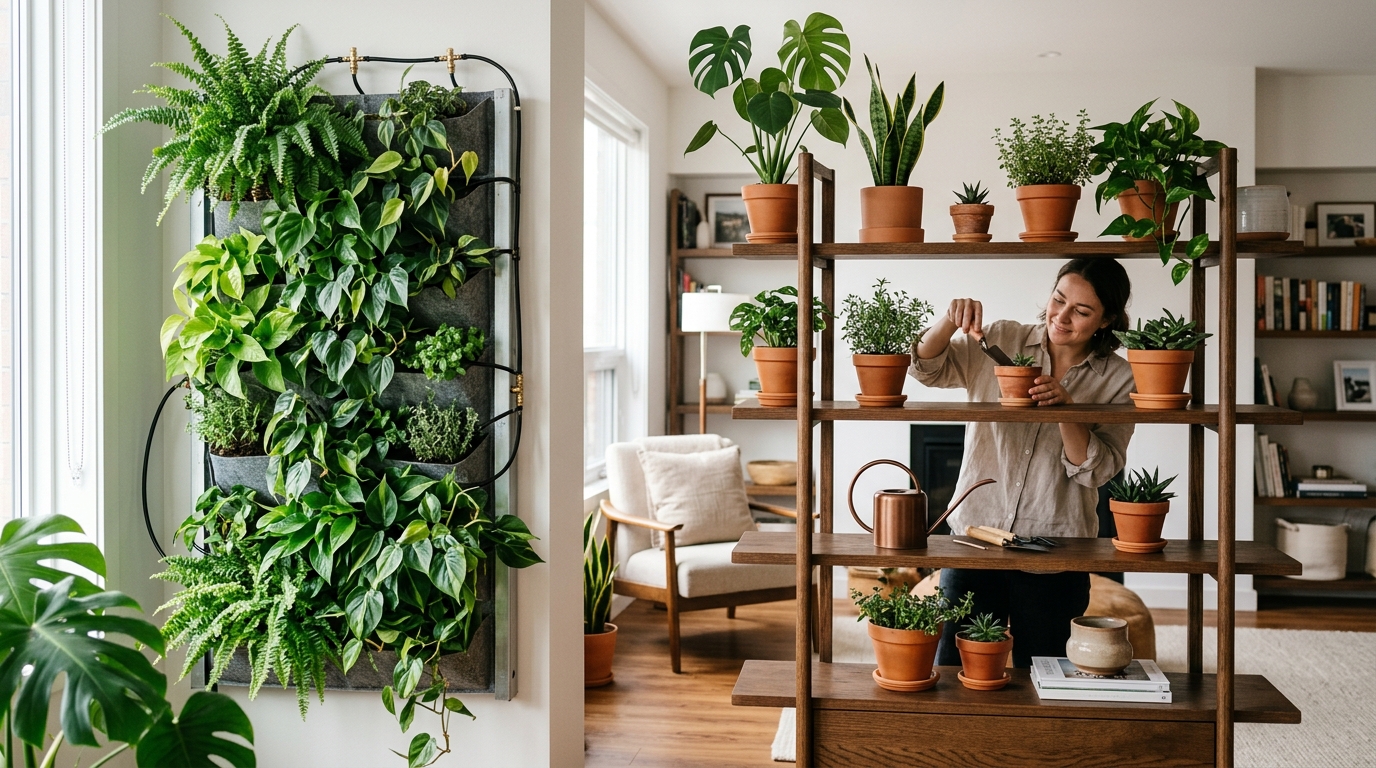
The short answer: for most indoor gardeners, a shelf garden wins — it holds more plant variety, allows easier access to every plant, and costs less to start. Vertical gardens (towers, wall planters) are the better choice when floor space is genuinely limited and you want maximum yield from a single small footprint, especially for lettuce and herbs.
Quick comparison
| Product | Best for | Rating | Notes | |
|---|---|---|---|---|
| Tower Garden FLEX (aeroponic) | Maximum greens yield in minimum floor space | ★★★★☆ | Holds 20 plants in a 2.5 sq ft footprint. Aeroponic mist system. $600-900. Best performance vertical tower. | Check price |
| Vevor 12-Pod Hydroponic Tower | Entry-level vertical hydroponics on a budget | ★★★★☆ | Pump-based circulation. Holds 12 plants in about 2 sq ft. $100-180. Best starter hydroponic tower. | Check price |
| Mr. Stacky 5-Tier Vertical Planter | Herbs and strawberries in soil without hydroponics | ★★★★☆ | Soil-based stackable pockets. $30-60. Self-watering overflow design. Best budget soil vertical planter. | Check price |
| Spider Farmer 4-Tier Grow Shelf | Seed starting, mixed plant types, and propagation | ★★★★★ | $180-260 with integrated LED bars. Adjustable tiers. Handles soil, coco, and hydroponic pots. Best all-in-one shelf. | Check price |
| Wire metro shelving with grow light strips | Custom flexible shelf setup with adjustable tier spacing | ★★★★☆ | $60-120 for shelving, $30-60 per tier for LED strips. Best DIY approach for plants of varied heights. | Check price |
What counts as a vertical garden?
For indoor growing purposes, “vertical garden” means any system that stacks plants in a column rather than spreading them across a flat surface. The three most common types:
Hydroponic towers — The most productive option. These are freestanding columns with plant pods arranged around the perimeter. A pump (or aeroponic mist heads) circulates nutrient solution from a reservoir at the base up to the top, where it drips down past all root zones. Examples include the Tower Garden FLEX, Vevor tower systems, and Juice Plus towers, ranging from $100-900. Most hold 12-32 plants in a floor space of 2-3 sq ft.
Stackable soil pocket planters — Plastic or felt columns with individual growing pockets. Mr. Stacky, Hangpot, and similar brands sell these for $25-70. Each pocket holds soil and one plant. Water poured from the top drips down through lower pockets — with mixed consistency depending on the column height. Best for strawberries, herbs, and compact lettuces that tolerate drying between waterings.
Wall-mounted planters — Grid systems, pocket organizers, or modular panels that attach to a wall. Best for succulents, air plants, and trailing herbs that tolerate variable watering. Without a drip irrigation system, indoor wall planters are rarely productive for food growing — the watering is too inconsistent for edibles.
For this comparison, the most meaningful practical choice is between hydroponic towers or stackable pocket planters versus shelving with grow lights.
What counts as a shelf garden?
A shelf garden is any tiered shelving setup where plants sit on horizontal surfaces under grow lights mounted on the shelf above them. Two main approaches:
Integrated grow shelves — Pre-built metal shelves with LED grow light bars already built into or designed to clip onto each tier. Spider Farmer, AC Infinity, and Vivosun sell these at $150-300 for 3-4 tiers. The lights are purpose-built for plant growth and the whole unit arrives ready to assemble and plug in.
DIY wire shelf plus lights — A standard wire metro shelving unit ($50-120 for 4-5 tiers at 36-48 inches wide) with separately purchased LED grow light strips mounted underneath each shelf. This approach costs roughly the same as integrated shelves but gives more flexibility in tier spacing and light selection. You can match light intensity to the specific plants on each tier, which is something fixed integrated units cannot do.
A typical 4-tier shelf (36 inches wide, 14 inches deep) holds 12-16 four-inch pots per tier, or 6-8 larger containers per shelf. Total footprint: about 3.5-4 sq ft.
The key differences
Space efficiency
Vertical towers pack the most plants per square foot of floor space. A Tower Garden FLEX holds 20 plants in a 2.5 sq ft circle. A Vevor 12-pod tower holds 12 plants in about 2 sq ft. No shelving unit can match that density at the same footprint.
A shelf garden is efficient but not equivalent. A 36-inch wide, 4-tier shelf holds 12-16 standard 4-inch pots per tier — theoretically 48-64 plants at seedling scale — but that shelf occupies 4.5 sq ft of floor space. For mature herb or lettuce plants in 6-inch pots, a realistic capacity is 6-8 plants per tier, or 24-32 total.
Verdict: vertical towers win on raw plants per square foot. If you have a 2-3 sq ft corner and want to grow 12-20 plants, a tower uses that space better than any shelf.
Plant variety
This is where shelves win clearly. Shelf gardens accommodate nearly everything that can grow indoors:
- Seed trays and seedling domes (too tall for most tower pods)
- Large pots for tomatoes, peppers, or larger herbs
- Propagation trays and cloning domes
- Succulents, cacti, and ornamental plants
- Microgreens trays (flat and wide — incompatible with vertical pods)
- Standard nursery pots in 4, 6, 8, or 10-inch sizes
- Fabric grow bags
Vertical towers are optimized for one category: plants with compact root systems that tolerate shared hydroponic conditions. Lettuce, basil, cilantro, dill, spinach, and strawberries all perform well. Large plants, root vegetables, or anything that needs individual soil conditions does not.
Verdict: shelf gardens accommodate virtually any plant; towers grow greens and herbs.
Access and maintenance
Shelves are straightforward to maintain. Every plant sits at eye level or within easy reach on its own shelf. Watering, pruning, transplanting, and harvesting are all as simple as reaching for a pot. Light levels are consistent across each tier, with the lowest tier receiving slightly less ambient light than upper levels — a minor issue in most setups.
Vertical towers introduce an inherent gradient problem: plants at the top of the column receive nutrient solution first and are closest to the grow light. Plants at the bottom receive solution last and are farthest from the light. In most hydroponic towers, bottom pods consistently lag behind top pods in growth rate by 20-40%. You can partially compensate by rotating plants between positions every week or two, but it adds a regular maintenance step that shelves do not require.
Reaching the bottom of a tall tower to transplant seedlings or clean pods is also awkward — particularly for towers over 4 feet. Hydroponic towers also need monthly deep cleaning to remove algae from the reservoir and flush the distribution tubes. This takes 20-30 minutes and requires draining the system. Watering a soil pot on a shelf takes 30 seconds.
Verdict: shelf gardens are substantially easier to manage, especially for beginners and anyone who wants lower-touch growing.
Cost to start
Soil pocket vertical planters are the cheapest entry:
- Mr. Stacky 5-tier: $30-60, plus $15-25 for soil and plants
Hydroponic towers range widely by quality:
- Vevor budget tower: $100-180 (grow light not included; add $60-100)
- Mid-range towers like Juice Plus: $300-500 with light
- Tower Garden FLEX: $600-900 plus light if not bundled
Integrated grow shelves land in the middle:
- Spider Farmer 4-tier with LED bars: $180-260 (lights included)
- DIY wire shelf with LED strips: $100-180 depending on tier count and light quality
Verdict: pocket planters cost least; integrated grow shelves and budget towers overlap in the $180-260 range; premium aeroponic towers cost significantly more.
Grow light requirements
Shelf gardens solve the lighting problem architecturally. Each tier has its own light mounted directly overhead, so every plant sits within 6-12 inches of a full-spectrum LED bar regardless of shelf height. The plants on the top shelf are just as well-lit as plants on the bottom shelf. This structural advantage is what makes a shelf garden so versatile.
Vertical towers need a separate grow light — typically a single overhead panel, a ring light designed for towers, or side-mounted vertical strips. With a single overhead source, the top pods are much closer to the light than the bottom pods. A 5-foot tower needs a powerful light to maintain adequate intensity at the base. The Tower Garden’s own light kit (approximately $200-300) addresses this and works reasonably well; most third-party grow lights are not designed for tall vertical columns and leave the lower third under-lit.
Verdict: shelf gardens are inherently better-lit per plant. Towers require careful light selection and often additional investment in specialized lighting.
Who should choose a vertical garden tower?
A vertical tower is the right choice when:
- Floor space is the primary constraint. If you have 2-3 sq ft in a corner and want to grow herbs and lettuce continuously, a tower extracts more production from that space than any shelf.
- You want a high-volume herb supply. A 20-pod aeroponic tower running lettuce, basil, and cilantro produces more harvestable greens per week than most 4 sq ft shelf setups.
- You are already comfortable with hydroponics. Towers require pH management and nutrient mixing — the same skills needed for any hydroponic system. First-timers without prior hydroponic experience struggle to troubleshoot tower problems.
- Your growing goals are lettuce and soft herbs. Lettuce, arugula, spinach, basil, cilantro, dill, and parsley are the tower sweet spot. These are also the most productive and fast-cycling crops for regular harvesting.
For vetted tower options and full system comparisons, see the best hydroponic systems guide.
Who should choose a shelf garden?
A shelf garden makes more sense when:
- You grow multiple plant types. If your garden includes herbs, seedlings, propagation cuttings, microgreens, and larger edibles, a shelf is the only format that accommodates all of them in one structure.
- You are starting seeds or propagating cuttings. Seed trays and propagation domes belong on shelves, not in hydroponic pods. If seed starting is part of your growing cycle, you need shelf space regardless.
- You prefer lower-maintenance growing. Soil pots on a shelf require watering every 2-5 days — no pH meters, no reservoir cleaning, no nutrient solution mixing.
- Your budget is $100-250. In that range, a shelf garden with integrated lights delivers more versatility per dollar than any tower at the same price.
- You are new to indoor growing. The indoor gardening setup guide recommends shelves as the starting point for most beginners because they work with soil, are forgiving of mistakes, and grow the widest range of plants without requiring hydroponic knowledge.
A well-equipped 4-tier grow shelf is genuinely versatile: run herbs and lettuce on the top tier under the strongest light, seedlings on the second tier under a gentler schedule, propagation cuttings on the third, and low-light plants on the bottom.
Can you run both at the same time?
Yes, and the two formats complement each other well. The most productive indoor gardening setups often combine:
- A shelf for seed starting, propagation, large pots, and mixed plant types — the operational backbone of the growing space
- A vertical tower for high-turnover crops like lettuce and basil that are harvested continuously
This division of labor works because the two systems do not compete for the same space or the same crops. An integrated grow shelf handles the variety; the tower handles the volume. Combined cost for a capable entry-level version of this dual setup: $280-450 (Spider Farmer shelf at $180-260 plus a Vevor tower at $100-180).
Best for Best all-in-one shelf garden for mixed plants
Spider Farmer 4-Tier Grow Shelf with LED Bars
Four adjustable tiers with full-spectrum LED bars on each level. Handles seedlings, herbs, larger pots, and microgreens trays in one unit. Lights are removable and repositionable as plants grow taller.
★★★★★ 4.5 · 312 reviews
Check current price on Amazon→Best for Best entry-level vertical hydroponic tower
Vevor 12-Pod Hydroponic Tower Garden
Holds 12 plants in under 2 sq ft of floor space. Pump-based circulation keeps roots oxygenated. Good for lettuce, basil, and herbs when floor space is the primary constraint. Pair with a 45W full-spectrum grow light.
★★★★☆ 4.2 · 189 reviews
Check current price on Amazon→What to skip
Cheap wall pocket planters — Fabric wall pockets sold as indoor vertical gardens struggle with watering consistency. Without a built-in drip system, top pockets stay wet while bottom pockets dry out. They work on outdoor walls with rain; indoors they create maintenance headaches rather than a productive garden.
Single-tier baker’s racks — A single shelf level with one overhead light cannot grow more than one plant generation at a time. The structural advantage of a shelf garden is independent lighting per tier; a single-level setup eliminates that advantage and gives you a more expensive version of just putting plants on a windowsill.
DIY PVC pipe towers — DIY vertical tower tutorials using PVC pipe produce impressive outdoor results but create chronic lighting and root access problems indoors. Purpose-built towers are engineered with consistent pod spacing and materials that resist algae; PVC DIY versions require constant problem-solving. Buy a purpose-built tower or build a shelf instead.
FAQ
Frequently asked questions
How many plants can a 4-tier grow shelf actually hold?
Do vertical towers produce more than shelf gardens?
What plants grow best in a vertical hydroponic tower?
Do I need a special grow light for a vertical tower?
Can I grow tomatoes in a vertical tower?
Which setup is better for a complete beginner?
Bottom line
For most indoor gardeners, start with a shelf garden. The Spider Farmer 4-tier or a DIY wire shelf with LED strips gives you maximum flexibility — seed starting, herbs, larger plants, and propagation all in one unit — for $150-260. Shelf gardens are easier to manage, more forgiving for beginners, and handle a far wider range of plant types than any vertical tower.
Choose a vertical tower when floor space is the primary constraint and you want a continuous harvest of lettuce and herbs from a 2-3 sq ft footprint. Expect to invest $200-600 and plan time to learn pH management and regular reservoir maintenance.
The best long-term setup runs both: a shelf as the main growing hub and a compact hydroponic tower for high-volume herb and greens production side by side.
Explore further: how to grow herbs indoors for which plants thrive in either format, best hydroponic systems for full tower comparisons, indoor gardening setup guide for building your first grow space, and best grow lights to pair with any shelf or tower setup.