guides
How to Propagate Houseplants
Learn how to propagate houseplants by stem cuttings, water rooting, division, and leaf cuttings — step-by-step instructions for every method.
 Priya Anand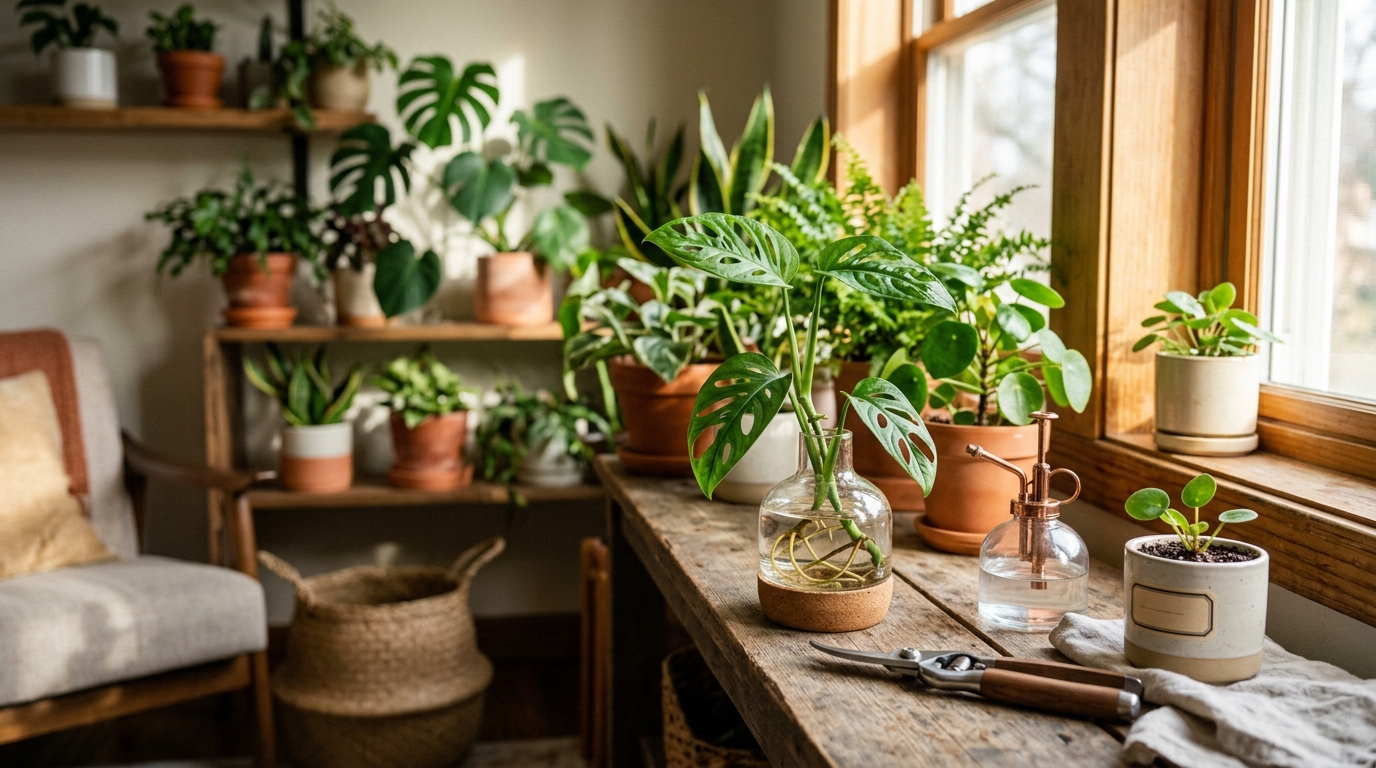
The easiest way to propagate most houseplants is a stem cutting placed in water or moist soil — take a 4- to 6-inch cutting just below a node, remove the lower leaves, and roots typically appear within two to four weeks. Pothos, philodendron, tradescantia, and coleus root fastest with nothing more than a glass of clean water. Succulents and cacti propagate reliably from leaf or stem cuttings placed directly on dry soil.
Which propagation method works for your plant?
Not every plant propagates the same way. Choosing the right method upfront saves time and prevents failed cuttings.
| Method | Best for | What you need |
|---|---|---|
| Stem cutting in water | Pothos, philodendron, tradescantia, impatiens, coleus | Clean glass or propagation vase |
| Stem cutting in soil | Ficus, rubber plant, rosemary, begonias, lavender | Perlite or propagation mix |
| Leaf cutting | Succulents, jade, African violet, snake plant, sedums | Tray of dry or barely moist cactus soil |
| Division | Peace lily, calathea, spider plant, hostas, Boston fern | Fresh potting mix, two pots |
| Offsets and pups | Aloe, agave, bromeliad, haworthia, sempervivum | Sharp knife, small pot |
Most common houseplants fall into the stem-cutting-in-water category. If your plant is on that list, start there — it requires no special equipment and gives you visible root progress in real time.
How to propagate plants in water
Water propagation is the most beginner-friendly method and works for the majority of popular houseplants. Understanding the node is the key to success.
Step 1: Locate the node on a healthy stem
A node is the bump or joint where a leaf attaches to the stem. Roots grow from nodes — not from random stem sections. A cutting with no node will never root regardless of how long it stays in water. Choose a healthy stem with at least two to three nodes, with firm green growth and no yellowing or soft spots.
Step 2: Cut just below a node
Use clean scissors or pruning snips — wipe the blades with rubbing alcohol first to avoid introducing bacteria. Cut at a 45-degree angle about one-quarter inch below a node. The angled cut maximizes root-generating surface area and keeps the stem end from sitting flat against the jar bottom where rot starts.
Step 3: Strip lower leaves
Remove any leaves that would sit below the waterline. Submerged leaves decompose quickly, contaminating the water and spreading rot to the cutting. Leave two to three healthy leaves at the top. For large-leaved plants like rubber plant or fiddle leaf fig, cut leaves in half horizontally to reduce moisture loss through transpiration while roots are developing.
Step 4: Set in clean, room-temperature water
Fill a glass or propagation vase so the node is fully submerged but the remaining leaves stay above the waterline. Place in bright indirect light — a few feet from a sunny window. Direct sun overheats the water and promotes algae growth. Change the water every three to five days; stagnant water breeds bacteria that rot the stem. This single step is the most commonly skipped and the most frequent cause of water-propagation failure.
Step 5: Transfer to soil at 1-2 inches of root length
Roots developed in water are structurally different from soil roots — they absorb water efficiently but are fragile. Transfer to soil once roots reach one to two inches. Waiting for longer roots makes the transition harder. Pot into a 50/50 blend of potting soil and perlite, water thoroughly, and treat like a newly purchased plant: bright indirect light, consistent moisture, no fertilizer for four to six weeks.
How to propagate plants in soil
Soil propagation works better than water for woody-stemmed plants like ficus, rubber plant, rosemary, lavender, and dracaena. These species root slowly or poorly in water but do well anchored in a porous, well-draining propagation medium.
Use a propagation mix instead of standard potting soil. Regular potting mix retains too much moisture and causes rot at the cut end before roots form. A mixture of equal parts perlite and coarse sand — or a commercial propagation mix — drains fast while staying just moist enough to encourage root initiation. Perlite for propagation is inexpensive and available at any garden center or online.
Take your stem cutting, strip the lower leaves, dip the cut end lightly in rooting hormone powder, and tap off the excess. Make a small hole in the propagation mix with a pencil first, then insert the cutting so the lowest node is buried. This prevents the rooting hormone from rubbing off during insertion. Cover loosely with a clear plastic bag or humidity dome to trap humidity around the cutting. Check the medium every few days and mist if it feels dry at the surface. Rooting typically takes two to eight weeks depending on species.
How to propagate by division
Division is the fastest and most reliable propagation method available because no rooting phase is required — each division has its own established root system from the start. It works for any plant that naturally grows in clumps: peace lilies, calathea, Boston ferns, hostas, snake plants (mature specimens), lemongrass, and spider plants.
How to divide a clumping houseplant:
- Water the plant thoroughly one day before dividing. Moist roots are more flexible and less likely to tear.
- Slide the plant out of its pot and lay it on its side. Work the root ball apart with your fingers, finding natural divisions in the clump. If the root mass is dense or fibrous, use a clean, sharp knife and cut directly through it.
- Each division needs at least two to three healthy stems and a visible root section. A single stem with no attached roots rarely survives.
- Pot each division into fresh potting mix in a container only slightly larger than the root mass.
- Water thoroughly and place in bright indirect light. Expect some wilting during the first week as the plant adjusts. New growth signals successful establishment.
How to propagate succulents from leaf cuttings
Succulent propagation requires almost nothing and produces satisfying results with minimal effort. Gently twist a firm, healthy leaf from the parent plant, pulling cleanly from the base so the entire leaf attachment point comes away intact. A leaf that snaps off partway up the blade will not propagate.
Let the leaf dry on a paper towel for 24 to 48 hours until the broken end callouses over — this step prevents rot when the leaf contacts soil. Lay the calloused leaves on top of a tray of barely moist cactus or succulent mix. Do not bury them. Place the tray in bright indirect light and mist lightly every few days.
Within two to four weeks, tiny roots emerge from the base followed by a miniature rosette of new leaves. The original leaf will slowly shrivel as it feeds the new plant — this is normal and expected. When the new plant has several leaves of its own and the original leaf is completely dry, gently separate them and pot the new plant into its own small container.
Using rooting hormone: when it actually helps
Rooting hormone contains indole-3-butyric acid (IBA), which signals stem tissue to initiate root growth. It matters most for difficult-to-root species: roses, ficus, rubber plant, lavender, rosemary, monstera (early cuttings), and most semi-woody stems. For easy rooters like pothos, tradescantia, spider plant, coleus, and impatiens, rooting hormone makes little measurable difference — these plants root readily on their own.
Bonide Bontone II Rooting Powder is the most widely available option and works well for most home propagation needs. For serious propagators, Clonex Rooting Gel offers superior adhesion to cut stem tissue and consistent concentration.
Use a light coating — dip the cut end, tap off excess, and plant immediately. Too much hormone inhibits rather than accelerates rooting. Pour a small amount into a separate dish before dipping; never dip directly into the main container, as this introduces bacteria from cuttings into your stock supply.
Tools that make propagation easier
You can propagate plants with only scissors and a glass of water. A few inexpensive tools raise your success rate significantly.
Best for water propagation of stem cuttings
Propagation Station Glass Vases
Dedicated propagation vases hold cuttings at the correct depth, expose only the node to water, and let you monitor root growth without disturbing the cutting. Most sets include multiple vase sizes for different stem diameters — narrow openings prevent cuttings from sinking too deep. Glass stays cleaner longer than plastic and does not leach anything into the water. On a windowsill they look intentional rather than improvised.
★★★★★ 4.6 · 2,800 reviews
Check current price on Amazon→Best for soil cuttings and seedling starts
Perlite for Propagation Mix
Adding perlite at 50 percent to potting soil creates a fast-draining, aerated rooting medium that delivers oxygen to the cut stem end — the stem rot that kills cuttings in dense potting soil almost never occurs in a perlite-heavy mix. Use it standalone or blended with coconut coir for cuttings that need slightly more moisture retention. A 4-quart bag fills several propagation trays and costs under $10.
★★★★★ 4.7 · 3,400 reviews
Check current price on Amazon→Best for woody and difficult-to-root cuttings
Bonide Bontone II Rooting Powder
Bonide Bontone II contains 0.1 percent IBA — the standard concentration for home propagation — and works reliably on plants that actually need rooting hormone: ficus, rubber plant, roses, lavender, and semi-woody stems. The powder format applies precisely: dip the cut end, tap off the excess, plant immediately. One bottle lasts years for home growers. If you buy one propagation product, this is it.
★★★★★ 4.5 · 5,200 reviews
Check current price on Amazon→Best for soil propagation and succulent leaf cuttings
Mini Humidity Dome Propagation Tray
A humidity dome traps moisture vapor around cuttings, maintaining the 80-90 percent relative humidity that speeds root initiation and prevents wilting before roots form. Adjustable vents let you reduce humidity gradually as roots develop, hardening the cutting off before full exposure to room air. Fits standard 10x20 seedling trays and pays for itself the first time you root a batch of cuttings that would otherwise wilt and fail.
★★★★★ 4.5 · 1,900 reviews
Check current price on Amazon→Common propagation mistakes
Cutting between nodes instead of below one: The most common beginner mistake. A cutting with no node cannot produce roots — there is no tissue capable of root formation. Always locate the node first, then cut just below it.
Too many leaves on the cutting: Each leaf loses moisture through transpiration. A cutting with four large leaves sheds water faster than a rootless stem can absorb, causing wilt before roots form. Strip all but two to three leaves.
Not changing the water: Stagnant water in water propagation breeds rot-causing bacteria within days. Change it every three to five days without fail. Clear water with white roots is healthy; brown or slimy water with soft stem tissue is failing propagation.
Propagating in low light: Cuttings need light to photosynthesize and drive root development. Bright indirect light means a few feet from a south- or west-facing window. A dim corner will not work.
Checking soil cuttings too early: Pulling or wiggling a soil cutting to test for roots breaks any roots that have started to form and sets the process back weeks. Wait four weeks minimum, then test by pushing gently sideways against the stem — resistance means roots have anchored.
FAQ
Frequently asked questions
Which houseplants are easiest to propagate?
How long does it take cuttings to root in water?
Can you propagate any houseplant from a leaf?
Do cuttings need rooting hormone?
Why are my cuttings rotting in water?
When should I move water-rooted cuttings to soil?
Bottom line
Propagating houseplants is one of the most rewarding skills in indoor gardening — new plants from cuttings cost nothing but time. Start with a pothos or tradescantia stem cutting in water to build confidence with the process, then move to soil cuttings and division as you get comfortable reading root development. The fundamentals stay constant: a healthy stem with a node, clean conditions, bright indirect light, and patience.
For related reading: how to fertilize indoor plants, how to water indoor plants correctly, best potting soil for indoor plants, and common indoor plant problems and fixes.