guides
How to Grow Spinach Indoors: Step-by-Step Guide
Grow fresh spinach indoors year-round with the right container, light, and temperature. Step-by-step guide for beginners and small spaces.
 Priya Anand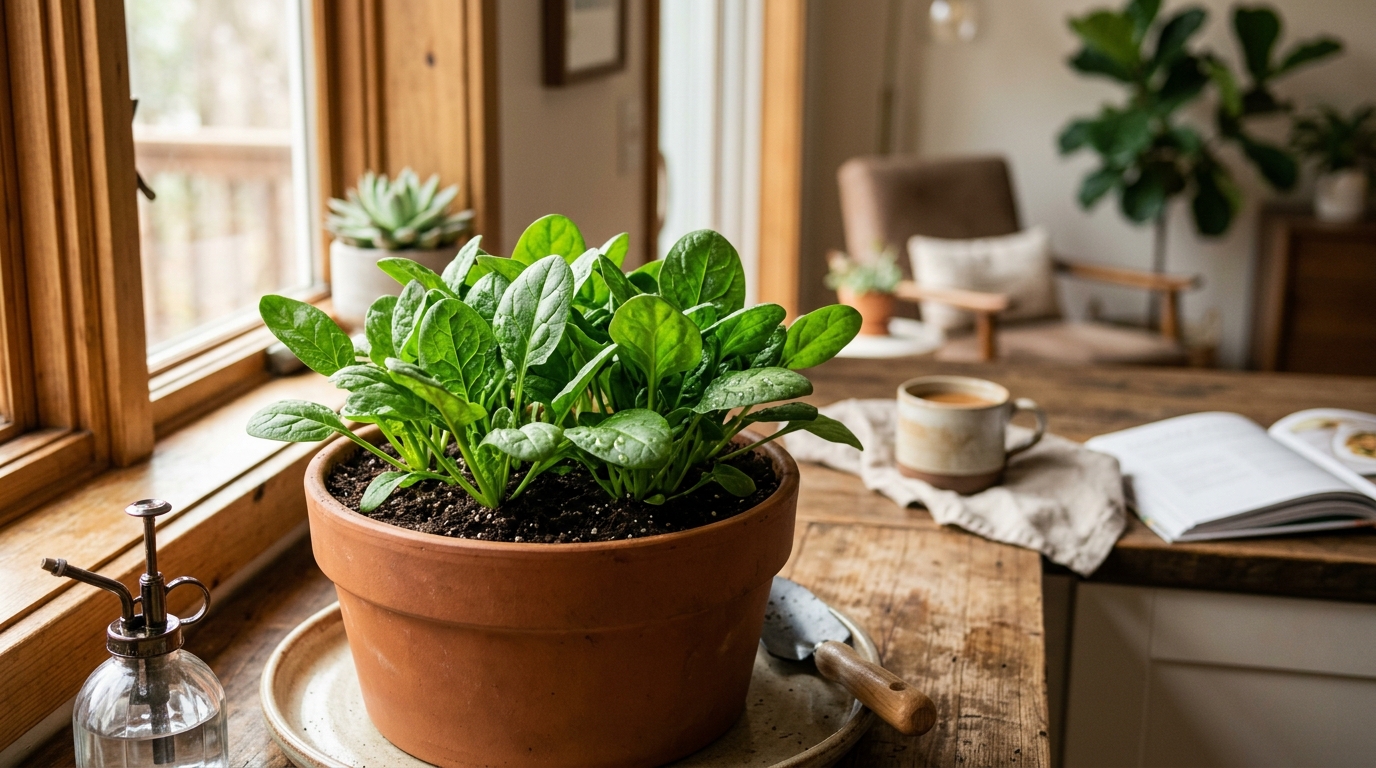
Spinach grows indoors year-round in any window with 4 to 6 hours of light — it is one of the few vegetables that actually prefers the modest light conditions of most homes. The biggest challenges are heat and bolting: keep temperatures at or below 70°F, sow seeds directly in containers at least 6 inches deep, and plan for 40 to 50 days from seed to first full-size harvest.
Why spinach is one of the best vegetables to grow indoors
Most edible plants grown indoors disappoint — they need more light, more warmth, and more space than typical home conditions provide. Spinach is the exception. It is a cool-season crop that evolved to grow in short days and modest light, which maps directly to the conditions most homes offer.
A north-facing kitchen window that would struggle to keep a basil plant alive is often enough for spinach. A cool bedroom in fall or winter — the same temperatures that would stress tropical houseplants — is ideal growing territory. Spinach does not need the heat, long days, or intense light that tomatoes and peppers require indoors.
The trade-off: spinach has a limited productive window even indoors. Once temperatures in the growing space consistently exceed 75°F, plants bolt — they shift energy into seed production, leaves turn bitter, and the flavor is ruined. In a climate-controlled home this usually happens near south-facing windows in summer unless you have air conditioning. Managing temperature is the central challenge of year-round indoor spinach growing.
Which spinach varieties work best indoors
Not all spinach varieties behave the same in containers and low-light conditions. Select varieties bred for dense leaf production and bolt resistance.
Best varieties for indoor growing:
- Bloomsdale Long Standing — savoyed (crinkled) leaves, excellent bolt resistance, one of the most reliable performers in containers. Available in almost every seed collection.
- Tyee — smooth, upright leaves that stay tender longer before bolting; developed for high-yield production in short seasons. A strong choice for spring and fall indoor growing.
- Baby Leaf Spinach (sold as mesclun or baby salad blends) — selected for small, tender leaves harvested young; ideal for cut-and-come-again growing in window boxes.
- Space Hybrid — compact habit suited to smaller containers; produces smooth, flat leaves with good cold tolerance.
- Carmel — particularly bolt-resistant in warm conditions; a reasonable summer option in a cool, air-conditioned room.
Avoid giant-leafed varieties like Giant Nobel or King of Denmark for indoor growing. They are bred for open field production and tend to underperform in the constrained root space of containers.
Seeds for any of these varieties are available online or at garden centers. A single packet costs $3–5 and supplies multiple succession plantings: view spinach seeds on Amazon.
What you need
| Product | Best for | Rating | Notes | |
|---|---|---|---|---|
| Rectangular window box or deep planter (8-10 inch depth) | Maximum root room for dense spinach stands | ★★★★★ | Spinach needs at least 6 inches of depth; 8 to 10 is better for sustained production. A 12 by 6 inch window box holds enough plants for a weekly salad harvest for one person. | Check price |
| Seed starting or all-purpose potting mix | Lightweight well-draining base for container spinach | ★★★★★ | Mix with 20 percent perlite to improve drainage. Avoid moisture-control mixes and anything with heavy bark content. Fox Farm Happy Frog and Espoma Organic Potting Mix both work well. | Check price |
| Perlite for soil amendment | Improving drainage and preventing compaction | ★★★★★ | Add 1 part perlite to 4 parts potting mix. Spinach tolerates briefly dry soil better than waterlogged roots, so fast drainage is the priority in containers. | Check price |
| Full-spectrum LED grow light (low to mid intensity) | Supplementing window light or replacing it entirely | ★★★★★ | Spinach does not need high-intensity lighting. A T5 fluorescent or low-wattage LED run for 12 to 14 hours per day is sufficient. Barrina T5 strips at about $30 cover a standard window-box setup. | Check price |
| Liquid nitrogen fertilizer for leafy greens | Feeding leaf production every 2 to 3 weeks | ★★★★★ | Use a high-nitrogen formula such as fish emulsion or a balanced 10-10-10 diluted to half strength. Nitrogen drives leaf production; phosphorus and potassium matter less for a leafy crop. | Check price |
Total setup cost for an indoor spinach container runs $30 to $60 depending on whether you already own a planter and whether you add a grow light. The seeds themselves cost almost nothing on a per-harvest basis.
Step 1: Choose the right container
Container depth is the most important hardware decision. Spinach develops a taproot system that needs at least 6 inches of growing room; 8 to 10 inches is better for plants you intend to harvest multiple times over several weeks.
Width and length determine yield. A single 6-inch pot holds 4 to 6 plants — enough for a garnish but not a meaningful harvest. For salad-level production, use a 12 by 6 inch window box or a rectangular planter in the 10 to 14 inch range. Multiple boxes arranged on a windowsill or a small wire shelf can produce a surprising amount of greens from a compact footprint.
Drainage holes are non-negotiable. Spinach is susceptible to root rot in waterlogged containers — even one episode of sitting in standing water can kill plants within days. Elevate planters on a rack or empty saucers after each watering.
Material matters less than depth and drainage. Plastic window boxes are inexpensive and retain moisture slightly longer than terracotta — an advantage in rooms that dry out quickly. Terracotta provides better airflow around roots and suits humid spaces or growers who tend to overwater.
Step 2: Prepare the growing medium
Spinach needs a loose, slightly moisture-retentive mix that drains quickly — not so fast that the soil dries completely between waterings, but fast enough that roots never sit in soggy conditions.
Recommended mix:
- 4 parts all-purpose or seed-starting potting mix
- 1 part perlite
Fill containers to within one inch of the rim. Do not compress the mix; loose soil allows roots to penetrate easily and water to drain evenly through the full container depth.
pH matters more for spinach than for most kitchen herbs. Spinach performs best in soil with a pH between 6.0 and 7.0. Most commercial potting mixes fall in this range. If you are using a peat-heavy mix that reads acidic (pH below 5.5), a small addition of garden lime raises the pH into the ideal range. A basic soil pH meter costs $10 to $15 and removes the guesswork: view pH meters on Amazon.
Step 3: Sow seeds correctly
Direct sowing — planting seeds into the final container rather than starting in trays and transplanting — is strongly preferred for spinach. The taproot is sensitive to disturbance, and direct-sown plants establish more quickly with less stress than transplanted seedlings.
How to sow spinach seeds indoors:
- Moisten the potting mix before planting until it feels damp throughout but is not dripping.
- Make shallow furrows 0.5 inches deep spaced 3 to 4 inches apart across the container.
- Drop 2 to 3 seeds every 3 inches along each furrow.
- Cover lightly with a thin layer of potting mix and press gently to ensure solid seed-to-soil contact.
- Mist the surface with a spray bottle — avoid drenching with a watering can, which can dislodge freshly sown seeds.
- Cover loosely with plastic wrap or a humidity dome and place in a location with temperatures between 50 and 70°F.
Germination timing: Spinach seeds germinate in 5 to 10 days when temperatures are between 50 and 65°F. Germination slows above 70°F and stops almost entirely above 80°F. If seeds have not sprouted after 12 days, the growing space is likely too warm.
Once seedlings emerge, remove the dome and move containers to bright light. Thin to one plant every 3 to 4 inches once seedlings reach 2 inches tall. Crowded spinach bolts faster and produces smaller, less flavorful leaves.
Step 4: Provide the right light
Spinach needs significantly less light than warm-season vegetables. It evolved in cool, short-day conditions and performs well with moderate light — which aligns with what most home windows actually deliver.
Natural light guidance:
- North or east-facing window: sufficient for baby leaf spinach and cool-season growing; expect somewhat slower growth but minimal bolting risk from excess light
- South or west-facing window: excellent natural light; monitor temperatures near south-facing glass in summer since heat near the window can push into bolt-triggering territory
- Any window in winter: typically adequate; the cool temperatures slow growth but leaf quality remains high
Grow light option: For faster growth or windows with limited exposure, a T5 fluorescent strip or low-wattage LED running 12 to 14 hours per day provides ideal conditions for spinach. Unlike fruiting crops, spinach does not need high intensity lighting — a 24 to 48 watt LED strip mounted 6 to 12 inches above the plant canopy is entirely sufficient.
Run lights on a timer. Consistent photoperiods produce more even growth than sporadic manual switching, and outlet timers under $15 make the setup hands-off: view outlet timers on Amazon.
Important: Do not run grow lights for more than 14 hours per day for spinach. Long photoperiods — 16 hours or more — can trigger bolting even in cool temperatures. Stick to 12 to 14 hours to mimic a natural long-day without crossing into bolt-inducing territory.
Step 5: Manage temperature — the critical factor
Temperature is where most indoor spinach attempts run into trouble. Spinach is a cool-season crop: it thrives between 50 and 70°F and declines above 75°F. Above 80°F in the growing space, bolting becomes almost inevitable regardless of variety selection.
Practical strategies to keep spinach cool:
- Grow in a north-facing room during summer months
- Keep containers away from heat registers, radiators, and south-facing glass in warm weather
- A basement or garage with some natural light is often ideal in summer
- In air-conditioned homes, rooms set to 68°F support year-round growing without special measures
Reading the signs of heat stress:
- New leaves narrowing and pointing upward rather than spreading flat is the first visual sign of pre-bolt stress
- A central stalk emerging from the crown means the plant has committed to bolting; harvest all remaining leaves immediately before flavor declines
- Bitter flavor in young leaves that look normal is a sign the plant is already shifting chemistry toward seed production
If your space runs warm, choose bolt-resistant varieties such as Carmel or Space Hybrid, and plan for shorter productive windows. A single spinach plant that lasts 8 weeks in a 68°F room produces far more usable harvest than a plant that bolts in 4 weeks at 78°F.
Step 6: Water and fertilize correctly
Watering indoor spinach:
Spinach prefers consistently moist but never waterlogged soil. Unlike drought-tolerant herbs such as thyme and rosemary, spinach stress-bolts more readily in dry conditions. Aim to keep the soil evenly moist in the top 2 inches.
- Check soil moisture every 2 to 3 days by pushing a finger into the soil
- Water when the top inch feels dry but before the soil has fully dried out across the container
- Water at the base of plants rather than overhead to reduce the risk of fungal leaf problems
- In winter with lower light and slower growth, reduce watering to every 4 to 5 days
A watering can with a fine rose head allows controlled, gentle watering that does not disturb shallow seedling roots: view indoor watering cans on Amazon.
Fertilizing:
Spinach is a leafy green — it primarily needs nitrogen to drive leaf production. Phosphorus and potassium matter for root health and stress tolerance but are secondary for yield.
Apply a balanced liquid fertilizer diluted to half the recommended strength every 2 to 3 weeks, starting 3 weeks after germination. Options that work well for indoor use:
- Balanced 10-10-10 liquid fertilizer at half strength: effective and low-odor, the most practical choice for indoor use
- Fish emulsion (3-1-1 or similar): a strong nitrogen source but noticeable odor indoors — dilute thoroughly and ventilate the room after applying
- Worm castings tea: a gentle slow-release option; steep castings in water for 24 hours, strain, and apply as a soil drench
View liquid fertilizer options on Amazon.
Stop fertilizing if the plant is showing pre-bolt signs (narrow upright leaves, central stalk forming). Additional nutrients will not slow bolting and simply accumulate unused in the soil.
Step 7: Harvest correctly for maximum production
The cut-and-come-again method extends production significantly compared to harvesting the whole plant at once.
How to harvest spinach with the cut-and-come-again method:
- Wait until outer leaves are 3 to 4 inches long — large enough to have real flavor but not yet tough or bitter from age.
- Use clean scissors or a sharp knife. Tearing damages stem tissue and opens wounds to pathogens.
- Cut outer leaves at the base of the stem, leaving the inner rosette (the cluster of young center leaves) completely intact.
- Remove no more than a third of the leaves in any single harvest session.
- The plant regrows from the center crown, producing a new flush of outer leaves within 7 to 14 days.
A single plant maintained this way can produce 4 to 6 harvest cycles before bolting. Three or four plants in a window box yield enough spinach for a salad every 10 to 14 days on an ongoing basis.
Baby leaf harvest: For baby leaf harvests, cut the entire canopy back to 2 inches from the soil when plants are 3 to 4 weeks old. The plant regrows 1 to 2 more times before declining. Baby leaf spinach is more tender than full-size leaves and has a milder, sweeter flavor well suited to salads.
Troubleshooting common indoor spinach problems
Seedlings not germinating after 10 to 12 days: Soil temperature is likely too warm (above 70°F) or too cold (below 45°F). Move to a cooler location, or provide gentle bottom heat in cold conditions using a seedling heat mat set to the low setting.
Pale yellow leaves on young plants: Nitrogen deficiency or insufficient light. Begin fertilizing if you have not already; check light levels and consider adding a grow light.
White powdery coating on leaves: Powdery mildew, triggered by low air circulation and high humidity around the leaves. Improve airflow around containers and avoid wetting leaves during watering.
Leaves turning yellow from the bottom up (older leaves first): Classic overwatering symptom combined with possible root stress. Allow soil to dry more between waterings and verify containers drain freely with no standing water in the saucer.
Bolting despite cool temperatures: Some bolting is triggered by long photoperiods rather than heat. If using a grow light, reduce the daily schedule to 10 to 12 hours. Photoperiods of 16 hours or more can induce bolting even at 65°F.
Fungus gnats flying around the soil: Fungus gnats breed in consistently moist topsoil. Allow the top inch to dry between waterings and use yellow sticky traps to intercept adult gnats before they lay more eggs: view sticky traps on Amazon.
Succession planting for continuous harvest
The most common mistake with indoor spinach is planting one batch, harvesting it, then waiting to start again. A better strategy is succession planting: starting a new container every 3 weeks so a fresh planting reaches harvest stage just as the previous one starts to decline.
With three containers staggered by 3 weeks each, one planting is always at the harvest stage, one is at mid-growth, and one was just seeded. Total container footprint: three 12-inch window boxes, which fit on a single wide windowsill or a small two-tier plant shelf.
This approach also removes the pressure to harvest every leaf before a plant bolts. When one container goes bitter, harvest and compost it, and the next planting is already producing.
FAQ
Frequently asked questions
Can I grow spinach indoors without a grow light?
How long does it take to grow spinach indoors?
Why is my indoor spinach bolting so fast?
Can spinach regrow after cutting?
What container depth does spinach need indoors?
Can I grow spinach indoors year-round?
Bottom line
Spinach is the most practical leafy vegetable for indoor growing: low light needs, cool temperature tolerance, and a fast enough growth cycle to feel genuinely rewarding. The setup is minimal — a deep window box, a well-draining potting mix, and a window with a few hours of daily light. A grow light removes the uncertainty for under $40 and opens up year-round growing in any room.
The single biggest determinant of success is temperature. Keep the growing space below 70°F and manage it actively in summer, and a rotating succession of staggered spinach plantings will supply fresh greens on a continuous basis.
For related reading: how to grow herbs indoors, how to fertilize indoor plants, best indoor grow kits for beginners, and the indoor gardening setup guide for a complete equipment and lighting overview.