guides
How to Grow a Lemon Tree Indoors
Grow a dwarf lemon tree indoors and get real fruit. Guide to variety selection, light, soil, watering, feeding, and pollinating for indoor citrus.
 Priya Anand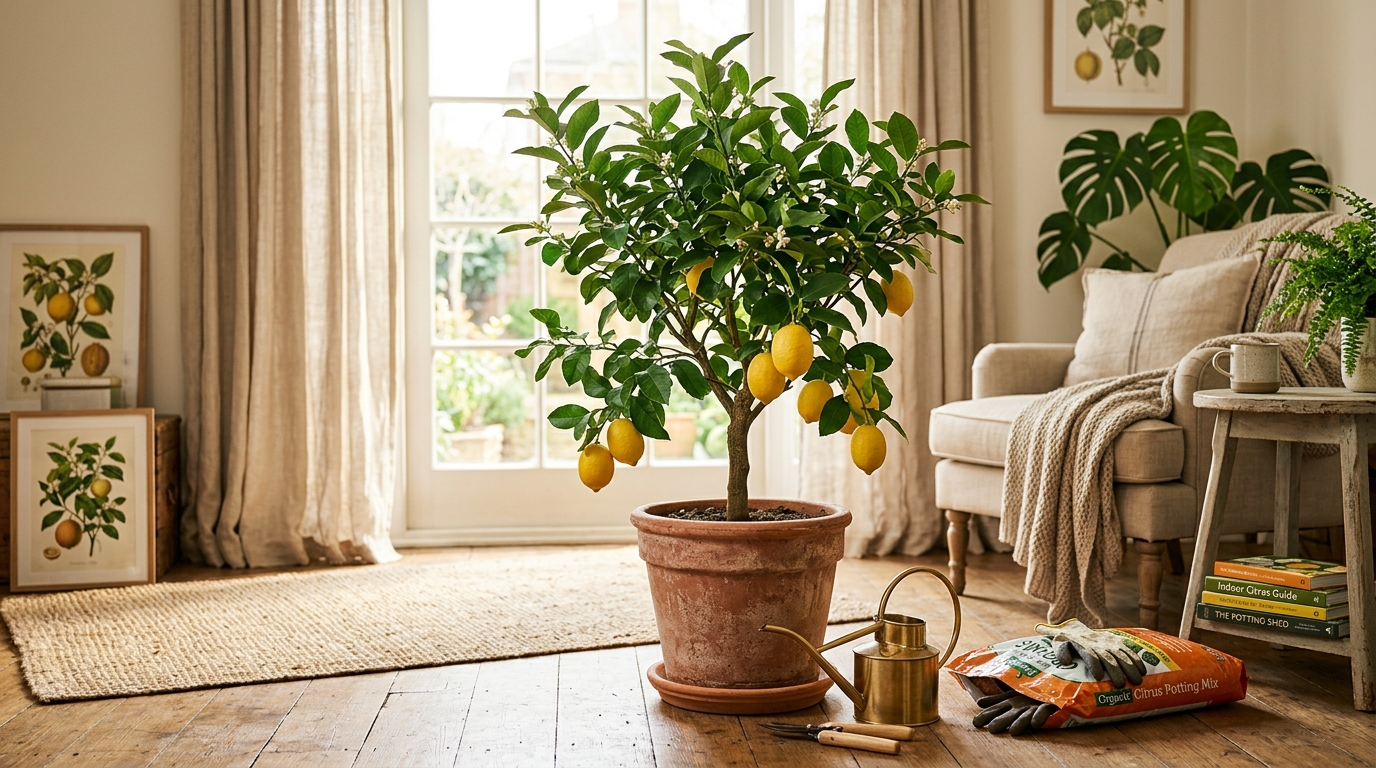
Growing a lemon tree indoors works best with a grafted dwarf variety — Improved Meyer Lemon is the top choice, with Ponderosa as a strong runner-up. Give it 8–12 hours of direct light from a south window or a full-spectrum grow light, pot it in fast-draining citrus mix, feed monthly from spring through fall, and hand-pollinate the flowers. Meyer lemons fruit reliably indoors within one to three years.
Indoor lemon trees offer something most houseplants cannot: actual edible fruit, glossy evergreen foliage, and a heady citrus fragrance when they bloom — all from a container small enough to fit in a bright corner of your living room. Unlike avocados, which rarely fruit indoors, a properly sited dwarf Meyer lemon tree is genuinely likely to produce lemons in a home environment. The key is buying the right variety, providing relentless light, and not overwatering. Get those three things right and everything else falls into place.
Can you actually grow lemons indoors?
Yes — and this is one of the most achievable indoor fruit projects available to home gardeners. Meyer lemon trees have been grown successfully indoors for decades, and unlike many tropical fruit trees, they do not require extreme heat, a second tree, or a full-sun greenhouse to produce fruit.
The distinction that matters most is between seed-grown and grafted trees. A lemon seed sprouted on your windowsill will likely never fruit indoors — citrus grown from seed takes 7–15 years to reach flowering maturity. A grafted dwarf Meyer lemon tree from a nursery is an entirely different proposition: it is already mature enough to flower and can begin producing lemons within 12–18 months of purchase under good conditions, and consistently within 2–3 years.
For indoor growing, “dwarf” describes the rootstock that limits the tree to 4–6 feet in a container, not the fruit size — indoor Meyer lemons produce full-size fruit. If a nursery cannot confirm whether a tree is grafted, look for the graft union: a visible scar or slight bend in the lower trunk about 4–8 inches above the soil.
What you need to get started
| Product | Best for | Rating | Notes | |
|---|---|---|---|---|
| Improved Meyer Lemon Tree, grafted dwarf | Growers who want reliable indoor fruit production within 1–3 years | ★★★★★ | The standard choice for indoor citrus. Improved Meyer is a cross between a lemon and a mandarin orange — slightly sweeter and thinner-skinned than standard lemons. Look for a 2–3 gallon starter tree at a reputable nursery or online citrus retailer. | Check price |
| Citrus potting mix | Providing the fast drainage and aeration that citrus roots require | ★★★★★ | Standard potting soil stays too wet for citrus. Use a dedicated citrus mix or blend standard potting soil 1:1 with perlite. Good drainage prevents the root rot that kills most indoor citrus trees. | Check price |
| 15-gallon container with drainage holes | Establishing a mature dwarf lemon tree for long-term container growing | ★★★★★ | Start young trees in a 5-gallon pot and upsize every 2–3 years. A mature indoor lemon tree needs 10–15 gallons for healthy root development. Always choose a container with multiple drainage holes. | Check price |
| Liquid citrus fertilizer | Feeding your lemon tree through the active growing season | ★★★★★ | Citrus-specific fertilizers include the elevated nitrogen, iron, zinc, and magnesium that citrus trees need for healthy foliage and fruit production. Apply monthly from March through October at label rate. | Check price |
| Full-spectrum LED grow light panel | Supplementing window light or growing in rooms without strong south-facing windows | ★★★★★ | Lemon trees need more light intensity than herb grow lights can provide. A 200W-equivalent panel positioned 12–18 inches above the canopy and running 14–16 hours daily delivers the light that drives flowering and fruit set. | Check price |
Step 1: Choose the right lemon variety
The variety you choose determines whether your indoor lemon project succeeds or spends years as a decorative but fruitless shrub.
Improved Meyer Lemon — the top recommendation for indoor growing. Compact, cold-tolerant down to about 22°F, and produces round, deep-yellow lemons with thin skins and a sweet-tart flavor. Grafted trees flower heavily and set fruit reliably indoors with minimal extra effort. Available year-round from specialty nurseries and online retailers.
Ponderosa Lemon — produces enormous lemons, sometimes the size of a grapefruit, and blooms prolifically indoors. The tree grows somewhat larger than Meyer but responds well to pruning. A single Ponderosa lemon can weigh one to three pounds. If novelty and conversation-starting fruit is the goal, Ponderosa delivers.
Eureka and Lisbon — these are the standard supermarket lemons, and both are grown commercially outdoors in warm climates. They fruit reliably but produce larger trees that are harder to manage in a container. Not ideal for most indoor growing situations, but manageable with aggressive pruning in very bright rooms.
What to avoid: any tree labeled only as “lemon tree” or “citrus” without a specific variety name, any tree that the seller cannot confirm is grafted, and bare-root mail-order trees shipped in winter without cold protection.
Best for anyone who wants the most reliable indoor lemon tree that produces full-size fruit and handles typical home conditions
Improved Meyer Lemon Tree, Grafted Dwarf (2–3 Gallon)
A grafted Improved Meyer lemon tree in a 2–3 gallon starter size is the right purchase for almost every indoor citrus grower. The grafted rootstock means the tree is already mature enough to flower and is far more vigorous than a seedling. Improved Meyer produces abundantly even in containers, tolerates indoor temperatures and lower humidity better than standard lemons, and its fruit is genuinely more versatile in cooking — the thin skin is edible and the juice is sweeter than a standard Eureka lemon. Buy from a reputable citrus specialist, not a general plant retailer, to ensure you receive a confirmed grafted tree.
★★★★★ 4.7 · 5,200 reviews
Check current price on Amazon→Step 2: Provide enough light
Light is the single most important variable for indoor lemon trees, and it is also the most commonly underestimated. Lemon trees in their native habitat grow in full subtropical sun. Indoor environments almost always deliver less light than an outdoor citrus grove, but a sufficiently bright south window or a dedicated grow light can bridge the gap.
What lemon trees need:
- A minimum of 8 hours of direct sun per day for reliable fruiting
- Optimal: 10–12 hours of direct sun or equivalent grow light intensity
- Grow light duration: 14–16 hours per day when used as the primary light source
Window placement:
- South-facing window — best option in the northern hemisphere; provides the most hours of direct sun year-round and is adequate for a Meyer lemon without supplemental lighting if the tree is within 2 feet of the glass
- West-facing window — provides direct afternoon sun and can sustain a lemon tree, though fruit production may be slower
- East-facing window — morning sun only; adequate for keeping the tree healthy but typically not enough for heavy fruit production
- North-facing window — insufficient; a lemon tree in a north window will decline over several months and will not flower or fruit
If your home does not have a south-facing window that receives unobstructed sun for most of the day, a grow light is not optional — it is required. The investment pays off quickly in consistent flower and fruit production.
Best for providing the light intensity an indoor lemon tree needs when south-facing window space is limited or unavailable
Spider Farmer SF-2000 LED Grow Light
The Spider Farmer SF-2000 draws 200W from the wall and covers a 3-by-4-foot footprint at 18 inches — large enough for a single mature lemon tree in a container. The Samsung LM301B diodes produce a full spectrum with elevated red output that drives flowering and fruit development. It is significantly more powerful than small clip-on grow lights and appropriate for the demanding light requirements of a fruiting citrus tree. Run it on a plug-in outlet timer set to 14–16 hours daily and position the fixture 12–18 inches above the canopy.
★★★★★ 4.8 · 22,000 reviews
Check current price on Amazon→Step 3: Choose the right container and soil
Container sizing by stage:
- Young tree from nursery (1-gallon): pot up to a 3–5 gallon container immediately
- Established tree (1–2 years): 7–10 gallon container
- Mature tree (3+ years): 15-gallon container
Resist the temptation to put a small tree directly into a very large pot — excess soil volume stays wet too long and dramatically increases root rot risk. Upsize by one container size every 2–3 years as roots fill the current pot.
Drainage is critical. Every container must have multiple drainage holes at the base, and the pot must never sit in standing water. Root rot from waterlogged soil is the most common way indoor lemon trees die, and it is largely preventable with proper container selection and watering habits.
Soil: Standard potting mix retains far too much moisture for citrus. Use one of the following:
- A bagged citrus and palm potting mix
- Standard potting soil blended 1:1 with perlite
- A cactus mix blended 2:1 with peat-free compost
All three options provide the fast drainage and aeration that citrus roots require. Never use garden soil or topsoil in a container — it compacts into an anaerobic mass that suffocates roots and invites fungal disease.
Step 4: Water correctly
Citrus trees are more drought-tolerant than most tropical houseplants and handle slight dryness far better than constant moisture. The goal is to water thoroughly, let the soil drain completely, and allow the top layer to dry before watering again.
The correct watering method:
- Insert a finger 1 inch into the soil. If any moisture remains, wait 1–2 more days and check again.
- When the top inch is dry, water slowly and thoroughly until water flows freely from all drainage holes at the base.
- Allow the pot to drain completely for at least 30 minutes before returning it to any saucer or drip tray.
- Empty any standing water from the saucer after 30 minutes; do not allow the pot to sit in collected water.
Seasonal variation: During active growth in spring and summer, a lemon tree in a 5-gallon container may need water every 5–7 days. In winter, the same tree may only need water every 10–14 days. Soil condition — not the calendar — determines the schedule.
Signs of overwatering: yellowing leaves throughout the plant, especially lower leaves; soil that stays wet for more than 7–10 days after watering; a musty smell from the pot.
Signs of underwatering: dry, crispy brown leaf edges; leaves curling inward; soil pulling away from the pot edges; new growth wilting during the day even after recent watering.
Step 5: Feed your indoor lemon tree
Lemon trees are heavy feeders that strip nutrients from container soil faster than most houseplants. A consistent fertilizing program from early spring through late fall is essential for healthy foliage and consistent fruiting.
What to use: A fertilizer formulated specifically for citrus trees includes the elevated nitrogen, potassium, and micronutrients — particularly iron, zinc, and magnesium — that citrus demands. A balanced 10-10-10 fertilizer can maintain a lemon tree, but citrus-specific formulas deliver better results in fruit production and foliage quality.
Feeding schedule:
- March through October: full-strength application monthly at label rate
- November through February: suspend feeding or apply at half-rate every 6–8 weeks
Best for a clean, low-effort fertilizing method for indoor lemon trees without measuring liquids
EarthPods Premium Citrus and Fruit Tree Fertilizer
EarthPods are pre-measured capsules pressed into the soil near the root zone, eliminating the mess and measurement of liquid fertilizing. The citrus formula includes elevated nitrogen, potassium, and the iron, zinc, and magnesium that lemons specifically need for deep green foliage and heavy fruit set. One pod per gallon of container volume every 2–3 weeks during the growing season. The organic-derived nutrients release slowly without the burn risk of synthetic liquid fertilizers, making them forgiving for growers who are still dialing in their routine.
★★★★★ 4.6 · 8,900 reviews
Check current price on Amazon→Step 6: Pollinate your lemon tree for fruit
Lemon trees are self-fertile — unlike many fruit trees, a single lemon tree can pollinate itself and set fruit without a second tree. Outdoors, bees and wind handle pollination automatically. Indoors, you need to replicate this process manually for the best fruit set.
How to hand-pollinate:
- Wait until flowers are fully open — white, fragrant, and showing visible yellow pollen on the stamens.
- Collect pollen by rubbing a small soft-bristle artist brush or cotton swab gently over the stamens (the pollen-dusted stalks in the center of each flower).
- Immediately dab the collected pollen onto the pistil — the single central stalk extending above the stamens — of the same or another open flower on the tree.
- Repeat for every open flower on the tree, working through the entire bloom period over 2–3 weeks.
- After pollination, small green fruitlets should appear at the base of the flowers within 2–3 weeks. Not every flower will set fruit — a lemon tree naturally drops unpollinated or excess flowers before the fruitlets develop.
Indoor Meyer lemon trees typically bloom in spring, with a secondary bloom possible in fall. Under very bright conditions, Meyer lemons often produce scattered flowers year-round.
Troubleshooting common problems
Yellow leaves with green veins — iron or magnesium deficiency, common in citrus. Apply a chelated iron supplement or citrus micronutrient spray. This is especially common in areas with alkaline tap water — if your water is hard, consider using filtered water or collecting rainwater for irrigation.
Yellowing lower leaves with wet soil — overwatering. Let the soil dry more thoroughly before the next watering. Check that drainage holes are clear and functioning, and empty any saucer water after watering.
Brown, crispy leaf tips and edges — low humidity or fertilizer salt buildup. Indoor heating drops humidity to 20–30%; lemons prefer 40–60%. Run a humidifier near the plant or set the pot on a pebble tray filled with water below the pot base. Flush the soil monthly with plain water to prevent salt accumulation from repeated fertilizing.
Flower drop without fruit — this usually means insufficient pollination, low humidity during bloom, or a sudden temperature drop. Hand-pollinate each flower, increase humidity around the plant, and keep temperatures above 55°F at night during the flowering period.
Leaf drop — sudden leaf drop is almost always caused by a cold draft, a rapid temperature swing, or root disturbance. Keep the tree away from air conditioning vents, exterior doors, and heating registers. Avoid moving the tree frequently.
Scale insects — small brown or tan bumps on stems and leaf undersides. Wipe off individual scale with a cotton swab dipped in rubbing alcohol, then follow up with neem oil spray: view on Amazon.
Spider mites — a common pest in warm, dry indoor environments. Look for fine webbing and pale, stippled leaves. Increase humidity and apply insecticidal soap spray: view on Amazon.
FAQ
Frequently asked questions
How long does it take an indoor lemon tree to produce fruit?
What is the best lemon variety to grow indoors?
Do indoor lemon trees need full sun?
Why are my indoor lemon tree leaves turning yellow?
Do I need two lemon trees to get fruit indoors?
How often should I water an indoor lemon tree?
Can indoor lemon trees survive winter?
Bottom line
Growing a lemon tree indoors is one of the most genuinely achievable indoor fruit projects — not just aspirational, but realistic with the right setup. A grafted Improved Meyer Lemon in a container with fast-draining citrus mix, positioned at your brightest south-facing window or under a quality grow light, can realistically produce a steady harvest of fragrant, thin-skinned lemons within 1–3 years.
The fundamentals are straightforward: maximum light you can provide, fast drainage with careful watering, monthly citrus fertilizer from spring through fall, and a quick hand-pollination pass during bloom. Get those four habits in place and your indoor lemon tree will reward you with constant fragrant blooms and a reliable supply of homegrown citrus.
For more on growing indoors: how to water indoor plants for container watering fundamentals, best grow lights for light fixture recommendations suited to larger fruiting plants, how to fertilize indoor plants for a complete seasonal feeding schedule, and common indoor plant problems for diagnosing yellowing leaves and pest infestations.