guides
How to Grow Kale Indoors: Step-by-Step Guide
Grow kale indoors year-round in containers under grow lights or a sunny window. Step-by-step guide from seed to harvest in any season.
 Priya Anand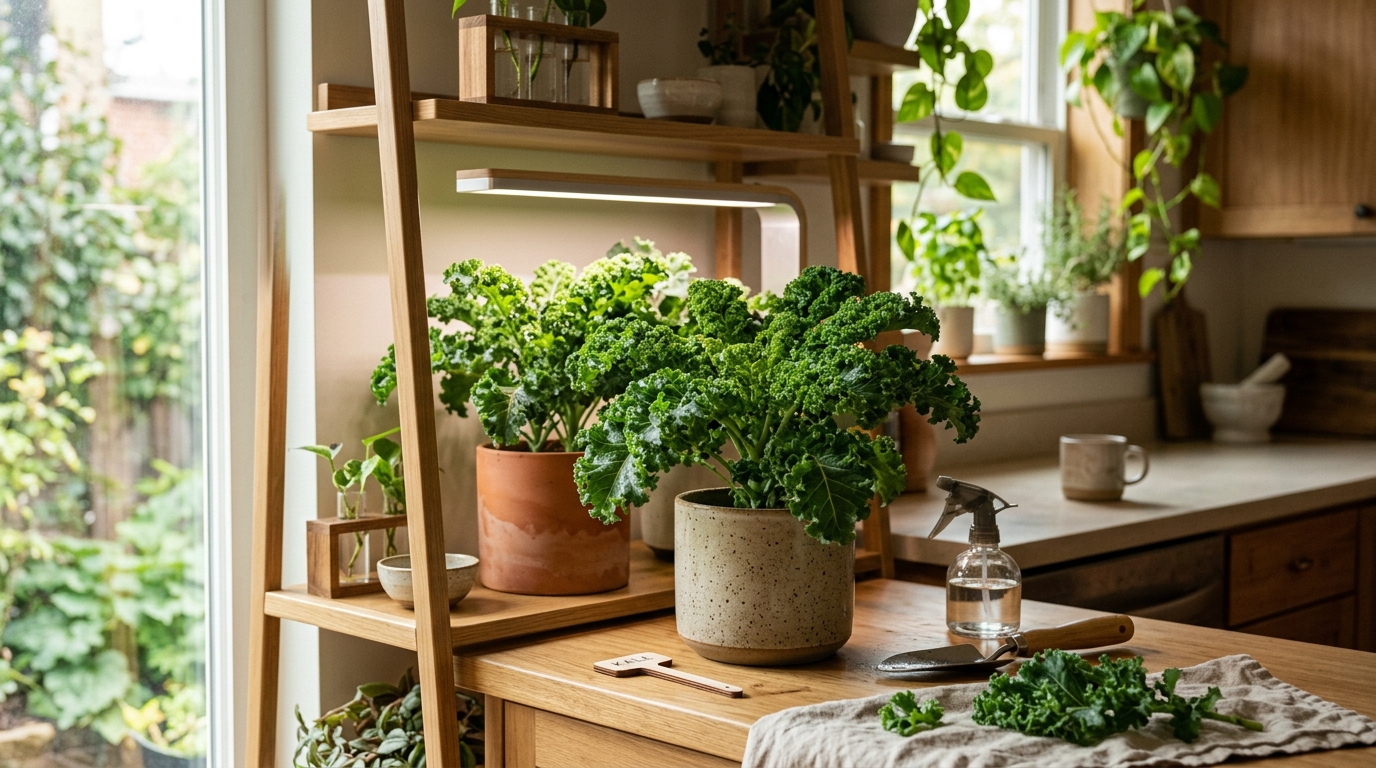
Kale grows indoors year-round in a 5-gallon container with a south-facing window providing 4-6 hours of direct sun, or under a full-spectrum grow light running 12-14 hours daily. Dwarf Siberian and Red Russian are the best varieties for indoor growing. First harvest is typically ready 4-6 weeks from transplant, and the plant regrows repeatedly for months of continuous cuts.
Kale is one of the most practical vegetables for indoor container growing. It tolerates cooler temperatures than most indoor crops, meaning you can grow it on a cool-facing windowsill where tomatoes or peppers would fail. It is forgiving of inconsistent watering and grows quickly enough to see real results within weeks. A single 5-gallon container of kale can supply 1-2 cups of fresh leaves per week for salads, smoothies, and sauteed greens without stepping outside. The main requirement is enough light — and if your windows cannot provide it, a basic grow light solves the problem for under $40.
Is growing kale indoors worth it?
Yes, for several practical reasons that make kale a better indoor crop choice than many people expect.
Cost and availability. A bunch of kale at the grocery store runs $2-4 and often wilts within 4-5 days in the refrigerator. A packet of kale seeds costs $3-5 and produces dozens of plants. A 5-gallon container of kale grown under a $30-40 grow light can supply fresh leaves through an entire winter season — the payoff period is measured in weeks, not months.
Nutritional density. Kale picked fresh from a plant and eaten within hours retains significantly more vitamin C and antioxidants than grocery store kale that has traveled days in refrigerated transport. Indoor-grown kale harvested at leaf maturity (6-8 inches) is at peak nutritional density.
Continuous harvest. Unlike lettuce, which you harvest as a whole head, kale is a cut-and-come-again crop. Harvest the outer leaves and the plant immediately pushes out new growth from the center. A single healthy plant in a 5-gallon container can sustain weekly harvests for 3-6 months before the quality declines.
Cool-temperature performance. Kale is a cool-season crop that actively prefers temperatures between 55-75°F. A north or east-facing window that runs cool in winter — too cold for tomatoes, too dim for peppers — is often workable for kale. It is the rare indoor vegetable that improves in flavor after exposure to mild cold, producing sweeter, less bitter leaves in cooler conditions.
What you need to grow kale indoors
| Product | Best for | Rating | Notes | |
|---|---|---|---|---|
| Full-spectrum LED grow light | Supplementing windows or growing kale in any room | ★★★★★ | Run 12-14 hours daily. A 30-45 watt strip or panel light covers one to two 5-gallon containers. Position 8-12 inches above the canopy for leafy greens. | Check price |
| 5-gallon fabric grow bag or pot | Single kale plants with full root development | ★★★★★ | Fabric bags prevent root circling and allow air pruning for healthier root systems. At minimum, choose a 12-inch pot at least 8 inches deep with drainage holes. | Check price |
| Premium vegetable potting mix | Providing nutrient-rich, well-draining growing medium | ★★★★★ | Use a potting mix formulated for vegetables, not a general all-purpose blend. Avoid moisture-control formulas — consistent drainage matters more than moisture retention for kale. | Check price |
| Kale seeds (Dwarf Siberian or Red Russian) | Starting kale from seed for the best variety selection | ★★★★★ | Seeds germinate in 5-10 days at 60-70°F. Dwarf Siberian and Red Russian stay compact and harvest faster than full-size varieties like Curly Green. | Check price |
| Liquid nitrogen fertilizer | Feeding kale every 3-4 weeks for vigorous leaf production | ★★★★★ | Look for a fertilizer with a higher first number (nitrogen) such as 5-2-3 or 6-4-4. Nitrogen drives leaf growth; phosphorus and potassium support root and overall plant health. | Check price |
| Outlet timer for grow lights | Automating a consistent 12-14 hour light schedule | ★★★★★ | A mechanical or digital outlet timer set to 12-14 hours on removes the guesswork. Consistent photoperiod produces steadier kale growth than manual on-off switching. | Check price |
Step 1: Choose the right kale variety
Variety selection matters significantly for indoor growing. Full-size outdoor kale varieties can reach 3-4 feet tall with a wide canopy that quickly outgrows most indoor setups. For containers, focus on compact and fast-maturing types:
Best varieties for indoor growing:
- Dwarf Siberian kale — compact plant reaching 12-18 inches, extremely cold-tolerant, mild and slightly sweet flavor, ready to harvest in 50-55 days from seed. The most reliable choice for windowsill growing without a dedicated grow light.
- Red Russian kale — flat, oak-leaf-shaped leaves with a purple-tinged stem, very tender texture, excellent raw in salads, 50-60 days to harvest. Slightly more light-demanding than Dwarf Siberian but more flavorful when grown well.
- Lacinato (Dinosaur) kale — narrow, deeply textured dark green leaves, compact upright growth habit that fits tight indoor spaces, 60-80 days to harvest. The richest flavor of the three; requires the most consistent fertilizing in containers.
- Redbor kale — deep purple frilled leaves, similar compact habit to Lacinato, visually striking and full-flavored. A good choice if you want ornamental and edible value from the same plant.
Varieties to avoid indoors: Standard Curly Green kale grows too large and harvests too slowly for most indoor setups. Any full-size open-pollinated variety that does not specify compact or dwarf habit will outgrow a practical indoor container within 2-3 months.
If starting from transplants rather than seed, most nurseries carry generic kale starts in spring. Ask if a compact variety is available, or buy starts early in the season and move to containers immediately.
Step 2: Start from seed or transplant?
Both approaches work indoors. The choice depends on your timeline and what is available locally.
Starting from seed (the 4-6 week path):
Kale seeds germinate readily at 60-70°F — cooler than most vegetable seeds, which makes indoor starting practical even in winter without a heat mat. Fill a seed-starting tray or small pot with moistened seed-starting mix, sow seeds 0.5 inch deep, and keep the surface evenly moist. Germination takes 5-10 days in most conditions.
Transplant seedlings to their final container once they have developed 2-3 true leaves, about 3-4 weeks after germination. At transplant time, water thoroughly and place under your grow light or in your sunniest window.
Best for starting compact kale varieties from seed for indoor container growing
Burpee Dwarf Blue Curled Kale Seeds
Compact kale seed varieties selected for container and indoor growing mature faster than full-size outdoor types and stay at a manageable 12-18 inch plant height. A single seed packet contains enough seeds for multiple succession plantings over a full season. Starting from seed gives you access to the best compact varieties not found at most nurseries, and kale seeds are among the easiest vegetable seeds to germinate — no heat mat required, just consistent moisture and a temperature above 50°F. Succession-sow a new pot every 6-8 weeks to keep harvests continuous through any season.
★★★★★ 4.7 · 8,200 reviews
Check current price on Amazon→Using nursery transplants (the fastest path):
Transplants from a nursery or garden center are ready to harvest within 2-4 weeks of planting, which is the fastest path to fresh kale. Transplants are widely available from late winter through early summer. In fall, start from seed indoors because most nurseries stop stocking transplants by midsummer.
When purchasing transplants, choose stocky plants with deep green color and no yellowing. Avoid transplants that have already begun to flower — bolted plants do not produce quality leaves and cannot be reversed.
Step 3: Set up the right container and soil
Container requirements:
Kale needs significantly more root space than most culinary herbs. A pot that works well for basil or parsley is too small for productive kale. Minimum container sizes by plant count:
- 1 kale plant: 5-gallon container or 12-inch diameter pot, at least 8 inches deep
- 2-3 kale plants: 7-10 gallon container with equivalent depth
Fabric grow bags are an excellent choice for indoor kale. They prevent root circling, allow air pruning (which produces denser, healthier root structure), and fold flat for storage between growing cycles. A 5-gallon fabric bag is the single most practical indoor kale container.
Standard plastic pots work fine but require good drainage holes. Avoid containers without drainage — kale cannot tolerate waterlogged roots.
Soil preparation:
Fill the container with a quality vegetable potting mix rather than garden soil or an all-purpose potting blend. Garden soil compacts in containers and blocks drainage. All-purpose mixes often lack the structure needed for vigorous vegetable root development.
Improving drainage is rarely necessary with kale the way it is with basil, because kale is more tolerant of consistent moisture. If you are using a standard potting mix, adding 10-15% perlite by volume improves aeration and reduces compaction over time.
Best for filling indoor vegetable containers with nutrient-rich, well-structured growing medium
FoxFarm Ocean Forest Potting Soil Mix
FoxFarm Ocean Forest is a premium potting mix made with aged forest products, earthworm castings, sea-going fish and crab meal, and composted forest humus. It provides an immediate nutrient base that supports vigorous kale growth from transplant without additional fertilizer for the first 4-6 weeks. The light, aerated texture maintains good drainage in containers while retaining enough moisture for consistent vegetable growing. This is a genuinely premium product that costs more than basic mixes and performs noticeably better for container vegetables — you will see the difference in leaf color and growth rate within the first month.
★★★★★ 4.8 · 54,000 reviews
Check current price on Amazon→Step 4: Get the light right for indoor kale
Kale needs 4-6 hours of direct sun or a grow light running 12-14 hours daily. It is more forgiving of lower light than most fruiting crops, but insufficient light produces thin, pale, and unproductive plants.
Window growing:
A south-facing window is the best choice for indoor kale in the northern hemisphere. An east or west-facing window providing 3-4 hours of direct morning or afternoon sun can work for Dwarf Siberian varieties, which are the most light-tolerant compact kale types.
In winter at northern latitudes (above 40°N), window light falls below what kale needs for productive growth from November through February. A grow light during this period is not optional if you want meaningful harvests.
Signs of insufficient light:
- Stems are pale and thin, reaching toward the window
- Leaves are lighter green than expected for the variety
- Growth has essentially stopped despite warm temperatures and regular watering
Grow light setup for kale:
Unlike basil, which benefits from the highest-intensity grow lights you can provide, kale does well under moderate-output LED lights. A 30-45 watt full-spectrum LED strip or panel light positioned 8-12 inches above the canopy running 12-14 hours daily produces productive indoor kale year-round.
Good options for a kale grow light setup:
- Barrina T5 LED grow light strips — about $30-40 for a 4-pack, easily mounted under a cabinet shelf: view on Amazon
- Spider Farmer SF-1000 LED panel — higher output, covers multiple plants, better for growing 3+ kale plants simultaneously: view on Amazon
- Clip-on adjustable grow light — clamps to a shelf edge and positions directly above the plant canopy, ideal for a single container: view on Amazon
Kale does not have the strict photoperiod sensitivity of some plants, but consistent light hours help. An outlet timer set to 12-14 hours on eliminates the guesswork and ensures steady growth.
Step 5: Water and fertilize correctly
Watering kale:
Check soil moisture by pressing a finger 1-2 inches into the container. Water when the top inch of soil feels dry, pouring until water flows from the drainage holes. Allow the container to drain completely before returning it to its saucer.
Kale is moderately drought-tolerant once established — established plants can handle occasional dry periods without permanent damage. However, consistently dry soil reduces yield and makes leaves bitter. Aim for even, consistent moisture rather than wet-dry extremes.
Kale in a 5-gallon container in warm conditions (70°F+) with grow lighting typically needs water every 2-4 days. In cool conditions (55-65°F) with lower evaporation rates, every 4-7 days. Always check before watering; do not water on a fixed schedule.
Fertilizing kale:
Nitrogen is the key nutrient for leafy greens. Kale in fresh potting mix has adequate nutrients for the first 4-6 weeks. After that, it requires regular feeding to maintain growth and leaf color.
Apply a liquid fertilizer with elevated nitrogen (first number higher than the other two, such as 5-2-3 or 6-4-4) diluted to the labeled rate every 3-4 weeks during active growth. Reduce to every 6-8 weeks during winter or during slow-growth periods.
Signs kale needs feeding:
- Older lower leaves turn yellow-green
- New leaves emerge smaller and paler than normal
- Growth has slowed noticeably despite adequate light and water
Best for feeding indoor kale and leafy greens with organic nitrogen every 3-4 weeks
Neptune Harvest Fish and Seaweed Fertilizer
Neptune Harvest Fish and Seaweed is a 2-3-1 organic liquid fertilizer made from Atlantic menhaden fish and sea kelp. The fish-based nitrogen is gentle enough not to burn kale in containers, and the seaweed fraction provides natural growth hormones and trace minerals that produce noticeably deeper green, more productive plants than synthetic-only fertilizers. The smell is strong when first applied but dissipates within a day indoors. Diluted at the labeled rate in watering, it provides the nitrogen boost leafy greens need without the salt accumulation that damages roots in containers over time. One quart treats a container garden through an entire season.
★★★★★ 4.7 · 11,400 reviews
Check current price on Amazon→Step 6: Harvest kale to maximize regrowth
The harvest technique you use determines how long a single kale plant remains productive.
The cut-and-come-again method:
Always harvest the oldest, outermost leaves first, leaving the central growing tip and the newest 4-6 inner leaves intact. The plant immediately redirects energy to producing new growth from the center when outer leaves are removed. Remove leaves when they reach 4-6 inches in length for the most tender texture; older leaves beyond 7-8 inches become tougher and more bitter.
How much to harvest at once:
Remove no more than one-third of the total leaf count in a single harvest. For an established plant in a 5-gallon container with 15-20 leaves, this means taking 4-6 leaves per harvest session. After removing those leaves, wait 7-14 days before the next harvest to allow the plant to regenerate.
Harvest frequency:
In strong light (a grow light running 12-14 hours), an established kale plant in a 5-gallon container produces harvestable outer leaves every 10-14 days. In lower light conditions, the regrowth cycle slows to every 2-3 weeks.
When to replace the plant:
After 3-6 months of repeated harvesting, most kale plants begin to show signs of decline: the stem becomes woody and tough, leaves become smaller and more bitter, and the regrowth cycle lengthens. At this point, replace the plant with a fresh seedling. The easiest approach is starting a new plant from seed 6-8 weeks before you expect to retire the current one, ensuring no gap in supply.
Troubleshooting indoor kale problems
Yellowing lower leaves — the most common symptom in indoor kale, usually indicating nitrogen deficiency. Apply liquid fertilizer at the labeled rate. Also check that the container is draining properly — waterlogged roots cause yellowing that looks identical to nutrient deficiency.
Leggy, pale plants — insufficient light. Add a grow light or move the plant significantly closer to an existing light source. New growth becomes noticeably greener and more compact within 1-2 weeks of improved light conditions.
Bitter-tasting leaves — caused by heat stress above 80°F, inconsistent watering, or harvesting leaves that are too old (over 7 inches). Move the plant to a cooler location or harvest more frequently to keep leaves young and tender.
White powdery coating on leaves — powdery mildew, a fungal issue promoted by low light, poor air circulation, and inconsistent moisture. Remove affected leaves immediately, improve air circulation around the plant, and water at soil level rather than misting leaves. A diluted baking soda spray (1 teaspoon per quart of water with a drop of dish soap) applied weekly to leaf surfaces controls mild outbreaks. A copper-based organic fungicide handles persistent cases: view on Amazon.
Aphids on the undersides of leaves — small soft-bodied insects that cluster on new growth and leaf undersides. A firm spray of water dislodges them. Neem oil applied every 5-7 days to leaf undersides is an effective organic control for persistent infestations: view on Amazon.
Plant stops producing new leaves — most likely caused by harvesting the central growing tip. Never cut the center of the plant; always take outer leaves only. If the central tip was damaged, give the plant 2-3 weeks to recover, keeping it well-fed and well-lit.
FAQ
Frequently asked questions
How long does it take to grow kale indoors?
Can kale grow indoors without a grow light?
What is the best container size for indoor kale?
Does kale need full sun indoors?
How often should I water indoor kale?
Why is my indoor kale bitter?
Can I grow kale from grocery store leaves?
Bottom line
Growing kale indoors is one of the most practical and rewarding indoor food projects for anyone who eats leafy greens regularly. Unlike basil or tomatoes, kale is genuinely forgiving — it tolerates lower light, cooler temperatures, and more variation in watering than most indoor crops. A single 5-gallon container of Dwarf Siberian or Red Russian kale under a $30-40 grow light delivers weekly harvests of fresh leaves through any season of the year.
Start with quality seeds or transplants, plant in a large enough container with premium vegetable potting mix, and harvest consistently from the outer leaves inward. Add a nitrogen-focused liquid fertilizer every 3-4 weeks once the plant is established, and expect the first productive harvest within 4-6 weeks of transplanting. Replace the plant with a fresh start every 3-6 months to maintain peak output.
For more indoor food growing: how to start seeds indoors for starting kale and other vegetables from scratch, best grow lights for choosing the right lighting for food crops, how to fertilize indoor plants for a complete guide to container nutrition, and how to water indoor plants for dialing in a watering schedule that keeps vegetable roots healthy.