guides
How to Grow an Avocado Tree Indoors
Grow avocado indoors from a pit or a grafted dwarf tree. Complete guide covering light, soil, watering, containers, and realistic fruit expectations.
 Priya Anand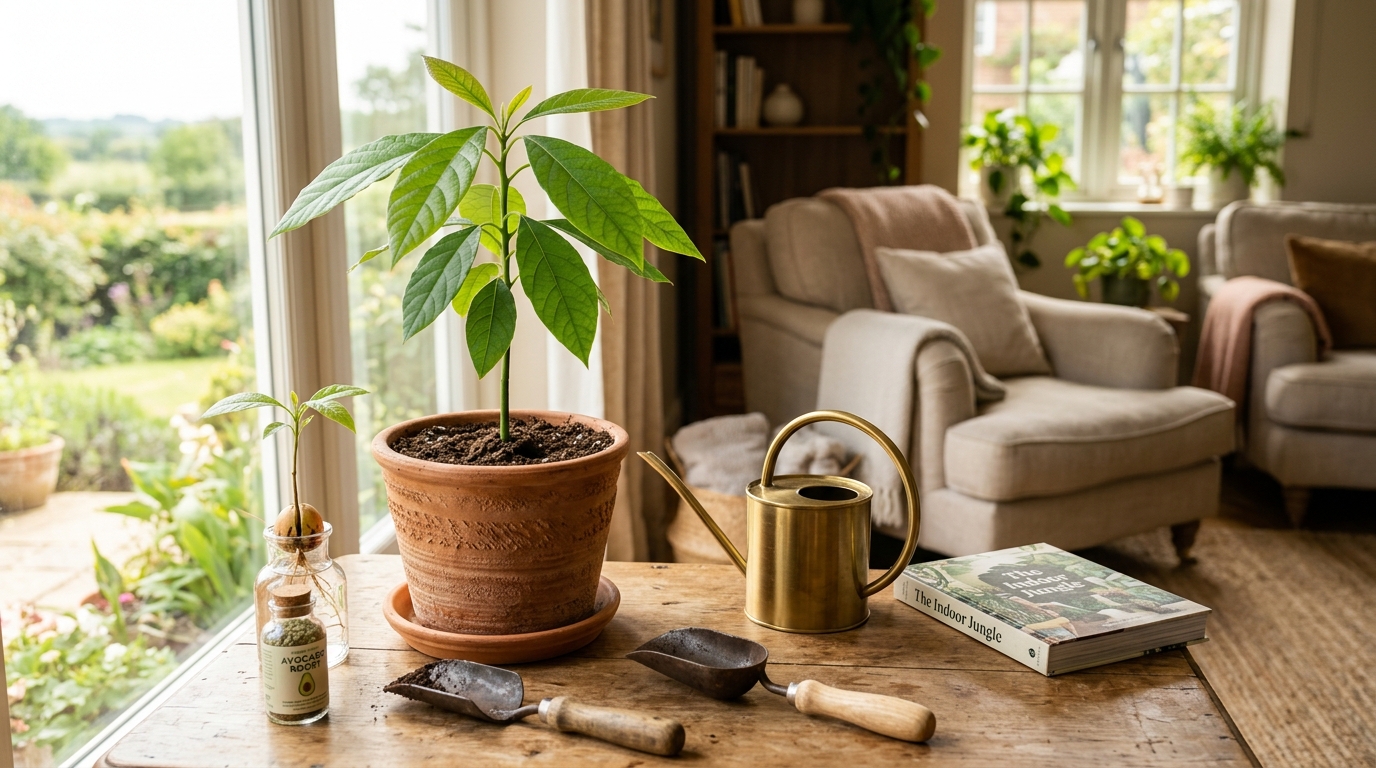
Growing avocado indoors starts with a germinated pit or a grafted dwarf variety such as Wurtz. Place it in a south-facing window or under a strong grow light, plant in fast-draining soil, and water deeply only when the top 2 inches are dry. Pit-grown trees rarely fruit indoors; a grafted Wurtz in a 15-gallon container gives you the best shot at actual avocados.
Avocado trees are among the most rewarding plants you can grow indoors — fast-growing, tropically beautiful, and a constant conversation starter. The glossy dark-green leaves, the dramatic tropical silhouette, and the novelty of a fruit tree in your living room justify the project even before a single avocado appears. Understanding what actually drives success — and what the realistic ceiling for indoor fruit production looks like — makes the difference between a thriving tree and a plant that slowly declines from neglect of a few key requirements.
Is growing avocado indoors worth it?
Yes — with realistic expectations. An indoor avocado tree is a genuinely beautiful houseplant with large, glossy leaves and a tropical presence that few other indoor plants match. It grows fast under good light, sometimes adding a foot of height in a single growing season, and tolerates indoor conditions well compared to other tropical trees.
The honest caveat: avocado trees grown from pits almost never produce fruit indoors. Commercial avocados come from grafted trees — a branch from a known fruiting cultivar grafted onto rootstock, so the resulting tree is genetically identical to the parent variety. Pit-grown trees are essentially wild seedlings. They may eventually produce fruit after 5–13 years if given near-ideal conditions, but it is rare in an indoor setting and the fruit quality is unpredictable.
For real indoor fruit production, a grafted dwarf avocado variety is the correct choice. The Wurtz avocado (sometimes sold as Little Cado) is the most widely available dwarf-suitable variety, growing to 8–10 feet in a large container. Other compact varieties include Day, Holiday, and Gwen. These grafted trees begin fruiting within 2–3 years of planting versus the decade-plus timeline for pit-grown trees.
What you need to get started
| Product | Best for | Rating | Notes | |
|---|---|---|---|---|
| Dwarf avocado tree, grafted (Wurtz/Little Cado) | Growers who want fruit production within 2-3 years | ★★★★★ | A grafted Wurtz is the most reliable path to indoor fruit. Available at nurseries or online in spring and summer. Expect to pay $30-80 for a 1-2 gallon starter. | Check price |
| Avocado germination kit | Growing a houseplant for foliage rather than fruit | ★★★★★ | Free using toothpicks over a glass of water, or use a kit for faster results. Takes 4-8 weeks to produce a rooted sprout from a fresh Hass pit. | Check price |
| 15-gallon nursery container with drainage holes | Establishing a grafted avocado for long-term growing | ★★★★★ | Start a young tree in a 5-gallon pot and upsize every 2-3 years. A mature indoor avocado needs at least 15 gallons for healthy root development. | Check price |
| Cactus and palm potting mix | Providing the fast drainage avocado roots require | ★★★★★ | Standard potting mix retains too much moisture for avocados. Cactus mix or a 50/50 blend of potting soil and perlite prevents root rot. | Check price |
| Avocado and citrus liquid fertilizer | Feeding your indoor avocado tree from spring through fall | ★★★★★ | Avocados benefit from a fertilizer with higher nitrogen and added zinc, common in citrus/avocado blends. Apply every 4-6 weeks during the growing season. | Check price |
| Full-spectrum LED grow light (200W+ equivalent) | Supplementing window light or growing in north/east-facing rooms | ★★★★★ | Avocados need more light than herb grow lights can deliver. Use a larger panel or bar-style fixture positioned 12-18 inches above the canopy. | Check price |
Step 1: Choose your starting method
Germinating from a pit
Growing from a pit is a classic indoor gardening project that produces a handsome tropical tree even if fruit is unlikely.
-
Clean the pit. Remove all avocado flesh by rinsing under warm water. Do not let the pit dry out — start the germination process the same day you eat the avocado.
-
Identify the top and bottom. The pointed end of the pit is the top where the shoot will emerge. The flat or rounded end is the bottom where roots will grow.
-
Suspend over water. Push three or four toothpicks around the equator of the pit, evenly spaced, angling downward slightly. Rest the toothpicks on the rim of a glass of water so the bottom third of the pit is submerged. Place on a warm windowsill — 70–80°F is ideal.
-
Wait for germination. Roots appear first from the bottom of the pit, usually within 3–6 weeks. The top then cracks and a shoot emerges. Wait until the shoot is 2–3 inches tall before potting.
-
Pot the sprout. Fill a 6-inch pot with fast-draining mix. Plant the pit so the top third remains above the soil. Water gently and move to bright light immediately.
The pit-sprouting method has a success rate of roughly 50–70% with fresh pits. Older pits or those allowed to dry out germinate poorly.
Best for germinating avocado pits faster with higher success rates than the traditional toothpick method
Avocado Tree Germination Kit
Dedicated avocado germination kits include a water tray, seed holder, and dome that maintains humidity and warmth around the pit during sprouting. The controlled environment reduces the failure rate compared to the toothpick-in-glass method, especially in cooler homes or low-humidity environments. Most kits sprout 1-2 pits simultaneously and double as a display piece during the 4-8 week germination period. A good kit costs under $15 and is reusable for multiple growing seasons.
★★★★★ 4.5 · 3,200 reviews
Check current price on Amazon→Starting with a grafted dwarf tree
A nursery-grown grafted tree skips 5+ years of the maturation period. Purchase a 1–2 gallon grafted Wurtz or Day avocado from a specialty nursery or online retailer in spring or summer. Inspect the graft union — a visible healed scar on the lower trunk — to confirm the tree is truly grafted rather than a seedling sold as a dwarf variety.
Pot immediately into a 5-gallon container with fast-draining mix. Water thoroughly, then move to your brightest window or under strong grow lights for the first 2–4 weeks of acclimation.
Step 2: Provide enough light
Light is the single biggest limiting factor for indoor avocados. Avocado trees grow natively in subtropical regions with year-round intense sunlight and need substantially more light than most common houseplants.
What avocados need:
- A minimum of 6–8 hours of direct sun per day — through a south-facing window or with a grow light
- Grow light duration of 14–16 hours daily when supplementing poor window conditions
Best window placement:
- South-facing window — best indoor option in the northern hemisphere; provides the most direct light year-round
- West-facing window — acceptable with afternoon direct sun; slower growth than south-facing
- East or north-facing windows — inadequate for long-term avocado health without supplemental grow lighting
Signs of insufficient light:
- Long gaps between leaf nodes and a leggy, reaching growth habit
- Yellowing or drop of lower leaves despite healthy watering
- Minimal new growth even in spring and summer
If your home lacks a south-facing window, invest in a serious grow light — not a small clip-on herb fixture, but a full panel capable of covering a larger canopy. Position the light 12–18 inches above the top of the tree and run it 14–16 hours per day.
Best for providing adequate light intensity for an indoor avocado tree or other large tropical plants
Spider Farmer SF-2000 LED Grow Light
The Spider Farmer SF-2000 delivers 200W of actual power draw with full-spectrum output covering a 3 by 4 foot growing area at 18 inches — large enough for a single avocado tree in a container. The Samsung LM301B diodes produce the red and blue wavelengths that drive leaf expansion and photosynthesis, with IR added for stem growth. It is significantly more powerful than typical herb grow lights and appropriate for the light demands of a tropical tree. Run it 14-16 hours per day on a timer for consistent results.
★★★★★ 4.7 · 18,500 reviews
Check current price on Amazon→Step 3: Choose the right container and soil
Container size by stage:
- Sprouted pit or young seedling: 4–6 inch pot
- 6-month-old seedling: 1-gallon container
- 1-year-old tree: 3–5 gallon container
- Established tree (2+ years): 10–15 gallon container
Upsize the container by one size every 1–2 years rather than jumping immediately to a very large pot — excess soil volume stays wet too long and causes root rot even with good drainage habits.
Drainage is non-negotiable. Every container must have multiple drainage holes. Avocado root rot from standing water kills the tree within days to weeks and is nearly impossible to reverse once established. Never allow the pot to sit in standing water in a saucer.
Soil: Standard potting mix retains too much moisture for avocados. Use either a cactus and palm potting mix directly from the bag, or standard potting soil mixed 1:1 with perlite. This creates the fast-draining, aerated root environment that avocados naturally grow in.
Step 4: Water correctly
Avocados experience most of their indoor growing problems through overwatering. The root system is relatively shallow and highly sensitive to oxygen deprivation from waterlogged soil.
The correct watering approach:
- Insert a finger 2 inches into the soil. If any moisture remains, wait.
- When the top 2 inches are dry, water slowly and thoroughly until water drains freely from the drainage holes.
- Allow the pot to drain completely before returning it to any saucer.
- Empty any water collected in the saucer after 30 minutes.
Seasonal adjustment: During active growth in spring and summer, an avocado in a 5-gallon pot may need watering every 5–7 days. In winter, when growth slows and light intensity drops, the same pot may only need water every 10–14 days. The soil check always overrides any fixed schedule.
Signs of overwatering: yellowing leaves starting at the bottom of the plant, soft stem tissue near the soil line, soil that stays wet for more than a week after watering.
Signs of underwatering: dry, brown, crispy leaf edges starting at the tips, leaves curling inward, soil pulling away from the pot edges.
Step 5: Feed your indoor avocado
Avocados are heavy feeders — particularly for nitrogen, which drives the lush, rapid leaf growth that makes the tree visually appealing. They also have a specific need for zinc, often deficient in standard potting soils.
Fertilizer choice: Use a fertilizer formulated for citrus and avocado trees, which provides a higher nitrogen ratio and includes zinc and micronutrients. A general balanced liquid fertilizer (10-10-10) can work if supplemented with a micronutrient spray containing zinc once or twice per season.
Feeding schedule:
- Spring through summer: every 4–6 weeks at label rate
- Fall: reduce to half-rate every 6–8 weeks
- Winter: suspend feeding entirely while growth is minimal
Common deficiency signs: pale yellow-green new leaves (nitrogen), yellow leaves with green veins (iron or magnesium), brown and mottled new growth (zinc — addressed by citrus-formula fertilizers).
Step 6: Shape your tree for indoor living
Left unpinched, an avocado tree grows as a single vertical trunk that can reach the ceiling within 2–3 years. Pinching and pruning redirects growth energy into a branching, more compact form better suited to indoor living.
The pinching method: When your tree reaches 12 inches in height, cut the main growing tip just above a leaf node. This forces 2–3 lateral branches to emerge from the remaining nodes below the cut. Repeat the process when each lateral branch reaches 12 inches — pinch their tips to force further branching. Within 6–12 months, you will have a multi-branched tree rather than a single tall trunk.
Annual pruning: In early spring, trim any branches crossing, growing inward, or extending past your intended canopy size. Avocados tolerate aggressive pruning well and recover quickly when done at the right time. Avoid pruning in winter, when recovery is slow.
Will my indoor avocado tree produce fruit?
The answer depends entirely on your starting material.
Pit-grown tree: Fruit production is possible but rare indoors. Pit-grown avocados take 5–13 years to reach flowering maturity, and indoor conditions rarely provide the light intensity, temperature fluctuations, and pollinator access needed to set fruit. Consider the tree a beautiful foliage plant.
Grafted dwarf variety (Wurtz, Day, Holiday): Fruit production within 2–4 years is realistic with adequate light. Avocados produce both male and female flowers on the same tree, but the flower types open at different times of day, which normally requires a second tree for cross-pollination. Indoors, you can hand-pollinate by collecting pollen from open male-phase flowers with a small soft brush and dabbing it onto the female-phase flowers. Wurtz trees are noted for partial self-pollination, making them the best choice for single-tree indoor setups.
Even with a grafted tree, fruit production demands exceptional light — consistently 6–8 hours of direct sun or equivalent grow light output. A grafted Wurtz in a dim room will grow happily but is unlikely to flower.
Troubleshooting common indoor avocado problems
Brown leaf tips and edges — most commonly caused by low humidity or fertilizer salt buildup. Avocados prefer humidity above 40%; indoor heating drops it to 20–30% in winter. Use a pebble tray with water below the pot or run a humidifier nearby. Flush the soil with plain water monthly to prevent fertilizer salt accumulation.
Yellowing leaves throughout the plant — overwatering is the most likely cause. Check soil moisture, ensure drainage holes are clear, and let the soil dry more deeply before the next watering. Insufficient light also causes yellowing — improve light conditions if the tree is in a dim location.
Leaf drop — avocados drop leaves in response to cold drafts, sudden temperature shifts, and chronic overwatering. Check that the tree is not near an air conditioning vent, a drafty window, or an exterior door. Maintain 60–85°F consistently year-round.
Root rot — identifiable by soft, dark brown roots when the plant is removed from the pot. Trim all rotted roots with sterile scissors, dust with sulfur powder or cinnamon as a natural antifungal, repot in completely fresh fast-draining mix, and reduce watering. Recovery is possible but requires catching it early.
Spider mites — a common pest on indoor avocados kept in warm, dry conditions. Look for fine webbing on the undersides of leaves and stippled, pale leaf surfaces. Increase humidity, rinse the leaves with water, and apply neem oil spray weekly: view on Amazon.
Fungus gnats in the soil — thrive in consistently moist topsoil. Let the top inch dry between waterings. Yellow sticky traps catch adults: view on Amazon.
FAQ
Frequently asked questions
How long does it take to grow an avocado tree from a pit?
Can an indoor avocado tree actually produce fruit?
How much light does an indoor avocado tree need?
Why are my avocado leaves turning yellow?
How often should I water an indoor avocado?
What is the best avocado variety to grow indoors?
Do I need two avocado trees to get fruit indoors?
Bottom line
Growing avocado indoors works best when you match expectations to your starting material. A pit-sprouted tree gives you a fast-growing, beautiful houseplant that will likely never fruit but adds genuine tropical presence to a bright room. A grafted dwarf Wurtz in a large container under serious grow lights or a south-facing window can realistically produce avocados within 2–4 years with hand-pollination.
Either way, success comes down to three fundamentals: maximum light you can provide, fast-draining soil with careful watering habits, and temperatures above 60°F year-round. Pinch the tip at 12 inches to develop a branching structure, feed regularly through spring and fall, and your indoor avocado will reward you with years of lush tropical growth — and possibly a bowl of homegrown guacamole.
For more on growing indoors: how to water indoor plants for container watering technique, best grow lights for light fixture recommendations suited to larger plants, common indoor plant problems for diagnosing issues as they arise, and how to fertilize indoor plants for a full feeding schedule guide.