roundups
Best Self-Watering Pots for Herbs 2026
The best self-watering pots for herbs keep basil, mint, and parsley hydrated via bottom wicking — no guesswork, no wilting, no root rot.
 Priya Anand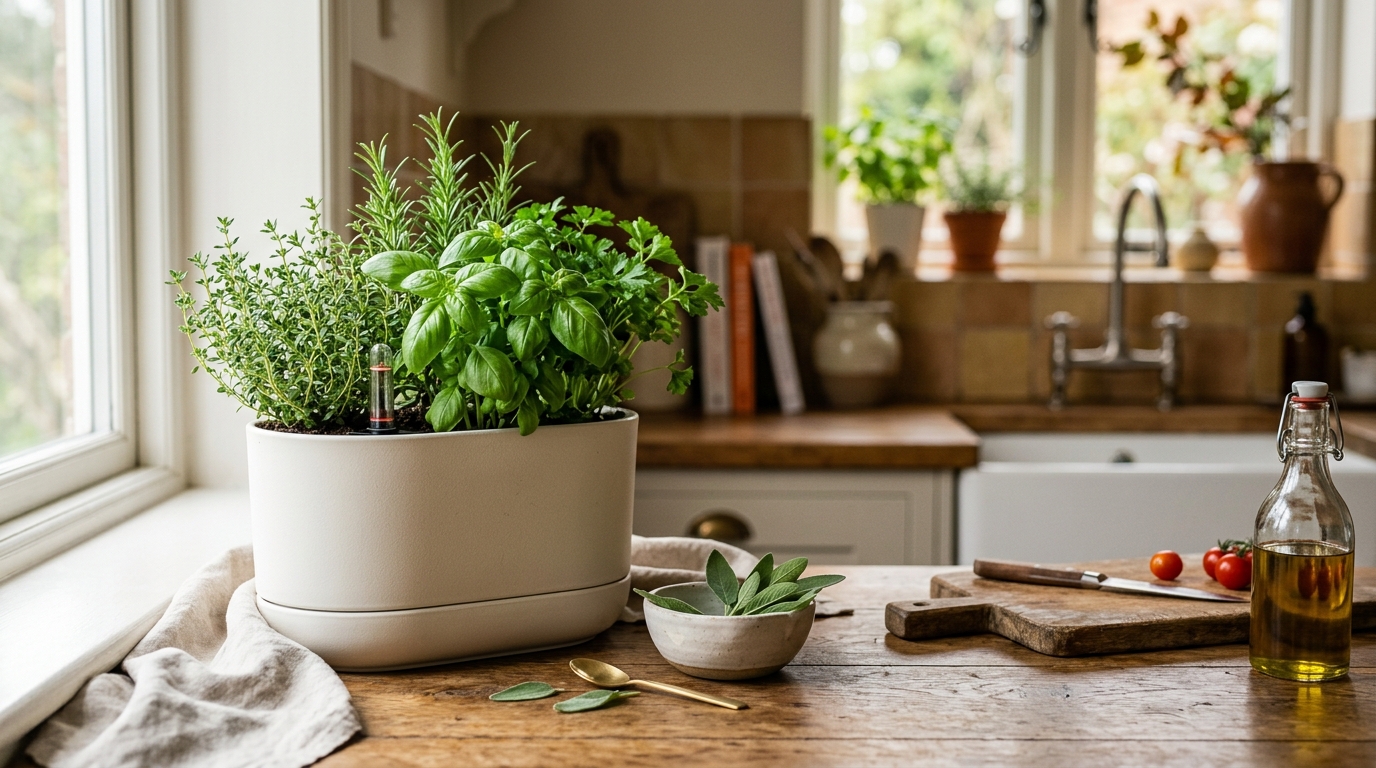
The VIVOSUN 6-inch Self-Watering Pots are the best choice for most herb growers — a three-pack under $25 that keeps basil, mint, and parsley hydrated for 5–10 days between refills, with a visible water level window and overflow drainage built in. For a premium windowsill that handles itself for 3–4 weeks at a stretch, the Lechuza Classico LS 21 is the runner-up, with a float indicator and large reservoir capacity.
Growing culinary herbs indoors sounds straightforward until basil wilts overnight because someone forgot to water it, or mint drowns after an overzealous pour. Herbs have narrow water tolerance: they want consistently moist but never wet soil, with roots that never sit in standing water. Getting that balance right by hand requires checking soil moisture almost daily. Self-watering pots solve this by moving water delivery underground — a reservoir in the base supplies moisture upward through a wick or perforated insert, drawing water into the root zone only as the soil dries. The result is steady, even moisture that dramatically reduces the two most common herb-killing mistakes: forgetting to water and overwatering.
This guide focuses specifically on pots sized and designed for culinary herbs — the kind that live on a kitchen windowsill, under a grow light on a counter, or in a small apartment with limited space. The picks cover individual pots for one or two plants, multi-pocket window boxes for a mixed herb row, and one larger system for serious kitchen gardeners.
How self-watering pots actually work
The core mechanism is capillary action — the same physics that draws water up through a paper towel when you dip one corner. All self-watering pots separate the growing medium from a water reservoir, connecting the two through a wicking channel. In the simplest designs, a felt strip or nylon cord runs from the reservoir through holes in a plastic insert into the soil above. As soil dries, capillary action pulls water upward, maintaining consistent moisture without any active effort.
More sophisticated designs — like Lechuza planters — use a perforated grow pot sitting above the reservoir, where roots grow down through the insert and draw water directly as needed. The soil above stays appropriately moist while roots never sit in standing water, because the grow pot insert keeps the root zone separated from the reservoir by an air gap.
What this means practically for herb growers: basil gets reliable moisture during the stretch when you forget to check, mint does not drown on a rainy weekend, and cilantro does not bolt prematurely from drought stress. The reservoir typically lasts 5–10 days in a 6-inch pot — longer in cooler months when evapotranspiration slows — which makes vacations and busy weeks manageable without a plant sitter.
What to look for in a self-watering herb pot
Reservoir capacity relative to pot size. A 6-inch pot with a 0.5-liter reservoir lasts 5–7 days in warm weather. The same pot with a 1-liter reservoir extends that to 10–14 days. For herbs under a grow light, which increases transpiration, a larger reservoir reduces refill frequency significantly. Check how much the reservoir holds, not just the overall pot dimensions.
Visible water level indicator. The best self-watering pots include a float indicator or clear side window that shows current water level. Without it, you fill the reservoir by feel — and guessing wrong means running dry for days before you notice. Any pot you will use long-term should include some way to see the water level.
Drainage overflow outlet. Reservoirs need an overflow hole — a port at the fill level that stops water from backing up into the grow medium if you overfill or a heavy rain falls on outdoor herbs. Without overflow protection, a single overfill soaks the soil from below and causes the root rot you bought the self-watering pot to avoid.
Soil type compatibility. Budget self-watering pots work with standard potting mix. Premium designs like Lechuza require their proprietary Pon substrate (a clay granule growing medium) or a perlite-heavy custom mix for the wicking to function properly. Factor substrate cost into the total price of premium systems.
Size fit for the herb. Most culinary herbs grown for kitchen use fit comfortably in 4–6 inch pots. Mint, which spreads aggressively, benefits from a wider 8-inch pot to contain roots. Rosemary and thyme are actually poor candidates for self-watering pots at any size — they prefer drying fully between waterings, and constant reservoir moisture causes root rot in these drought-tolerant Mediterranean herbs.
Quick comparison
| Product | Best for | Rating | Notes | |
|---|---|---|---|---|
| VIVOSUN 6-inch Self-Watering Pots (3-pack) | best overall; 3-pack under $25 with water level window and overflow drainage | ★★★★★ | Under $25. Three 6-inch pots. ~0.6L reservoir each. Water level window. Standard soil. | Check price |
| Lechuza Classico LS 21 | best premium; 3-4 week reservoir with float indicator, long-term low-maintenance use | ★★★★★ | $30–45. 8-inch equivalent. 1.6L reservoir. Float indicator. Needs Pon substrate. | Check price |
| EarthBox Original Container Garden | best for serious growers; 2-gallon reservoir grows a full herb row for weeks | ★★★★★ | $55–70. 3-gallon grow volume. 2-gallon reservoir. Cover and overflow included. | Check price |
| Mkono Self-Watering Planter (3-pack) | best budget; 4-inch pots under $20, basic wick system for compact herbs | ★★★★☆ | Under $20. Three 4-inch pots. Basic wick cord. No water indicator. Standard soil. | Check price |
| Santino IDA 5.5 Self-Watering Pot | best mid-range single pot; deep reservoir and float indicator per herb at $12-18 | ★★★★★ | $12–18 each. 5.5-inch. Deep reservoir. Float indicator. Overflow outlet. | Check price |
The picks
Best overall: VIVOSUN 6-inch Self-Watering Pots (3-pack)
Best for kitchen herb gardeners who want a reliable 3-pack under $25 that works with standard potting mix and handles a week or more between waterings
VIVOSUN 6-inch Self-Watering Pots (3-pack)
The VIVOSUN 6-inch self-watering pots earn the top spot by combining the features that matter most — a visible water level window on the side, a bottom reservoir that holds approximately 0.6 liters, and an overflow drainage hole — into a sturdy package that works with any standard herb or vegetable potting mix. No proprietary substrate required. Fill the pot, add your herb, fill the reservoir via the side fill tube, and the pot handles hydration for 5–10 days depending on temperature, humidity, and how vigorously your herbs are growing. The three-pack configuration is ideal for a kitchen windowsill where basil, parsley, and chives each get their own dedicated pot without crowding. Pots stack for storage when not in use, and the white finish keeps them visually clean alongside other kitchen items. The water indicator window — a translucent strip on the front face — shows current reservoir level without needing to tip or probe the pot. The overflow hole at the midpoint of the reservoir prevents flooding if you overfill, which is the single most important safety feature for a self-watering pot used indoors. At under $25 for three pots, this set is the practical starting point for any herb gardener moving from conventional pots.
★★★★★ 4.6 · 8,200 reviews
Check current price on Amazon→Pros
- Three-pack under $25 makes outfitting a full windowsill affordable without a large upfront cost
- Visible water level window on the front face shows reservoir level without lifting or probing
- Overflow drainage hole prevents flooding and root rot if the reservoir is overfilled
- Compatible with any standard potting mix — no proprietary substrate investment required
- Reservoirs hold approximately 0.6L, providing 5–10 days of autonomous watering for most herbs
- Stackable design saves storage space when pots are not in use between growing seasons
Cons
- Translucent window indicator requires front-facing placement to read clearly at a glance
- 0.6L reservoir runs dry faster during summer heat or under a grow light with high transpiration
- Plastic construction is functional but less durable than ceramic or premium European planters
- Fill tube opening is narrow — a small funnel helps refill without spilling on the counter
Best premium: Lechuza Classico LS 21
Best for herb growers who want a 3-4 week reservoir, a genuine float indicator, and a planter that looks as good as it performs over many years
Lechuza Classico LS 21 Self-Watering Planter
Lechuza is a German planter brand that has spent decades engineering self-watering systems for indoor use, and the Classico LS 21 is their benchmark single-pot design for kitchen herbs. The system separates growing from the reservoir completely: a perforated inner grow pot sits above a 1.6-liter base reservoir, connected by wicking inserts that draw moisture upward into the root zone. The visible float indicator on the side of the reservoir rises and falls with water level — a precise floating gauge rather than a translucent window you angle to see. At 1.6 liters, the reservoir runs 3–4 weeks in moderate indoor conditions, making this the right choice for frequent travelers or anyone who does not want to think about watering weekly. The design requires Lechuza Pon substrate (sold separately at $15–25 for a 6-liter bag) or a perlite-heavy custom mix — standard potting soil compacts over time in the wicking system and reduces effectiveness. Once set up with appropriate substrate, the Classico LS 21 is genuinely low-maintenance: fill the reservoir and herbs grow without further attention for a month. The matte finish and clean color options look premium on a kitchen counter or dining table.
★★★★★ 4.7 · 3,400 reviews
Check current price on Amazon→Pros
- Float indicator on the reservoir side panel gives a precise, easy-to-read water level at a glance
- 1.6-liter reservoir provides 3–4 weeks of autonomous watering in moderate indoor conditions
- Perforated grow pot insert keeps root zone separate from standing water, eliminating root rot risk
- Matte premium finish in multiple colorways looks intentional in a kitchen or dining space
- Durable German construction — many Lechuza owners report 10-plus years of continuous use
- Overflow protection built into the reservoir design prevents flooding during overfilling
Cons
- Requires Lechuza Pon substrate or perlite-heavy mix — standard potting soil is not compatible long-term
- $30–45 price plus substrate cost ($15–25) makes this 3–4 times more expensive than budget alternatives
- The 8-inch equivalent diameter takes meaningful counter or windowsill space for a single herb
- Inner grow pot and reservoir sold as a system — replacement parts require Lechuza-specific accessories
Best for serious growers: EarthBox Original Container Garden
Best for kitchen gardeners who want to grow a full herb collection in a single self-watering system with minimal weekly attention
EarthBox Original Container Garden System
The EarthBox is not a decorative kitchen planter — it is a sub-irrigated growing system that has been in production since the 1990s and consistently outperforms conventional containers in productivity per square foot. The system holds 3 gallons of growing medium above a 2-gallon sub-irrigation reservoir, fed from a fill tube at one end. A plastic cover mulch reduces evaporation from the soil surface, and a drainage hole prevents flooding. The result is a system you fill once a week at most, even in summer heat, with a full mixed herb row. Basil, parsley, chives, and cilantro can grow together in the same 29x14 inch footprint, each getting the steady moisture they need without competing or crowding separate pots. The EarthBox has been validated by university extension programs and long-term home growers as a system that produces near-outdoor yields indoors with consistent watering. It is too large for most kitchen windowsills but fits a countertop, a balcony, or a table beneath a grow light. Casters (sold separately) allow moving the filled system — at 12-plus pounds when full — without lifting.
★★★★★ 4.6 · 6,100 reviews
Check current price on Amazon→Pros
- 2-gallon reservoir requires refilling once a week at most — right for growers who want truly low-maintenance herb production
- 3-gallon growing capacity supports 4–6 culinary herbs simultaneously in a single container
- Plastic cover mulch significantly reduces surface evaporation, extending time between refills
- Sub-irrigation delivers water at root level, maintaining ideal moisture without wet surface soil
- Decades-proven system with documented productivity advantages over conventional containers
- Drainage overflow plug — remove for outdoor rain exposure, keep for indoor countertop use
Cons
- 29x14 inch footprint requires countertop, table, or balcony space — too large for most kitchen windowsills
- $55–70 price point is the highest in this roundup; casters add cost for mobility
- Plastic cover mulch makes the system look functional rather than decorative — not a fit for every interior
- Heavy when full — approximately 25 pounds with soil and water — restricting placement flexibility
- Overkill for growers who only want one or two herb pots rather than a full herb garden
Best budget: Mkono Self-Watering Planter (3-pack)
Best for first-time herb growers who want to try self-watering pots at minimum cost before committing to a larger or premium option
Mkono Self-Watering Planter 4-inch (3-pack)
The Mkono 4-inch self-watering planters are the straightforward entry point — three compact pots under $20 with a basic wick cord that draws water from a small base reservoir into the soil above. The 4-inch diameter suits a single compact herb like chives, a small basil plant, or a parsley seedling; it is tight for a mature mint plant, which will outgrow it quickly. The wick cord system is less sophisticated than perforated insert designs — water delivery is slower and less consistent, particularly once the cord accumulates mineral deposits after a few months of tap water use. Replacing the cord annually or using filtered water extends the system lifespan significantly. The minimalist white cylindrical design is clean and works in most kitchens. There is no water level indicator, which means checking the reservoir by tipping the pot or using a probe — a minor inconvenience at this price point. For a first herb garden or a gift for someone who frequently overwatered or underwatered plants with conventional pots, the Mkono set is a low-risk starting point that genuinely reduces the daily attention herbs require.
★★★★☆ 4.4 · 5,700 reviews
Check current price on Amazon→Pros
- Three pots under $20 — the most affordable self-watering option in this roundup
- Clean minimalist white design works unobtrusively in any kitchen or countertop setting
- Works with standard potting mix — no substrate investment required
- 4-inch size suits compact culinary herbs including chives, small basil, and parsley starts
- Lightweight and easy to move — right for renters or those who rearrange frequently
Cons
- No water level indicator — checking the reservoir requires tipping the pot or inserting a probe
- Basic wick cord delivers water more slowly and less consistently than perforated insert designs
- Wick cord collects mineral deposits over time — needs annual replacement or filtered water to maintain performance
- 4-inch diameter is too small for mature mint, rosemary, or large basil plants at full size
- Small reservoir capacity makes refill frequency similar to a conventional pot for herbs under grow lights
Best mid-range single pot: Santino IDA 5.5
Best for anyone who wants one quality self-watering pot per herb with a visible float indicator and reliable overflow protection at $12-18 each
Santino IDA 5.5 Self-Watering Flower Pot
The Santino IDA sits in the productive middle of the market: more capable than budget wick-cord planters, less expensive and demanding than Lechuza systems. The 5.5-inch pot includes a deep reservoir that holds significantly more water than its compact diameter suggests, extending time between refills to 7–14 days for most kitchen herbs. The visible float indicator on the side of the reservoir is a genuine float gauge — a small rod that rises and falls with water level — rather than a translucent window that requires squinting to read at an angle. The overflow outlet on the side of the reservoir base protects against flooding from overfilling. The growing insert sits above the reservoir with a soil contact wick running down into the water, and standard potting mix works fine without any proprietary substrate. The Santino IDA is the right choice if you want one good pot for each herb rather than a multi-pot bundle — sized appropriately for basil, mint (in a single contained plant), parsley, or cilantro individually, with the indicator eliminating the main inconvenience of budget self-watering pots.
★★★★★ 4.5 · 4,100 reviews
Check current price on Amazon→Pros
- True float indicator on the side panel shows water level clearly without guessing or tipping the pot
- Deep reservoir relative to 5.5-inch diameter extends time between refills to 7–14 days
- Overflow outlet prevents flooding and root rot from overfilling or outdoor rain exposure
- Compatible with standard potting mix — no proprietary substrate or additional investment required
- $12–18 per pot is a meaningful step up from budget options without the premium price of Lechuza systems
- Multiple color options allow matching to kitchen or indoor decor without sacrificing function
Cons
- Sold individually — outfitting a full windowsill with three to four pots costs $36–72 total
- 5.5-inch diameter is slightly small for vigorous mint or large basil at peak summer growth
- Wick system vs. full perforated insert means slightly less even moisture distribution than premium designs
- Float indicator rod can occasionally stick after extended use without periodic rinsing of the reservoir
What to skip
Self-watering pots without overflow drainage holes. If the reservoir has no overflow outlet, any excess water from overfilling or an outdoor rainstorm backs up into the soil from below and saturates it completely — exactly the root rot condition self-watering pots are supposed to prevent. Check the spec listing or product photos for an overflow hole before buying. It is a basic engineering requirement that some inexpensive imports omit entirely.
Hanging self-watering baskets for culinary herbs. Hanging basket self-watering systems lose water faster than enclosed pots due to airflow around the entire container exterior. Their small reservoirs (typically 0.3–0.5 liters) run dry in 3–5 days in warm months. They work well for ornamental trailing plants but create more watering work, not less, for herbs you intend to harvest frequently.
Rosemary, thyme, and sage in any self-watering pot. These Mediterranean herbs evolved in rocky, fast-draining soils and are deliberately drought-tolerant. They thrive with thorough but infrequent watering — soak deeply, then dry fully before the next water. A self-watering pot keeps the root zone in consistently moist soil, which is the slowly waterlogged condition that causes Mediterranean herbs to rot over weeks. Grow these three in conventional terracotta with coarse drainage mix.
Very large self-watering pots for herbs specifically. Herbs grown for kitchen cutting do not need the root volume of a 12-inch or larger self-watering planter. Oversized pots hold excess soil volume that stays wet longer than herb roots can absorb, encouraging fungal issues at the soil surface. Match pot size to plant size: 4–6 inches for most culinary herbs, 8 inches for established mint.
FAQ
Frequently asked questions
How often do you refill a self-watering herb pot?
Can all herbs grow in self-watering pots?
What soil should I use in a self-watering herb pot?
How do I know when to refill the reservoir?
Can self-watering pots go outdoors?
Why is my herb still wilting in a self-watering pot?
Bottom line
Best overall: VIVOSUN 6-inch Self-Watering Pots (3-pack) — visible water window, overflow protection, and standard-soil compatibility at under $25 for three pots make this the practical choice for most herb windowsills. Best premium: Lechuza Classico LS 21 — float indicator, 3–4 week reservoir, and long-term build quality justify the higher price for frequent travelers or serious indoor gardeners. Best for serious growers: EarthBox Original — the only system here that grows a full herb collection in a single container with once-weekly watering. Best budget: Mkono 4-inch (3-pack) — the low-risk starting point under $20 if you want to test self-watering pots before committing. Best single pot: Santino IDA 5.5 — the right mid-range choice when you want one quality pot per herb with a genuine float indicator and reliable overflow protection.
Start with the VIVOSUN three-pack if you have a windowsill and three herbs to grow. Upgrade to the Lechuza or Santino once you have confirmed that self-watering actually changes your herb results — and it will, especially for basil.
For more on growing culinary herbs indoors: how to grow herbs indoors for placement, light, and harvesting technique, how to water indoor plants to understand the moisture principles that self-watering pots automate, best grow light bulbs to supplement natural light for a year-round windowsill herb garden, and best plant stands to elevate your pots into the best light your kitchen window offers.