roundups
Best LED Grow Lights for Seedlings 2026
Top LED grow lights for seedlings: Spider Farmer, Barrina T5, AC Infinity picks. Stronger stems, faster germination, less leggy growth.
 Priya Anand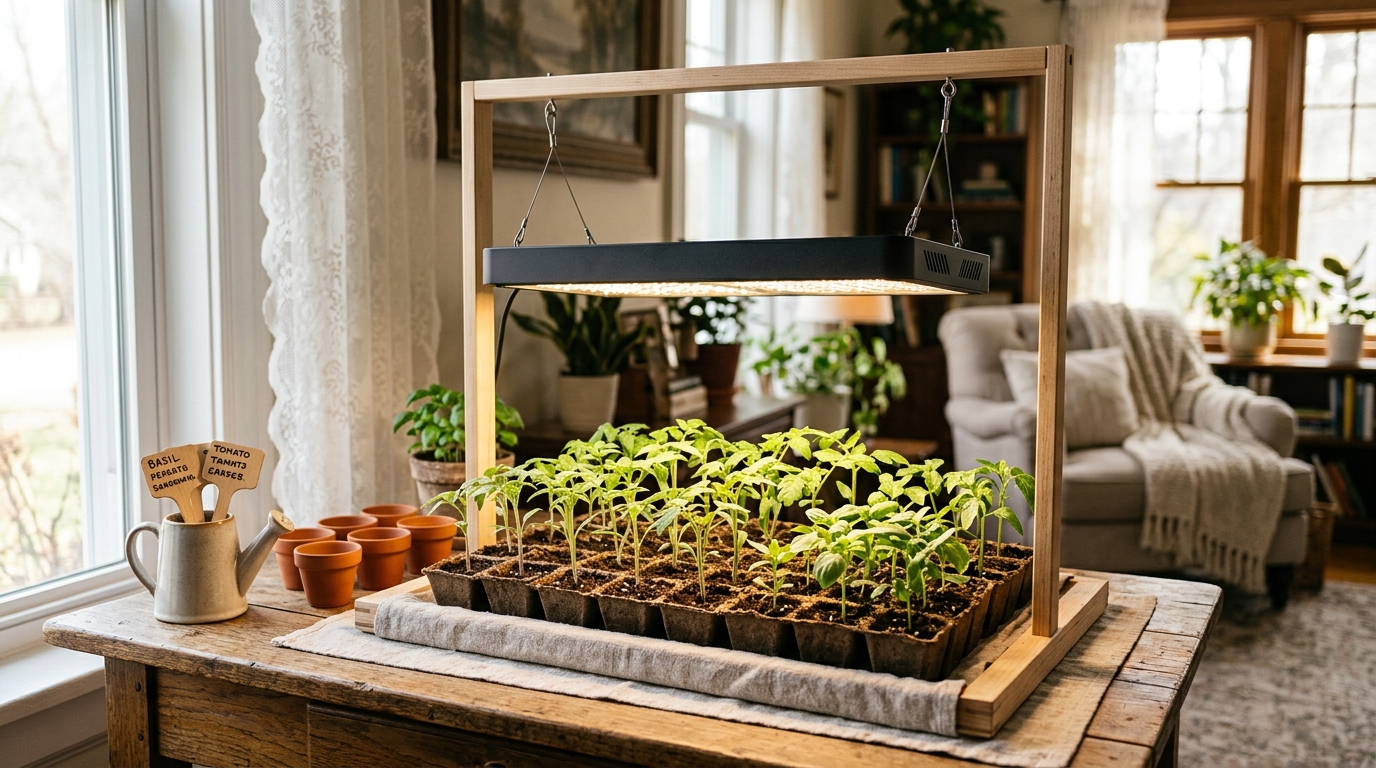
The best LED grow light for seedlings is the Spider Farmer SF-1000 for most indoor seed-starters: it delivers the 200-400 PPFD seedlings need, dims so you do not fry tender sprouts, and scales up through early vegetative growth. For a strip-light setup over wire shelving, the Barrina T5 LED is the budget-first alternative at a third of the price.
Why seedlings need their own grow light
A window is rarely enough for seed starting indoors. South-facing windows in winter provide 3-5 hours of usable light at perhaps 100-200 PPFD on bright days — well below the 200-400 PPFD seedlings need for compact, sturdy growth. The result is the classic problem: seedlings stretch toward the light, stems grow thin and weak (etiolated), and transplants are fragile come planting time.
A dedicated grow light solves all of this. It delivers consistent PPFD at the right spectrum for 14-16 hours daily, regardless of weather or season. The result is shorter, thicker stems, darker green color, and transplants tough enough to survive hardening off.
You do not need the most powerful grow light for seedlings. In fact, a grow light sized for fruiting plants (800-1000 PPFD at 18 inches) can damage seedlings at close range — which is why dimmability matters. The right pick for a seed-starting setup is a light that hits 200-400 PPFD at standard seedling distance, can be raised or dimmed as seedlings mature, and covers the tray size you are working with.
What PPFD range do seedlings actually need?
Seedlings move through three stages that each call for different intensities:
- Germination. Seeds do not photosynthesize — they need warmth and moisture, not light. Cover the tray until sprouts emerge.
- First leaves (cotyledon stage). 100-200 PPFD. Keep light at full distance (24 inches for most panels) or on a low-dim setting.
- True leaf development (pre-transplant). 200-400 PPFD. As seedlings develop 2-4 true leaves, they can handle more intensity. Gradually lower the light or increase the dimmer.
For reference: a Spider Farmer SF-1000 at 24 inches delivers approximately 250-300 PPFD at 100% intensity. Dimmed to 50%, that drops to 125-150 PPFD — ideal for the earliest seedling stage. This flexibility is why dimmability earns weight in every pick below.
Quick comparison
| Product | Best for | Rating | Notes | |
|---|---|---|---|---|
| Spider Farmer SF-1000 | Best overall for most seed-starting setups | ★★★★★ | About $120-150. 100W. Samsung LM301B diodes. Dimmable. Covers 2x2 ft. | Check price |
| Barrina T5 LED Grow Lights (4-pack) | Best strip setup for wire shelving racks | ★★★★★ | About $35-50. 144W total. Easy daisy-chain mounting. Low profile. | Check price |
| AC Infinity IONBOARD S24 | Best premium bar light with smart dimming | ★★★★★ | About $90-120. Samsung LM301H diodes. UIS controller compatible. | Check price |
| Vivosun VS1000 | Budget dimmable panel with Samsung diodes | ★★★★☆ | About $80-100. Samsung LM301H. Dimmable. Good value for price. | Check price |
| Mars Hydro TS 600 | Cheapest full LED panel; seasonal seed starters | ★★★★☆ | About $60-80. 100W. Non-dimmable base model. Adequate for seedlings. | Check price |
The picks
Best overall: Spider Farmer SF-1000
Best for most seed-starting setups; covers a standard 2x2 ft seedling tray
Spider Farmer SF-1000 LED Grow Light (100W, Dimmable)
The Spider Farmer SF-1000 is the consensus pick for indoor seed starting. Samsung LM301B diodes deliver genuine full-spectrum white light, and the dimmable driver lets you dial intensity from 10-100% — critical for matching light level to seedling stage. At 24 inches and 50% power, it sits squarely in the 150-200 PPFD range first seedlings need. Ramp to 80% as true leaves develop. The 2x2 ft coverage matches a standard 1020 seedling flat, making it purpose-sized for the task. A 5-year warranty and replaceable driver mean it outlasts the growing season.
★★★★★ 4.6 · 2,100 reviews
Check current price on Amazon→Pros
- Samsung LM301B diodes — genuine quality diodes, not unbranded chips
- Dimmable 10-100% — one light covers every seedling stage without moving the fixture
- Full-spectrum white; plants look normal and problems are easy to spot
- Covers a standard 2x2 ft seedling flat at flowering-height distance
- 5-year warranty; replaceable driver extends useful life significantly
Cons
- Fanless design is quiet but requires airflow — do not enclose it against a low ceiling
- Driver hangs separately from the light panel and needs its own mounting point
- Overkill for a single small tray; step down to Barrina strips if budget is tight
Best strip light: Barrina T5 LED Grow Lights
Best for wire shelving rack setups; multi-shelf seed starting on a tight budget
Barrina T5 LED Grow Lights (4-pack, 2ft)
Barrina T5 strips are the standard solution for seed-starting racks. Each 2-foot strip is thin, lightweight, and designed to daisy-chain — connect multiple strips to one power adapter and lay them across shelving wire. A 4-pack produces adequate light for a standard 1020 flat of seedlings at a fraction of a panel cost. The spectrum is not as dialed-in as Spider Farmer, but for germination and early seedling stages the difference in growth outcomes is minor. The main advantages are price and form factor: these lay flat across shelves that a hanging panel cannot reach.
★★★★★ 4.5 · 8,700 reviews
Check current price on Amazon→Pros
- Lowest cost per shelf covered ($35-50 for a 4-strip pack)
- Daisy-chain design runs multiple shelves from one power cable
- Thin profile fits tight shelving; easy to install without hardware
- Full-spectrum white LED output — not blurple; seedlings look healthy green
Cons
- Not dimmable — intensity is controlled only by changing height
- Lower PPFD than a dedicated panel; seedlings may stretch slightly more
- Fixture feels lightweight compared to brand-name panels
- Not suitable for fruiting plants if you keep seedlings past the transplant stage
Best premium: AC Infinity IONBOARD S24
Best for growers who want smart scheduling, dimming, and premium build quality
AC Infinity IONBOARD S24 LED Grow Light Bar
The AC Infinity IONBOARD S24 is a 24-inch bar-style light built for shelving setups, with Samsung LM301H diodes and compatibility with AC Infinity UIS smart controllers. If you already run AC Infinity fans or environmental controls, the IONBOARD integrates into the same app — set schedules, ramp intensity on sunrise/sunset curves, and monitor from your phone. For seedling setups, the scheduler automates the 14-16 hour cycle without a separate timer. The premium price over Barrina is justified if you take seed starting seriously and want unified smart control over your indoor environment.
★★★★★ 4.7 · 940 reviews
Check current price on Amazon→Pros
- Samsung LM301H diodes — highest efficiency standard at the home growing tier
- Smart controller integration via AC Infinity UIS app
- Built-in scheduling and dimming eliminates the need for a separate timer
- Bar profile ideal for shelving without requiring hanging hardware
Cons
- Price premium over Barrina strips or even the Spider Farmer SF-1000
- Best value only if you already use other AC Infinity gear
- Single bar covers one shelf; multiple units required for a full multi-shelf rack
Best budget dimmable panel: Vivosun VS1000
Best for growers who want Samsung diodes and dimmability below Spider Farmer pricing
Vivosun VS1000 LED Grow Light (Samsung Diodes, Dimmable)
The Vivosun VS1000 sits between the Mars Hydro TS 600 and the Spider Farmer SF-1000: Samsung LM301H diodes (same quality tier as Spider Farmer at this wattage), dimmable driver, and a price of $80-100 that undercuts the SF-1000 by $20-50. Coverage is similar — 2x2 ft at flowering intensity, 3x3 ft at seedling or vegetative intensity. If the SF-1000 is sold out or priced up, the VS1000 is the direct alternative. Build quality is slightly below Spider Farmer but meaningfully above Mars Hydro.
★★★★☆ 4.4 · 1,900 reviews
Check current price on Amazon→Pros
- Samsung LM301H diodes at a lower price than Spider Farmer
- Dimmable — same staged intensity flexibility for seedling care
- Good coverage for the price; grows with seedlings through vegetative stage
Cons
- Brand recognition below Spider Farmer or AC Infinity
- Customer support less established than Spider Farmer
- Build finish slightly rough compared to the SF-1000
Best budget panel: Mars Hydro TS 600
Best for first-time seed starters on the tightest budget; seasonal indoor growing
Mars Hydro TS 600 LED Grow Light
The Mars Hydro TS 600 is the entry point for seedling-stage LED panels. At $60-80 it is significantly cheaper than the Spider Farmer SF-1000, and for seed starting only it delivers adequate performance — roughly 200-350 PPFD at 18 inches, which covers germination through early true-leaf stages. The diodes are not Samsung-grade but hold up for 2-3 seasons of home use. Seedlings that will be transplanted outdoors do not need premium diodes — they need enough light for 8-12 weeks. The TS 600 handles that job at a price that makes sense for seasonal seed starting.
★★★★☆ 4.3 · 3,200 reviews
Check current price on Amazon→Pros
- Lowest price for a full LED panel ($60-80)
- Adequate PPFD for germination and early seedling stages
- Comes with hanging hardware and power cord included
- Lightweight and easy to move between setups
Cons
- Non-dimmable on the base model — output is fixed
- Not a quality long-term investment if you plan to grow through the fruiting stage
- Diode quality below Samsung-grade; more brightness degradation over time
How to position a grow light for seedlings
Position matters as much as which light you choose. Four principles:
- Start high, then lower. Begin at 24 inches above the soil for LED panels. As seedlings develop true leaves, lower to 18 inches or increase the dimmer setting — adjust one variable at a time.
- Measure stretch, not calendars. If seedlings stretch noticeably between waterings, light is too far or too dim. If seedlings look compact and dark green, the position is right.
- Cover the whole tray evenly. A single LED bar may leave corners dimmer than center. For a 1020 tray, a 24-inch panel or two linked T5 strips side-by-side ensures even coverage across all cells.
- Watch for heat at close range. Modern full-spectrum LEDs run cool at seedling distances — no special ventilation needed. If your hand feels warm after 30 seconds at seedling height, the light is too close or the fixture is old-generation HID, not LED.
What to avoid
Grow light bulbs (E26 screw-in) for tray seed starting. Individual grow bulbs work for a single potted plant but are not designed for 72-cell seedling trays. Coverage drops off sharply at the edges, and a single 15-30W bulb does not provide enough PPFD for an entire flat.
Old-generation fluorescent T5 fixtures. They work but consume more power than equivalent LED strips, run warmer, and require tube replacements every 1-2 seasons. New T5-profile Barrina LED strips deliver the same form factor at lower running cost and no tube replacements.
Unbranded LED panels under $40. Seed starting is high-stakes — poor light causes damping off from stressed immune systems, delayed germination, and fragile transplants. The savings on a budget panel are not worth a failed seed tray in February.
Grow lights marketed as 1000W. A panel that draws 100W at the wall but is marketed as 1000W equivalent uses nominal chip wattage math. The actual PPFD is what matters, and these panels almost always underperform what the marketing implies.
FAQ
Frequently asked questions
How far should a grow light be from seedlings?
How many hours of light do seedlings need per day?
Can I use a regular LED grow light for seedlings?
Why are my seedlings leggy under a grow light?
Do I need a grow light during germination?
Spider Farmer SF-1000 vs Mars Hydro TS 600 for seedlings?
Bottom line
Best overall: Spider Farmer SF-1000 — dimmable Samsung diodes sized for a standard 1020 seedling flat. Best strip setup: Barrina T5 four-pack for wire shelving racks. Best premium: AC Infinity IONBOARD S24 for smart scheduling and UIS integration. Best budget panel: Mars Hydro TS 600 for seasonal seed starters who will not grow past transplant.
Position lights at 18-24 inches, run 14-16 hours daily on a timer, and dial intensity based on stem stretch — not a fixed calendar schedule.
For the full seed-starting workflow, see how to start seeds indoors. Compare panel and bulb options in best LED grow lights. For the LED vs fluorescent question, read LED vs fluorescent grow lights.