roundups
Best Countertop Gardens 2026
Best countertop garden picks for 2026: AeroGarden, soil kits, and hydroponic systems for growing fresh herbs and greens at home.
 Priya Anand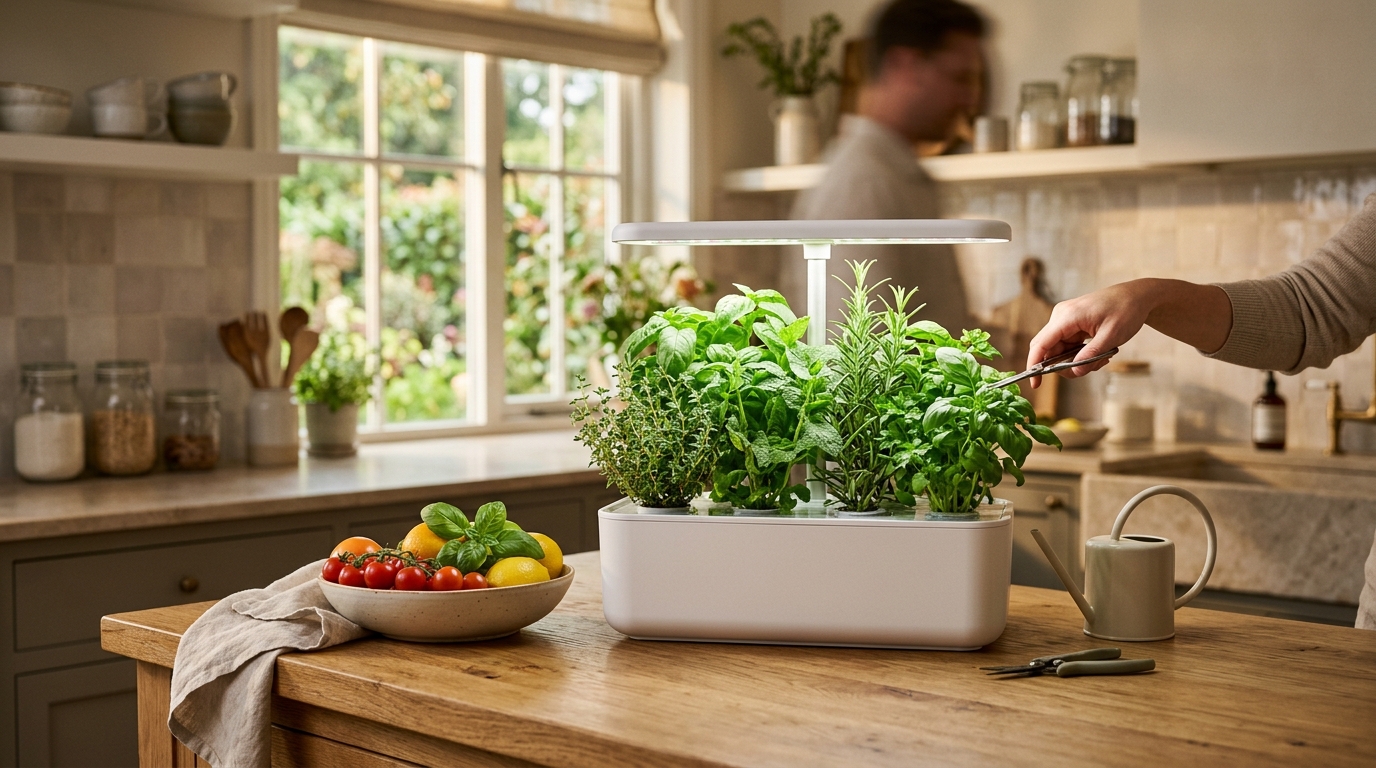
The best countertop garden for most buyers is the AeroGarden Bounty — 9-pod, built-in 30W grow light, works on any counter without sunlight. For growers who prefer soil over hydroponics, the Click & Grow Smart Garden 9 eliminates nutrient measuring entirely. A traditional soil kit is the right call for windowsill growers who already get 4-6 hours of direct sun daily.
What type of countertop garden should you choose?
Countertop gardens break into three categories: hydroponic pod systems, soil-pod systems, and traditional soil kits. Each works differently and suits a different grower type.
Hydroponic pod systems (AeroGarden) suspend plant roots in a water reservoir. A built-in pump circulates water continuously. You add a few drops of liquid nutrients every two weeks directly to the reservoir. A built-in grow light runs on an automatic 16-hour timer — no sunlight needed. Growth is fastest in this category: basil reaches first harvest in 3-4 weeks, parsley and dill in 4-6 weeks. Maintenance is real but light: top up water every 1-2 weeks, add nutrients on a two-week schedule, and trim plants aggressively so fast growers like basil don’t shade their neighbors.
Soil-pod systems (Click & Grow) use biodegradable capsules pre-filled with a NASA-patented peat-based growing medium that contains nutrients and pH buffering already mixed in. A reservoir below the pod tray delivers moisture via capillary wicking — no measuring, no timing, no nutrient concentrate. Growth is 30-50% slower than hydroponic systems (basil takes 5-6 weeks to first harvest), but the maintenance genuinely is simpler: fill the reservoir every 1-2 weeks and do nothing else. No algae management, no reservoir chemistry, no forgotten nutrient doses.
Traditional soil kits (Burpee and similar) are seed-and-soil starter sets with small terracotta or plastic pots. No electronics. They depend on natural window light or a separate grow light you provide. They are the most affordable option and produce excellent herbs — but only if your kitchen gets adequate direct sun. A south- or west-facing window with 4-6 hours of direct daily sun is the minimum. Without it, herbs grow pale, leggy, and bolt within weeks regardless of how well you water.
The practical decision: if your kitchen gets fewer than 4 hours of direct sun, buy a system with a built-in grow light. AeroGarden or Click & Grow — not a passive soil kit.
Quick comparison
| Product | Best for | Rating | Notes | |
|---|---|---|---|---|
| AeroGarden Bounty (9-pod) | best overall: full herb garden without sunlight | ★★★★★ | $130-170. Built-in 30W LED, 24-in adjustable arm, Wi-Fi. Fastest herb results in class. | Check price |
| AeroGarden Sprout (3-pod) | best entry-level hydroponic; small counter or first-timer | ★★★★☆ | $50-65. 3 pods, 10W LED, 10-in arm. Right starting system before committing to a larger unit. | Check price |
| Click and Grow Smart Garden 9 | simplest system; soil pods with no nutrient measuring | ★★★★☆ | $120-150. 9 soil pods. Zero nutrient routine — easiest smart garden to maintain long-term. | Check price |
| Click and Grow Smart Garden 3 | most compact soil-pod option; ideal gift or starter | ★★★★☆ | $50-75. 3 pods, smallest footprint. Right for very limited counter space or a first purchase. | Check price |
| Burpee Organic Herb Seed Starter Kit | best traditional soil kit for sunny windowsill growers | ★★★★☆ | $20-35. Soil, seeds, pots included. No electronics — needs 4-6 hours of natural sunlight daily. | Check price |
The picks
Best overall: AeroGarden Bounty (9-pod)
Best for most buyers who want a full herb garden on the counter with no sunlight required
AeroGarden Bounty 9-Pod Countertop Garden
The AeroGarden Bounty is the right answer for the majority of buyers. Nine pods lets you run a complete kitchen herb selection simultaneously — the included seed kit typically covers basil, parsley, dill, mint, thyme, Thai basil, and curly parsley. The 30W full-spectrum LED runs on an automatic 16-hour timer, and the 24-inch adjustable arm gives enough clearance above cherry tomato vines and compact pepper plants when you eventually want to grow beyond herbs. Wi-Fi connects to the AeroGarden app, which sends push reminders to top up water and add nutrients — keeping the two-week maintenance schedule on track without you having to remember it. Herbs reach harvestable size in 3-4 weeks. At $130-170, the Bounty costs more than the entry-level Sprout and Harvest models, but the extra arm height, additional pods, and Wi-Fi connectivity are worth the premium over the base 3-pod units for anyone who plans to grow year-round.
★★★★★ 4.6 · 8,400 reviews
Check current price on Amazon→Pros
- 9 pods fits a complete kitchen herb set — basil, parsley, dill, mint, cilantro running simultaneously
- 24-inch adjustable arm accommodates cherry tomatoes and compact peppers beyond standard herb heights
- 30W full-spectrum LED; noticeably stronger than the 10-20W on entry-level models
- Wi-Fi app sends water and nutrient reminders so the two-week schedule stays on track automatically
- No sunlight required — works on any counter regardless of window placement or direction
- Broad seed pod catalog with 30-plus varieties: herbs, greens, cherry tomatoes, hot peppers, and flowers
Cons
- Pod refill kits run $15-35 per 9-pod set, replaced every 4-6 months — $60-100 per year at regular use
- Reservoir needs topping up every 1-2 weeks plus liquid nutrients every two weeks — not fully autonomous
- Basil grows fast and shades slower neighbors — trim it back aggressively from week four onward
- $130-170 is a real upfront spend; the Sprout is a lower-risk first step if long-term commitment is uncertain
Best entry pick: AeroGarden Sprout (3-pod)
Best for first-time buyers and anyone who wants to test hydroponic growing before committing to a larger system
AeroGarden Sprout 3-Pod Countertop Garden
The Sprout is the smartest way to enter the AeroGarden ecosystem when you are not yet sure whether you will maintain a hydroponic garden consistently. It uses the same core technology as the Bounty — roots in a water reservoir, liquid nutrients every two weeks, automatic 16-hour LED cycle — but in a 3-pod form that fits almost any counter corner. The 10W LED and 10-inch arm cap the Sprout at herbs and compact greens; cherry tomatoes and peppers need the arm height of the Bounty. At $50-65, the entry cost is low enough that a full growing season feels like a reasonable test rather than a serious financial commitment. If you harvest regularly and refill pods reliably through one or two crop cycles, upgrade to the Bounty or Harvest Elite. The Sprout pod catalog is identical to the larger units — every AeroGarden seed variety fits the same pod format, so you are not locked out of any variety by choosing the smaller unit.
★★★★☆ 4.4 · 5,200 reviews
Check current price on Amazon→Pros
- Lowest-cost AeroGarden entry point at $50-65 — minimal financial risk for a first test
- Compact 3-pod footprint fits nearly any counter corner or tight kitchen space
- Same pod ecosystem as the Bounty — full AeroGarden variety catalog works in the Sprout
- Identical hydroponic growing method as larger units: results are comparably fast for herb varieties
- Right proof-of-concept purchase before committing to a 9-pod Bounty
Cons
- 10-inch arm and 3 pods limit you to herbs and low-growing greens — no cherry tomatoes or peppers
- 10W LED is the weakest light in the AeroGarden lineup; growth is slower than higher-wattage models
- No Wi-Fi and no app integration — maintenance reminders are your own responsibility
- If you already know you will grow year-round, start with the Bounty to avoid buying twice
Best soil-pod system: Click & Grow Smart Garden 9
Best for growers who want a smart countertop garden with no nutrient measuring, no reservoir chemistry, and no hydroponic upkeep
Click and Grow Smart Garden 9
Click and Grow distinguishes itself from AeroGarden through one core decision: soil pods instead of hydroponics. Each pod is a biodegradable capsule pre-filled with a NASA-patented peat-based growing medium that includes nutrients and pH buffering built in. You slot the pods into the tray, fill the water reservoir, and a capillary wicking system delivers exactly the right moisture to each pod automatically. There is nothing else to do besides topping up the water every week or two. No liquid nutrients to measure, no reservoir chemistry to monitor, no algae to prevent. The trade-off versus AeroGarden is growth speed: basil takes 5-6 weeks to first harvest instead of 3-4 weeks, and overall growth rate runs 30-50% slower. But the Click and Grow catalog has expanded significantly — 60-plus varieties now including compact tomatoes, peppers, basil, mint, dill, strawberries, and flowers — and the biodegradable soil pods are compostable after the harvest cycle ends.
★★★★☆ 4.4 · 5,100 reviews
Check current price on Amazon→Pros
- Zero nutrient measuring — pods are pre-loaded with nutrients and pH buffering from the factory
- No reservoir chemistry, no algae management, and no liquid concentrate to handle
- 9 pods with 60-plus variety catalog including compact tomatoes, peppers, and flowers
- Biodegradable pods are compostable after harvest — cleaner end-of-crop disposal
- Wicking delivery means water reservoir lasts longer between refills than AeroGarden in most kitchens
Cons
- Herb growth runs 30-50% slower than AeroGarden hydroponic systems under equivalent light
- Per-pod cost is higher than AeroGarden at scale — $5-8 per Click and Grow pod vs $2-4 per AeroGarden pod
- LED output is lower than the AeroGarden Bounty; fruiting plants like tomatoes grow slower
- Smaller reservoir than Bounty means more frequent water top-ups in warm kitchens or for thirsty varieties
Best traditional soil kit: Burpee Organic Herb Starter Set
For growers with a genuinely sunny windowsill — a south- or west-facing window that delivers 4-6 hours of direct sun daily — a traditional soil kit is the most affordable and least complicated path to fresh countertop herbs. Burpee organic herb starter sets include terracotta-style pots, pre-mixed organic potting soil, and certified organic seeds for basil, parsley, chives, and cilantro. Germination takes 7-14 days, and herbs reach harvestable size in 6-8 weeks in adequate light.
No electronics, no liquid nutrients, no proprietary refills. At $20-35, the upfront cost is a fraction of a pod-based smart garden. Long-term ongoing costs are minimal: a packet of new seeds ($2-5) and occasional potting mix top-ups are the entire refill expense.
The practical limitation is non-negotiable: without a sunny window, soil kits produce pale, leggy herbs that bolt and decline within weeks regardless of watering quality. Before buying one, evaluate your window honestly. If you are not confident it qualifies, the AeroGarden Sprout at $50-65 is the safer and not much more expensive choice — and it works regardless of sun exposure.
Most compact soil-pod: Click & Grow Smart Garden 3
The Click & Grow Smart Garden 3 is a 3-pod version of the Smart Garden 9 at $50-75, taking roughly 6 by 4 inches of counter footprint — smaller than a cutting board. Grow basil, parsley, and mint simultaneously: the everyday cooking herb trio. Arm height is appropriate for herbs only. Right as a starter unit for buyers who want to evaluate Click & Grow before committing to the 9-pod version, and a genuinely useful gift for anyone who has mentioned wanting fresh herbs on the counter.
What to skip
No-name “hydroponic gardens” under $35. Unknown LED chips use incorrect or unspecified spectrum that produces elongated, weak plants. Unknown pump mechanisms fail within weeks of use. Seed germination rates with unspecified pods are inconsistent. Stick to AeroGarden, Click & Grow, or a quality traditional kit — the brand matters in this category more than most.
Countertop pod systems for full-size vegetables. Cherry tomatoes (Tumbling Tom, Red Robin, AeroGarden Mighty Cherry), compact jalapeños, mini peppers, and dwarf kale produce real results in the AeroGarden Bounty with the 24-inch arm. Beefsteak tomatoes, cucumbers, large pepper varieties, and squash need root volume and light intensity that no countertop unit can provide. Every “tomatoes in an AeroGarden” video you see is a compact cherry variety — not a standard slicing tomato.
Seed starter kits without matching light. Many kits sold as “herb garden sets” include peat pellets, seed packets, and small pots — but no grow light and no honest assessment of the light level required. If the kit lacks a grow light and your kitchen window gets fewer than 4 hours of direct sun, the herbs will germinate weakly and stall. Prioritize kits that either include a grow light or are transparently sold as windowsill-only products.
Auto-refill pod subscriptions before checking single-pack pricing. Both AeroGarden and Click & Grow push subscription auto-ship at checkout. Individual refill kits bought one at a time are frequently the same price per pod or cheaper, particularly during seasonal sales. Check the per-pack price before committing to auto-ship, especially at the start before you know how many crop cycles you will actually run per year.
FAQ
Frequently asked questions
What is the easiest countertop garden to maintain?
Do countertop gardens need sunlight?
How long does it take to grow herbs in a countertop garden?
Can you grow vegetables in a countertop garden?
How much does a countertop garden cost to run per year?
AeroGarden Bounty vs Click and Grow Smart Garden 9 — which should I choose?
Can you use your own seeds in a pod-based countertop garden?
Bottom line
The best countertop garden for most buyers is the AeroGarden Bounty — 9 pods, 24-inch adjustable arm, 30W grow light, Wi-Fi reminders, and fast enough to put harvestable basil on the counter in under a month. First-timers who want a lower-risk entry should start with the AeroGarden Sprout at $50-65 before committing to a larger unit.
Growers who want zero nutrient measuring and the simplest possible maintenance routine should choose the Click & Grow Smart Garden 9 — soil pods, capillary wicking, and nothing to mix or measure.
For windowsill growers with a reliable south- or west-facing window delivering 4-6 hours of direct sun, a Burpee Organic Herb Starter Kit at $20-35 delivers excellent results at a fraction of a pod system’s cost — no electronics, no refill subscriptions, no ongoing nutrient expense.
Related reading: best grow lights for expanding beyond countertop pod systems, best indoor herb gardens for soil-pot herb setups near a window, best hydroponic systems for larger-scale vegetable production, and how to grow herbs indoors for a step-by-step planting guide.